Bacchus by Caravaggio: Vibrant Color Edit
Free to Download & Reuse: You are welcome to use this image! If you republish or share it online, you must include a direct link back to this webpage for attribution.
Original Image Source: wikiart.org
Introduction
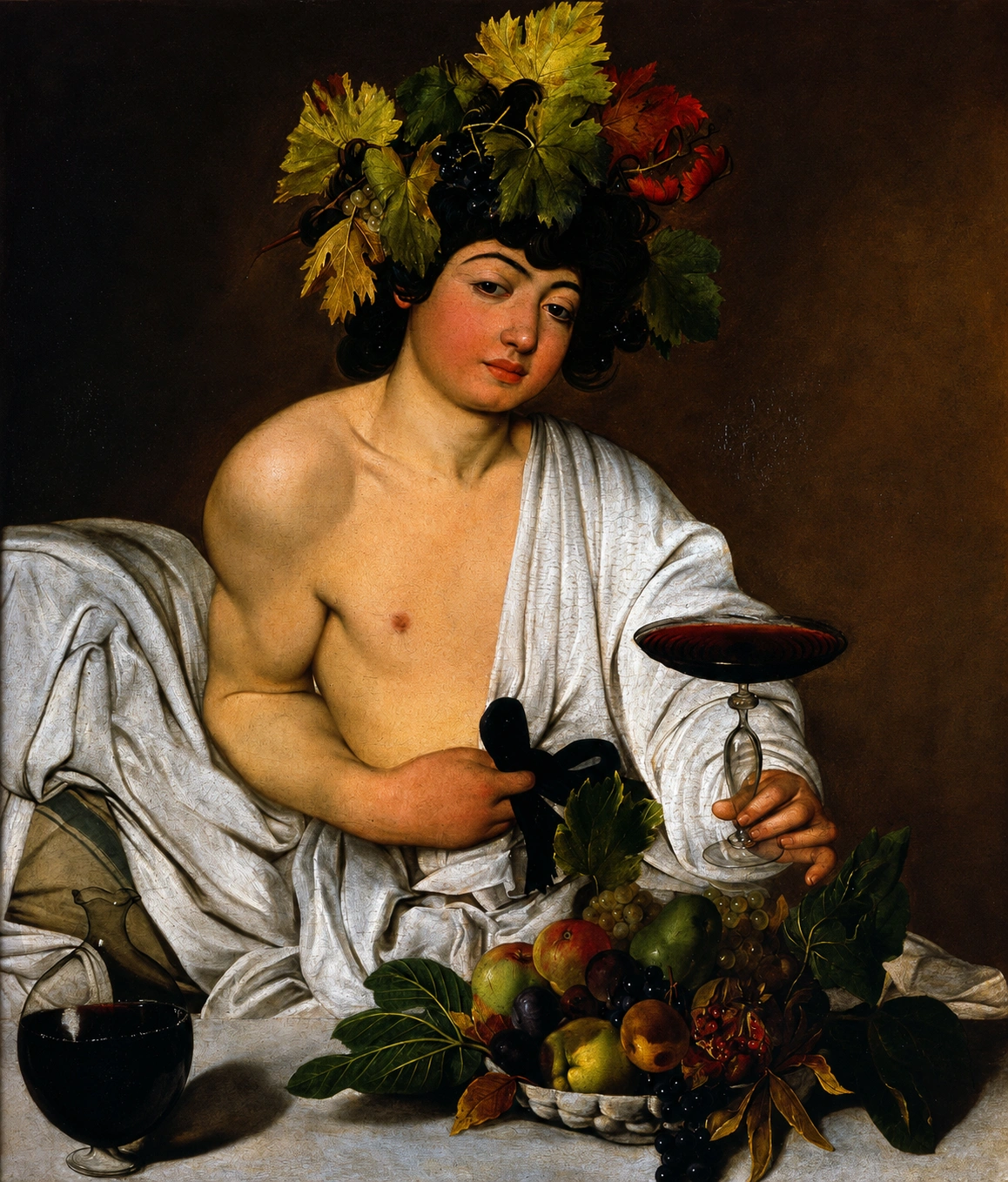
Caravaggio’s “Bacchus,” painted in 1596, is one of the most fascinating images of youth, pleasure, theatricality, and decay in early Baroque art. At first glance, the painting presents the Roman god of wine as an inviting figure. He sits before the viewer with a glass of dark red wine in one hand, a bowl of fruit before him, and a wreath of vine leaves, grapes, and autumnal foliage in his hair. Yet the longer we look, the more unstable the image becomes. This is not a distant, idealized god from classical mythology. Caravaggio gives Bacchus a human body, a flushed face, tired eyes, and an atmosphere of uneasy intimacy. The result is a painting that feels both seductive and unsettling, both festive and fragile.
Caravaggio’s Humanized God
Instead of presenting Bacchus as a perfected antique deity, Caravaggio paints him as a young model dressed in theatrical costume. His white drapery recalls classical sculpture, but it is not arranged with perfect elegance. It folds heavily around his body, slipping and bunching like real fabric. The wreath on his head is grand but slightly unruly, filled with leaves that look natural rather than decorative. This humanization is central to the painting’s power. Bacchus is divine in subject, but ordinary in presence.
The figure looks directly toward the viewer, creating a strong sense of confrontation. His expression is calm, almost sleepy, yet also knowing. He does not appear heroic or triumphant. Instead, he seems caught in a quiet moment of presentation, as though he is offering both the wine and himself as part of a carefully staged performance. Caravaggio blurs the line between mythology and everyday life, making the ancient god feel physically close and psychologically complex.
The Invitation of the Wine
The raised glass is one of the most important details in the composition. Bacchus holds it toward the viewer, turning the act of looking into an act of participation. The wine is not simply a symbol placed in the painting. It becomes an invitation. The viewer is positioned as someone being offered a drink, drawn into the world of pleasure, appetite, and temporary escape.
Yet Caravaggio’s invitation is never simple. The wine is dark, almost black in the shadowed cup, and the glass is delicately held. The gesture is graceful, but there is also a slight tension in it. Bacchus’s face does not show pure celebration. His gaze is heavy and ambiguous, suggesting that pleasure may already be touched by exhaustion. The painting seems to ask whether indulgence brings joy, forgetfulness, or decline.
Fruit, Ripeness, and Decay
The still life at the front of the painting is more than decoration. Caravaggio gives the fruit a striking physical presence. Apples, grapes, figs, and leaves are arranged close to the viewer, forming a dense cluster of color and texture. Some fruit appears ripe and appealing, while other details suggest bruising, fading, or decay. This contrast between abundance and imperfection is essential to the meaning of “Bacchus.”
In traditional symbolism, fruit can represent fertility, sensual pleasure, and the richness of the natural world. But overripe fruit can also suggest the passage of time. What is beautiful now will soon spoil. Caravaggio uses this still life to deepen the painting’s mood. The world of Bacchus is not only a world of celebration. It is also a world where beauty is temporary, bodies age, wine is consumed, and freshness turns into decay.
Light, Shadow, and Theatrical Presence
Caravaggio’s handling of light gives the painting its dramatic intensity. The figure emerges from a dark background, illuminated by a controlled light that falls across the face, shoulder, white drapery, and fruit. This contrast between brightness and darkness would become one of Caravaggio’s most recognizable artistic signatures. In “Bacchus,” the darkness does not simply create depth. It creates atmosphere.
The background is plain and shadowed, removing any distracting setting. There is no vineyard, no mythological landscape, no crowd of followers. Bacchus exists in an intimate stage-like space, surrounded only by the objects that define him. This simplicity focuses attention on the figure’s body, expression, gesture, and symbolic objects. The painting becomes less a narrative scene than a psychological encounter.
Realism and Imperfection
One reason “Bacchus” remains so compelling is Caravaggio’s refusal to idealize. The skin is not marble-smooth in the manner of classical sculpture. The body has weight and softness. The face is youthful but not perfectly symmetrical. The leaves are uneven. The fruit shows natural irregularity. Even the white cloth, with its folds and creases, feels observed from life.
This realism was revolutionary because it brought sacred, mythological, and allegorical subjects into the realm of lived experience. Caravaggio’s Bacchus does not appear as an unreachable god. He appears as a person playing a god, or perhaps as a god who has taken on the awkward truth of human flesh. That ambiguity gives the painting its modern feeling. It invites viewers to question what they are seeing: divinity, theater, portraiture, or temptation.
The Meaning of Bacchus
Bacchus was traditionally associated with wine, festivity, intoxication, theater, and the release of ordinary restraints. In Caravaggio’s interpretation, those meanings are present, but they are complicated. The painting does not show wild celebration or ecstatic movement. Instead, Bacchus is still, almost suspended. The pleasure he represents is quiet, controlled, and strangely introspective.
This restrained mood makes the painting more thoughtful than decorative. Caravaggio seems interested not only in pleasure itself, but in the moment before or after pleasure. The glass is offered, the fruit is ready, the god is present, but the mood is uncertain. The viewer must decide whether the scene represents abundance, temptation, melancholy, or a warning about the fleeting nature of youth and beauty.
Composition and Viewer Engagement
The composition is carefully balanced. Bacchus’s head and wreath dominate the upper center, while the fruit and glass anchor the lower half. The diagonal fall of the white drapery gives the painting movement, guiding the eye from the figure’s shoulder down toward the still life. The dark cups and wine create visual counterpoints to the pale fabric and illuminated skin.
Caravaggio places the viewer very close to the table. The fruit nearly enters our space, while the glass extends outward through Bacchus’s hand. This closeness is one of the painting’s strongest effects. We do not feel like distant observers of mythology. We feel like participants in a private exchange. That intimacy makes the image memorable, but also slightly uncomfortable. Bacchus’s gaze does not let us remain neutral.
Conclusion
“Bacchus” by Caravaggio is a masterful painting because it transforms a familiar mythological subject into a deeply human encounter. Through dramatic lighting, close observation, symbolic still life, and psychological ambiguity, Caravaggio presents the god of wine as both alluring and fragile. The painting celebrates the pleasures of youth, fruit, wine, and beauty, but it also hints at their instability. Nothing in the image feels permanent. The fruit will decay, the wine will be consumed, the body will age, and the theatrical role will end.
This tension between abundance and mortality gives “Bacchus” its lasting power. It is not merely a painting about a god holding a glass of wine. It is a meditation on desire, performance, time, and the fragile pleasures that make life vivid. Caravaggio’s genius lies in making myth feel immediate and human, while allowing ordinary details to carry profound meaning.