The Portinari Altarpiece by Hugo van der Goes: Vibrant Color Edit
Free to Download & Reuse: You are welcome to use this image! If you republish or share it online, you must include a direct link back to this webpage for attribution.
Original Image Source: commons.wikimedia.org
Introduction to The Portinari Altarpiece
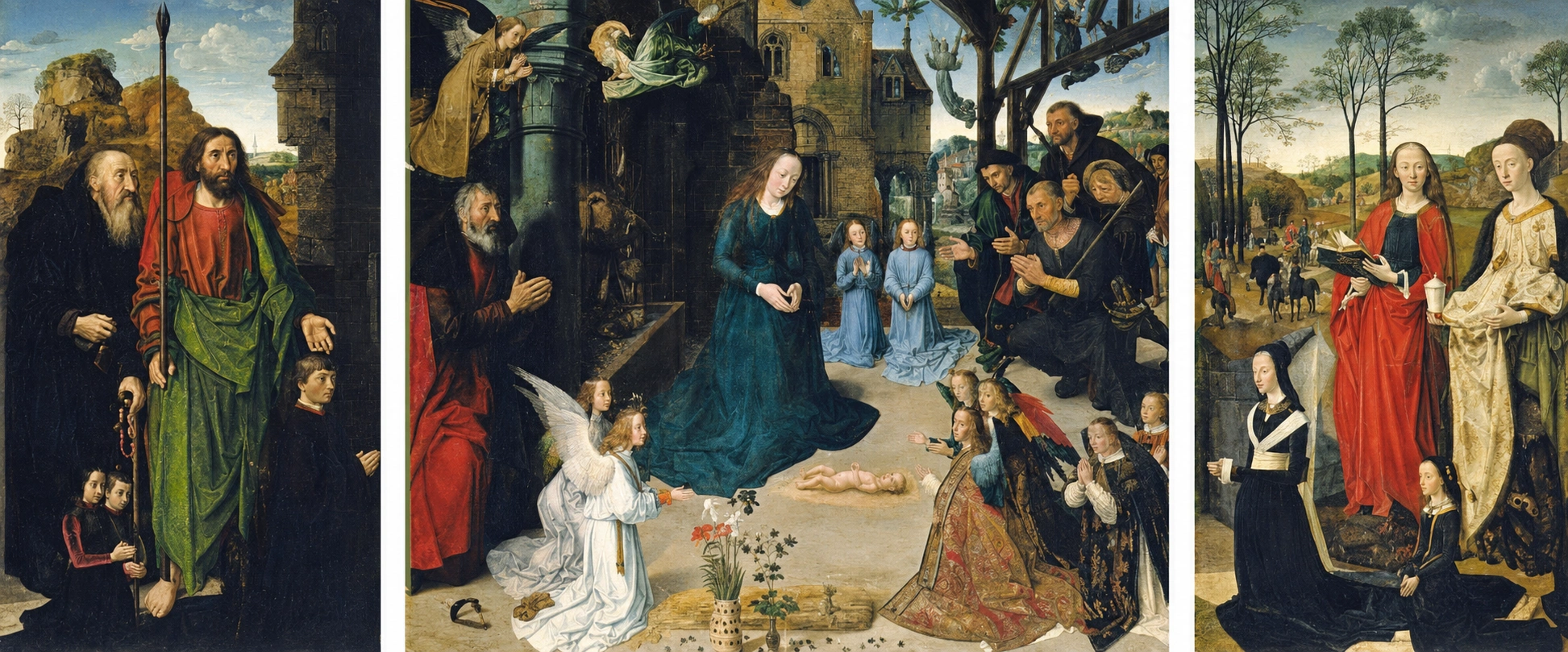
The Portinari Altarpiece by Hugo van der Goes, painted around 1475, is one of the most celebrated achievements of Early Netherlandish painting. This monumental triptych combines religious devotion, extraordinary realism, complex symbolism, and deeply expressive figures. Its central subject is the Adoration of the Shepherds, while the two side panels present members of the Portinari family accompanied by their patron saints.
The altarpiece was commissioned by Tommaso Portinari, an Italian banker who represented the Medici family in Bruges. Although created in the Netherlands, the painting was intended for a church in Florence. Its arrival in Italy introduced Florentine artists to the remarkable naturalism, rich color, and meticulous detail associated with Northern European painting.
Hugo van der Goes transformed the familiar Nativity story into a scene filled with emotional intensity. The figures do not appear distant or idealized. Instead, they react to the birth of Christ with wonder, humility, anxiety, and devotion. Every gesture, face, flower, and object contributes to the painting’s religious meaning.
The Central Scene and the Birth of Christ
The central panel depicts the newborn Christ lying directly on the ground. Mary kneels above him with her hands gently folded, while Joseph stands nearby in an attitude of reverence. Angels surround the infant, forming a sacred circle of worship around the humble scene.
Christ’s placement on the bare earth is especially significant. Rather than resting in an elaborate cradle, he appears fragile and exposed. This emphasizes his humility and his entrance into the material world. It also suggests his future suffering, since the vulnerable infant will eventually become the sacrificial figure of the Crucifixion.
Mary is the visual and spiritual center of the composition. Her dark blue robe spreads across the floor in broad folds, creating a powerful area of color around the pale body of Christ. Her quiet posture contrasts with the energetic movement of the shepherds entering from the right. She seems absorbed in contemplation, fully aware of the miraculous nature of the child before her.
Joseph appears older and more physically grounded. His expression is thoughtful, and his slightly separated position reflects his traditional role as a witness to the divine birth. He has removed one of his wooden shoes, an action that may indicate that the space around Christ has become sacred ground.
The Shepherds and Human Emotion
The shepherds are among the most memorable figures in The Portinari Altarpiece. They enter the stable with animated gestures and intensely individualized faces. Their rough features, weathered skin, and simple clothing contrast with the graceful angels and the solemn figure of Mary.
Hugo van der Goes presents the shepherds as ordinary laborers rather than idealized biblical figures. One clasps his hands while another leans forward with his mouth slightly open. Their expressions communicate astonishment and sincere religious excitement. They appear overwhelmed by the sight of Christ, yet their emotional response makes the miracle understandable on a human level.
The exaggerated size and expressive presence of the shepherds were unusual for a religious painting of this period. Their prominent role reflects the Christian belief that the birth of Christ was first revealed to humble people. Social status becomes unimportant in the presence of divine grace.
The shepherds also create a bridge between the viewer and the sacred event. Their amazement encourages the audience to approach the painting with the same sense of wonder. Instead of merely observing the Nativity, viewers are invited to imagine themselves entering the stable alongside these figures.
Symbolic Flowers and Everyday Objects
The foreground contains a carefully arranged still life of flowers, containers, and scattered plants. These objects demonstrate Hugo van der Goes’s astonishing powers of observation, but they also carry symbolic meanings connected to Christ, Mary, and the Passion.
A glass vessel holds flowers near the center of the composition. The transparent glass may symbolize Mary’s purity, while the flowers refer to different aspects of Christian theology. Lilies are traditionally associated with virginity, and irises can suggest sorrow or royal dignity. Red flowers may anticipate Christ’s blood and future sacrifice.
A sheaf of wheat appears behind the infant. Wheat is closely connected to the Eucharist, in which bread represents the body of Christ. Its presence near the Nativity links Christ’s birth with his eventual sacrificial death and the Christian ceremony of Communion.
The discarded shoe, simple pottery, wooden structures, and ordinary plants make the biblical event feel physically real. Van der Goes does not separate sacred meaning from everyday life. Instead, humble objects become vessels of spiritual significance.
The Side Panels and the Portinari Family
The left and right wings contain portraits of Tommaso Portinari, his wife Maria Baroncelli, and their children. They kneel in prayer at a smaller scale than the saints standing behind them. This difference in size follows an older tradition in which sacred figures appear larger than mortal donors.
Tommaso appears on the left with his sons. Behind them stand Saint Thomas and Saint Anthony Abbot. Saint Thomas refers to Tommaso’s name, while Saint Anthony was associated with healing and charitable care. On the right, Maria kneels with her daughter, accompanied by Saint Margaret and Saint Mary Magdalene.
The saints serve as protectors and spiritual intermediaries. Their presence connects the Portinari family with the holy figures of Christian history. The donors do not physically enter the central Nativity scene, but their prayerful poses suggest that they contemplate it through faith.
Van der Goes treats the family portraits with remarkable seriousness. Their faces are individualized, and their reserved expressions communicate devotion rather than social pride. Although the commission demonstrates the wealth and international importance of the Portinari family, the donors present themselves as humble worshippers.
Color, Light, and Composition
The painting’s colors create both visual harmony and dramatic contrast. Mary’s deep blue clothing dominates the central panel, while bright red garments draw attention to selected figures. The pale bodies and robes of the angels stand out against the darker interior of the stable.
Light enters the scene unevenly, illuminating faces, fabrics, and objects with almost sculptural clarity. The distant landscape is rendered in cooler colors, creating a sense of atmospheric depth. Through open sections of the architecture, the viewer can see roads, buildings, trees, and arriving figures.
The composition combines stability with tension. Mary and Christ form the calm center, but the surrounding figures lean inward from different directions. Angels kneel, shepherds rush forward, and background figures approach through the landscape. This movement gives the impression that the entire world is gathering around the infant.
Van der Goes also plays with differences in scale and space. The central holy figures appear larger and more imposing than the background characters. The result is not a perfectly unified Renaissance perspective, but a spiritually organized world in which importance determines visual presence.
Northern Realism and Italian Influence
The Portinari Altarpiece became highly influential after it reached Florence. Italian artists were impressed by its detailed textures, expressive faces, atmospheric landscape, and convincing treatment of light. The painting demonstrated how religious subjects could be made emotionally powerful through close observation of the visible world.
Van der Goes carefully distinguishes between materials. Velvet, wool, glass, stone, wood, skin, and vegetation each possess their own texture. This attention to surfaces reflects a central characteristic of Early Netherlandish painting.
Yet the work’s importance goes beyond technical skill. Its realism serves a devotional purpose. The more physically convincing the scene becomes, the easier it is for viewers to imagine the Nativity as an event that truly occurred. Naturalism strengthens belief by making the sacred story immediate and tangible.
Emotional Power and Lasting Significance
The Portinari Altarpiece remains compelling because it combines grandeur with vulnerability. Christ is presented as the center of salvation, but he appears as a small, defenseless infant. Mary possesses spiritual dignity, yet her downcast face also suggests solemn reflection. The shepherds are awkward and unpolished, but their emotional honesty gives the scene much of its power.
Hugo van der Goes created a world in which divine revelation transforms ordinary people and objects. Flowers become signs of sacrifice, wheat anticipates the Eucharist, and a rough stable becomes a holy sanctuary. The painting’s beauty comes not from ideal perfection alone, but from the meeting of the sacred and the everyday.
Through its monumental scale, psychological depth, symbolic detail, and extraordinary realism, The Portinari Altarpiece helped reshape the development of European painting. It remains one of the clearest demonstrations of Hugo van der Goes’s ability to unite visual observation with profound spiritual emotion.