Hunters in the Snow by Pieter Bruegel the Elder: Vibrant Color Edit
Free to Download & Reuse: You are welcome to use this image! If you republish or share it online, you must include a direct link back to this webpage for attribution.
Original Image Source: wikiart.org
“Hunters in the Snow” by Pieter Bruegel the Elder
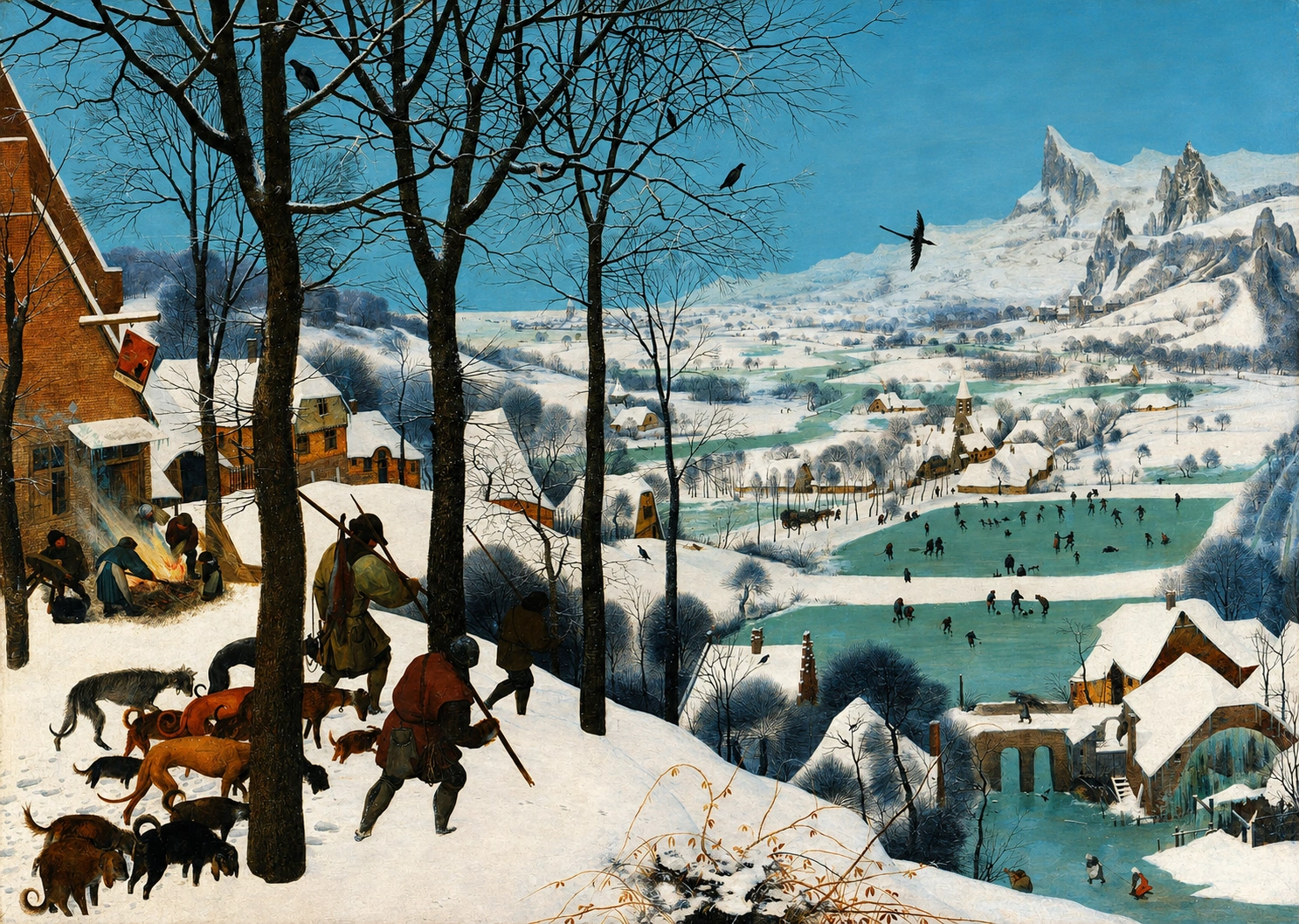
Pieter Bruegel the Elder’s “Hunters in the Snow,” painted in 1565, is one of the most celebrated winter landscapes in Western art. The painting presents a broad, snow-covered countryside filled with hunters, villagers, skaters, animals, houses, and distant mountains. Although the hunters provide the work with its traditional title, they occupy only one part of a much larger vision of seasonal life. Bruegel transforms an ordinary winter day into a complex meditation on nature, human endurance, community, and the passage of time.
The viewer looks down from an elevated hillside toward a frozen valley. Three hunters and their dogs return to the village after an apparently unsuccessful expedition. Beyond them, people skate, play games, gather firewood, work around their homes, and cross the icy landscape. Every section contains a small story, yet none overwhelms the painting as a whole. This balance between individual activity and panoramic unity is one of Bruegel’s greatest achievements.
The Hunters and Their Unsuccessful Return
The hunters enter from the lower left, moving slowly down the snowy slope. Their dark silhouettes contrast sharply with the pale ground. Their bodies lean forward, suggesting exhaustion, disappointment, and the physical difficulty of walking through deep snow. One hunter carries the body of a small fox, the only visible result of their expedition. The limited catch implies that food may be scarce during the harsh winter months.
The dogs appear equally tired. Their lowered heads, thin bodies, and uneven formation reinforce the mood of failure. Rather than celebrating hunting as an aristocratic sport, Bruegel presents it as demanding work connected to survival. The hunters are not heroic figures. They are ordinary people returning to their community after a difficult day.
Their movement guides the viewer into the composition. As they descend the hill, the eye follows them toward the distant village and frozen ponds. Bruegel uses their journey to connect the dark foreground with the brighter valley beyond.
A Panoramic Winter Landscape
The landscape dominates the painting. Snow covers rooftops, fields, roads, branches, and hills, creating a sense of visual unity. Dark trees rise through the foreground, forming a natural frame around the valley. Their bare branches spread across the sky like an intricate network of lines.
The elevated viewpoint allows Bruegel to include an extraordinary amount of detail. The land unfolds gradually from the steep hill in the foreground to the village in the middle distance and the dramatic mountains on the horizon. Roads, rivers, fields, and frozen ponds link the different parts of the countryside.
The distant mountains are more imaginative than geographically accurate. Their sharp peaks resemble Alpine scenery rather than the relatively flat landscapes of the Netherlands. Bruegel had travelled through the Alps, and the memory of those mountains influenced many of his landscapes. Here, they make the valley feel enclosed by immense natural forces.
The high viewpoint also changes the relationship between people and nature. Human figures appear small when compared with the scale of the environment. They remain active and resilient, but they do not control the landscape. Nature determines the conditions under which they must live.
Color and Winter Atmosphere
Bruegel creates a convincing winter atmosphere through a restrained palette of white, green, grey, brown, and black. The snow is not painted as a single, brilliant white surface. It contains subtle variations that suggest shadows, uneven terrain, footprints, and changing light.
The frozen ponds have a muted green tone that distinguishes them from the surrounding snow. This green appears throughout the valley and sky, unifying the landscape. The dark hunters, dogs, trees, and birds stand out clearly against the pale background.
Small areas of warm color bring life to the scene. The orange fire outside the inn glows against the snow, while reddish-brown houses add warmth to the village. These accents suggest shelter, food, and human companionship within an otherwise cold environment.
The sky is calm but heavy. Its greenish-grey color contributes to the feeling of deep winter. There is no dramatic storm, yet the cold seems to penetrate every part of the landscape. Bruegel’s winter is quiet, persistent, and unavoidable.
Village Life on the Frozen Ponds
While the hunters struggle home, the villagers have adapted to the season. The frozen ponds have become public spaces filled with movement. People skate, play games, carry objects, and gather in small groups. Children and adults share the ice, turning the cold weather into an opportunity for recreation.
Bruegel does not isolate one central event. Instead, he distributes attention across many small activities. Some figures glide smoothly, while others appear to stumble or bend over. A person pulls another individual across the ice. Groups gather near the edges of the ponds, and workers continue their daily responsibilities.
These scenes create a lively contrast with the hunters’ exhaustion. Winter brings hardship, but it also creates new forms of community and entertainment. The villagers do not defeat the season. They adjust their routines to it.
The figures are very small, yet their gestures are remarkably expressive. Bruegel often represented people through posture rather than detailed facial expression. A bent back, raised arm, or extended leg is enough to communicate effort, balance, conversation, or play.
The Inn, Fire, and Signs of Survival
On the left side of the painting, several figures gather around a fire outside an inn. A sign hanging above them displays Saint Hubert, the patron saint of hunters. The sign hangs at an awkward angle, adding a small note of disorder and perhaps suggesting that the establishment has seen better days.
The fire provides one of the painting’s strongest contrasts. Its warm flames rise beside the cold snow, symbolizing the human need for warmth and protection. The people appear to be preparing food or singeing the bristles from a pig, a traditional winter activity associated with seasonal slaughter.
This scene connects survival with communal labour. Food, shelter, and warmth require cooperation. The hunters may have returned with little, but the village continues to function through many different forms of work.
Smoke rising from chimneys also suggests domestic comfort. Even though the landscape appears cold and immense, the houses contain unseen interiors where families can gather. Bruegel presents these homes as small refuges within nature.
Birds and the Sense of Distance
Birds play an important compositional role. A dark bird flies across the valley near the centre of the painting, while another rests on a branch. Their black forms echo the hunters and trees in the foreground.
The flying bird helps communicate depth. It appears suspended between the viewer and the distant landscape, making the open space of the valley feel more convincing. Its wings also introduce a brief moment of freedom into a scene dominated by slow movement and frozen surfaces.
At the same time, the bird may remind the viewer that nature continues according to its own rhythms. People hunt, skate, work, and seek shelter, while animals move through the same environment according to different needs.
Seasonal Cycles and Human Endurance
“Hunters in the Snow” originally belonged to a series representing different times of the year. Its winter imagery therefore forms part of a larger reflection on seasonal change. The painting captures a temporary moment within an endless natural cycle.
Winter appears difficult, but not catastrophic. The hunters are weary, the trees are bare, and the land is frozen, yet village life continues. People work, play, travel, and gather together. Bruegel’s vision is neither sentimental nor entirely bleak. He acknowledges hardship while emphasizing adaptation.
The painting can be interpreted as a study of human endurance. The villagers cannot change the weather, but they can respond to it. Their survival depends on labour, shared knowledge, and community. Even recreation on the ice becomes a sign of resilience.
Composition and Visual Movement
Bruegel organizes the scene through strong diagonal lines. The hillside descends from the upper left toward the centre, carrying the hunters and the viewer into the valley. The distant roads, rivers, rooftops, and mountain slopes continue this movement.
The tall trees divide the foreground into sections without blocking the view. Their trunks establish a sense of scale and create a visual threshold between the viewer’s position and the world below. The branches spread horizontally across the upper portion of the composition, balancing the broad expanse of snow.
The painting moves from darkness to light. The hunters, dogs, and trees create a dense foreground, while the valley becomes increasingly pale and distant. This gradual shift produces atmospheric depth and strengthens the sense of cold air.
Despite the many figures and buildings, the composition never feels chaotic. Every activity contributes to the larger rhythm of the landscape. Bruegel combines close observation with careful design, making the scene appear natural while controlling every visual relationship.
The Lasting Importance of “Hunters in the Snow”
The enduring power of “Hunters in the Snow” comes from its ability to unite the ordinary and the monumental. It is a painting about hunters returning home, but it is also about an entire community living within a vast natural environment.
Bruegel avoids idealizing rural life. The hunt has been unsuccessful, winter is severe, and survival requires effort. Yet the painting also contains warmth, humour, play, and companionship. Its many small narratives reward close observation, while its sweeping landscape creates an immediate emotional impact.
The viewer is invited to observe the valley from above, almost as though witnessing the complete pattern of human life. Every person appears small, but each action matters. Together, the hunters, workers, skaters, animals, and villagers form a portrait of life continuing through the coldest season.