Self Portrait with Two Circles by Rembrandt: Vibrant Color Edit
Free to Download & Reuse: You are welcome to use this image! If you republish or share it online, you must include a direct link back to this webpage for attribution.
Original Image Source: https://commons.wikimedia.org/wiki/File:Rembrandt_Self_Portrait_with_Two_Circles.jpg
Introduction
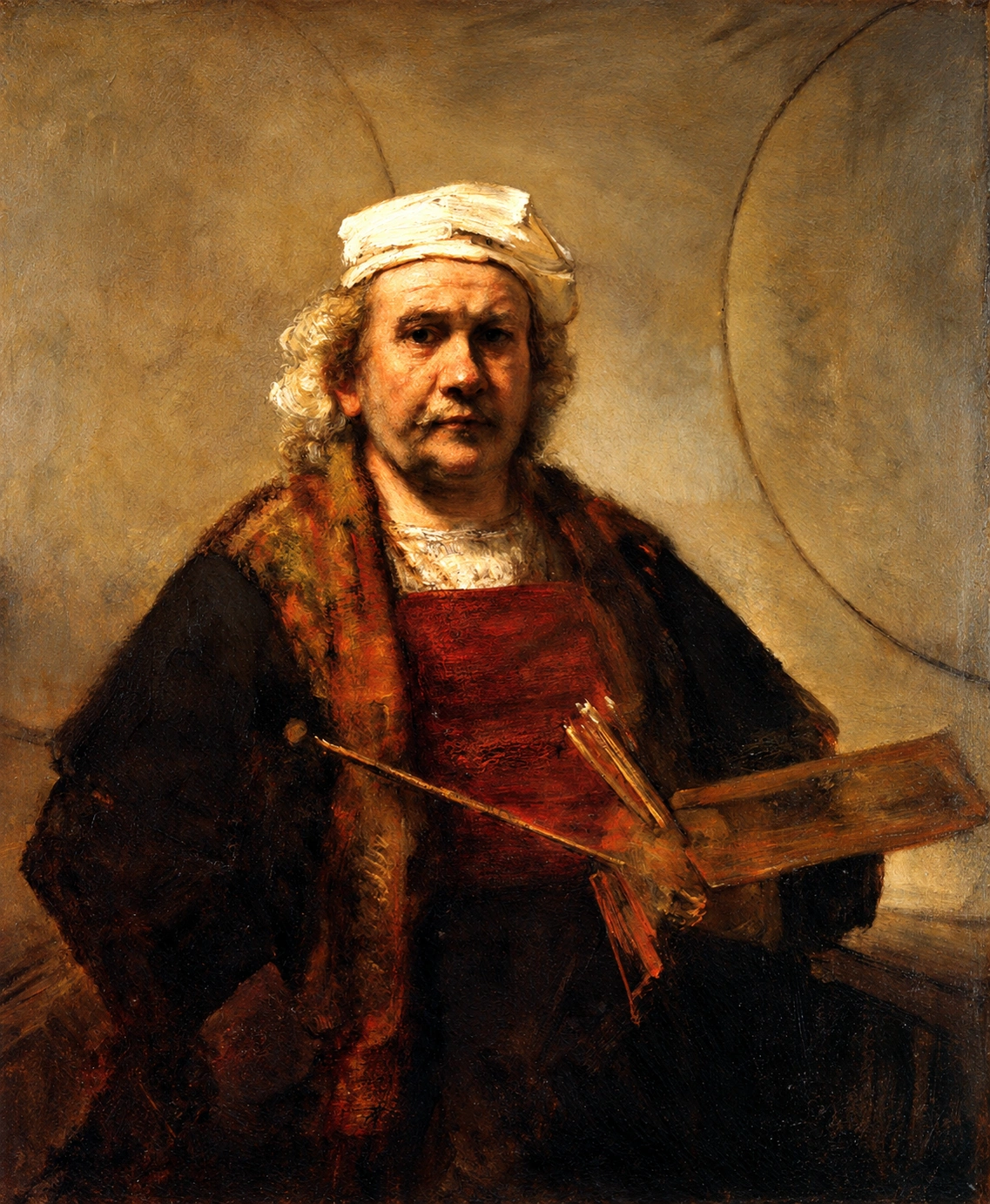
Rembrandt’s Self Portrait with Two Circles, painted around 1665, is one of the most powerful and psychologically complex self-portraits in the history of European art. Created during the final years of Rembrandt van Rijn’s life, the painting presents the aging artist not as an idealized gentleman or celebrated celebrity, but as a working painter confronting the viewer with extraordinary confidence. His direct gaze, heavy clothing, painter’s tools, and the mysterious circles behind him combine to create an image that feels both deeply personal and deliberately monumental.
Rembrandt produced self-portraits throughout his career, using his own face as a subject through which he could explore expression, age, status, costume, light, and artistic identity. In Self Portrait with Two Circles, however, the experimentation of his youth has been replaced by something quieter and more profound. The painting is less concerned with theatrical appearance than with the enduring identity of the artist himself.
Rembrandt as an Aging Artist
Rembrandt was approximately fifty-nine years old when he painted Self Portrait with Two Circles. His face bears the visible effects of age, and he makes little attempt to conceal them. The cheeks are full, the skin is unevenly illuminated, the eyes appear slightly shadowed, and the features possess a weight and physical presence that contrast sharply with conventional idealized portraiture.
This willingness to represent aging honestly is central to the painting’s emotional power. Rembrandt does not present himself as weakened or defeated by time. Instead, his solid stance and unwavering expression suggest a man who remains firmly committed to his artistic identity despite the difficulties that had characterized much of his later life.
The portrait therefore becomes more than a visual record of Rembrandt’s appearance. It becomes an examination of what remains when youth, fashion, financial success, and public reputation become uncertain. What remains here is the artist, standing before his work with his tools in hand.
Composition and the Power of Rembrandt’s Presence
Rembrandt dominates the center of the composition. His broad figure fills much of the canvas, creating a strong sense of physical presence. Unlike portraits in which elaborate architectural settings or decorative objects compete for attention, the surroundings here are remarkably restrained.
The artist faces the viewer almost directly, although his body is positioned with a slight turn. This creates enough movement to prevent the composition from becoming rigid while preserving the remarkable force of his gaze. His head occupies the brightest region of the painting, immediately drawing attention to his face.
The large dark mass of his clothing gives his figure visual weight. His body appears almost to emerge from the shadowed lower portion of the canvas, while the lighter wall behind his head creates separation between figure and background. The result is a composition that feels stable, balanced, and quietly imposing.
Light, Color, and Atmosphere
The color palette of Self Portrait with Two Circles is dominated by warm earth tones, including browns, ochres, blacks, muted reds, and creamy whites. These colors create a subdued atmosphere while allowing small areas of brightness to become especially expressive. The white cap covering Rembrandt’s head is particularly luminous, catching the light more strongly than almost anything else in the image.
Warm light also moves across his forehead, nose, cheeks, and the upper portions of his clothing. Rather than illuminating every feature evenly, Rembrandt allows parts of the face to dissolve into shadow. This irregular distribution of light makes the portrait feel alive because the viewer’s attention continually moves between clearly defined and partially obscured forms.
The reddish garment at the center of the composition provides an important source of warmth. Its muted crimson color connects visually with the warmer tones of Rembrandt’s face while contrasting with the heavy darkness of his outer clothing. The entire palette feels harmonized, creating an impression of age, warmth, material richness, and intimacy.
Rembrandt’s Brushwork and Late Style
One of the most remarkable features of Self Portrait with Two Circles is Rembrandt’s handling of paint. Instead of disguising individual brushstrokes in pursuit of a polished surface, he frequently allows the physical texture of the paint to remain visible. Certain areas appear almost sculpted through layers of pigment, particularly around the face, cap, clothing, and painter’s tools.
This technique is characteristic of Rembrandt’s mature style. From a distance, apparently loose marks combine to create convincing forms, textures, and expressions. When viewed closely, however, those forms partially dissolve into strokes, patches, and accumulated layers of paint.
The contrast between finished and unfinished areas is equally important. Some passages receive substantial attention while others remain deliberately vague. This selective approach concentrates the viewer’s attention on what Rembrandt considered essential, particularly the face and the psychological encounter created by his gaze.
The Meaning of the Two Circles
The two large circles painted on the wall behind Rembrandt are among the most mysterious elements of the portrait. Only portions of the circles are visible, and their exact meaning has never been conclusively established. Their presence nevertheless transforms an otherwise simple studio background into something intellectually provocative.
One interpretation connects the circles to stories about artistic skill. Since drawing a perfect circle freehand had traditionally been associated with exceptional mastery, the circular forms may function as subtle declarations of Rembrandt’s abilities. Rather than displaying luxury or social status, he may be presenting artistic competence itself as the foundation of his identity.
The circles also give the background an unusual sense of scale and structure. Their curved lines surround and frame Rembrandt without creating a conventional decorative border. Because they remain incomplete and unexplained, they introduce an element of ambiguity that encourages viewers to continue questioning the painting.
The Painter’s Tools
Rembrandt holds the tools of his profession prominently in front of his body. Brushes, a palette, and possibly a mahlstick identify him unmistakably as a working artist. These objects are not merely accessories added to clarify his occupation. They play a central role in the meaning of the self-portrait.
Earlier European portraits sometimes represented artists in refined clothing to emphasize their intellectual and social status. Rembrandt instead connects dignity with the physical act of painting. His tools become symbols of experience, labor, craftsmanship, and sustained creative effort.
Their position also helps organize the lower half of the composition. The diagonal lines formed by the brushes and other implements interrupt the heavy vertical mass of his body. These diagonals introduce subtle movement and direct attention back toward the artist himself.
Psychological Depth and Expression
Rembrandt’s expression is difficult to reduce to a single emotion. He does not smile, yet he does not appear conventionally sorrowful. His gaze is calm, observant, serious, and remarkably direct.
This emotional ambiguity gives the painting much of its lasting fascination. Viewers are encouraged to search his face for evidence of pride, fatigue, determination, vulnerability, or wisdom, yet the portrait never provides a simple answer. Rembrandt preserves the complexity of individual character rather than transforming himself into an easily interpreted symbol.
The effect resembles an encounter more than a conventional portrait. Rembrandt seems aware of the viewer’s presence, but he does not perform for that viewer. His expression suggests concentration and self-possession, as though the spectator has entered his studio while he remains absorbed in the identity he has built through decades of artistic practice.
A Self-Portrait About Artistic Identity
Self Portrait with Two Circles can ultimately be understood as a meditation on what it means to be an artist. Rembrandt presents himself surrounded by almost nothing that indicates conventional wealth or social prestige. Instead, the painting emphasizes his face, his hands, his tools, his clothing, and the enigmatic evidence of artistic activity behind him.
The portrait gains additional significance because it comes from the final period of Rembrandt’s career. By the 1660s, he had experienced enormous professional success as well as serious financial difficulties and personal losses. Yet the painting does not function simply as a document of hardship. Its dominant impression is one of endurance.
Rembrandt’s identity is grounded in the act of painting itself. The rough surfaces, glowing flesh tones, dark shadows, broad silhouette, and mysterious circles demonstrate the very mastery that the portrait celebrates. He does not need to announce his reputation through elaborate symbols because the painting itself serves as evidence of his achievement.
Conclusion
Rembrandt’s Self Portrait with Two Circles is one of the defining achievements of his late career. Through its restrained composition, warm palette, textured brushwork, direct gaze, visible painter’s tools, and mysterious circular forms, the painting transforms a self-portrait into a profound reflection on creativity, aging, and artistic identity.
What makes the work especially compelling is its balance between vulnerability and authority. Rembrandt allows the viewer to see an aging human being while simultaneously presenting a painter whose command of his medium remains unmistakable. The face may reveal the passage of time, but the painting surrounding it demonstrates extraordinary artistic confidence.
More than three centuries after its creation, Self Portrait with Two Circles continues to feel remarkably immediate. Rembrandt stands before the viewer not simply as a historical figure, but as an artist confronting his own image, his profession, and the passage of time. The result is a portrait in which the act of painting becomes inseparable from the question of who the painter truly is.