The Astronomer by Johannes Vermeer: Vibrant Color Edit
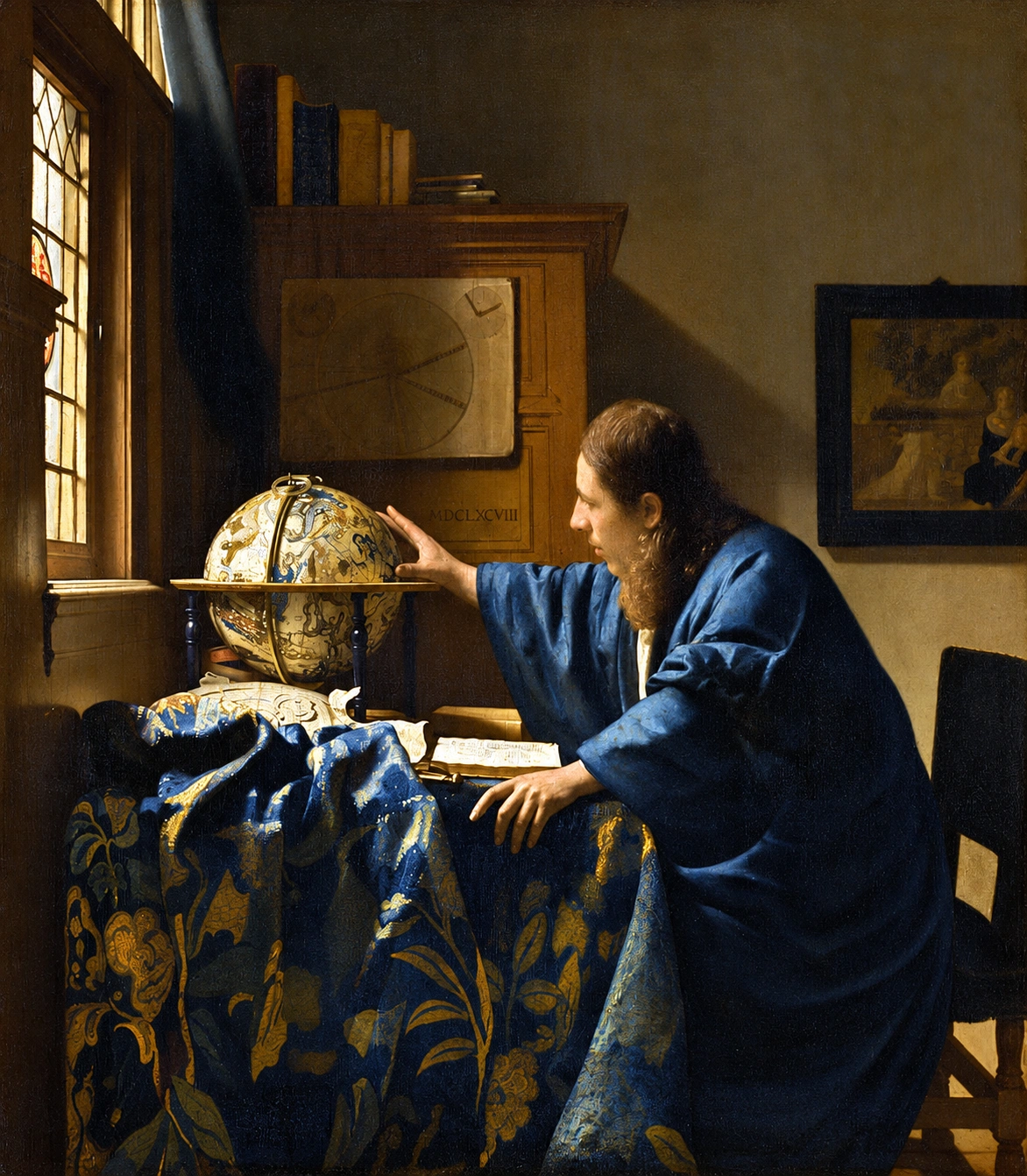
Free to Download & Reuse: You are welcome to use this image! If you republish or share it online, you must include a direct link back to this webpage for attribution.
Original Image Source: wikiart.org
Introduction to The Astronomer by Johannes Vermeer
The Astronomer, painted in 1668 by the Dutch master Johannes Vermeer, is one of the most fascinating examples of seventeenth-century Dutch Golden Age painting. Renowned for his extraordinary treatment of light, intimate interiors, and carefully balanced compositions, Vermeer created a remarkable image of scientific curiosity and intellectual discovery. Through the depiction of a scholar examining a celestial globe, the artist explores the relationship between human knowledge, scientific observation, and the mysteries of the universe.
Unlike many of Vermeer’s celebrated paintings featuring women engaged in everyday domestic activities, The Astronomer presents a male intellectual absorbed in scholarly investigation. The painting captures a seemingly ordinary moment, yet its carefully selected objects and sophisticated symbolism transform the scene into a meditation on humanity’s desire to understand the cosmos. Every element, from the illuminated globe to the books scattered across the table, contributes to the painting’s atmosphere of contemplation and discovery.
Historical Context and the Dutch Golden Age
Johannes Vermeer painted The Astronomer during a period of remarkable scientific and cultural advancement in the Dutch Republic. The seventeenth century witnessed important developments in astronomy, mathematics, geography, and navigation, driven partly by the Netherlands’ expanding maritime trade networks. Scientific instruments, detailed maps, and celestial globes became increasingly important tools for understanding the natural world.
The Scientific Revolution transformed European perceptions of the universe during Vermeer’s lifetime. Earlier discoveries by Nicolaus Copernicus, Johannes Kepler, and Galileo Galilei had challenged traditional astronomical theories and encouraged new approaches to studying celestial phenomena. By 1668, the intellectual environment of the Dutch Republic reflected a growing confidence in observation, mathematical reasoning, and scientific experimentation.
Vermeer’s painting captures this atmosphere of intellectual transformation through the quiet concentration of a single scholar. Rather than depicting a dramatic astronomical discovery, the artist emphasizes the patient investigation underlying scientific progress. The astronomer’s thoughtful interaction with his instruments suggests that knowledge emerges through careful study, curiosity, and sustained attention.
Composition and the Arrangement of the Interior
The composition of The Astronomer demonstrates Vermeer’s exceptional ability to organize complex visual elements within a relatively small interior. The scholar occupies the central portion of the painting, leaning forward toward a celestial globe positioned on a table. His extended arm creates a strong diagonal movement that guides the viewer’s attention directly toward the instrument.
The table, covered with a richly patterned textile, establishes a substantial foreground presence. Its carefully arranged objects create a visual connection between the astronomer and the intellectual resources surrounding him. An open book, a celestial globe, and additional scholarly materials reinforce the painting’s central theme of astronomical investigation.
Vermeer uses the room’s architectural features to establish depth and spatial coherence. The window on the left introduces natural light, while the cabinet and wall decoration on the right balance the composition. These elements create an intimate environment in which the scholar appears entirely absorbed in his work.
The painting’s carefully controlled perspective further enhances its realism. The arrangement of furniture, the positioning of the table, and the placement of the astronomer’s body establish a convincing sense of three-dimensional space. Despite the numerous objects present, the composition remains harmonious and remarkably uncluttered.
The Masterful Use of Light and Shadow
Light is among the most distinctive features of Johannes Vermeer’s artistic style, and The Astronomer provides an outstanding demonstration of his mastery. Natural daylight enters through the window on the left, illuminating the astronomer’s face, clothing, and scientific instruments. This directional lighting creates a subtle contrast between the illuminated foreground and the darker areas of the interior.
The astronomer’s blue robe responds beautifully to the incoming light. Its folds reveal delicate variations of blue, gray, and white, demonstrating Vermeer’s sensitivity to the interaction between fabric and illumination. The highlights along the sleeves and shoulders help establish the figure’s physical presence while reinforcing the painting’s tranquil atmosphere.
The celestial globe receives particular attention from the incoming light. Its rounded surface becomes a visual focal point, emphasizing its importance as an instrument of scientific understanding. The globe’s illumination also establishes a symbolic connection between physical light and intellectual enlightenment.
Rather than creating dramatic contrasts, Vermeer employs gentle transitions between brightness and shadow. This restrained approach produces an atmosphere of quiet concentration and invites viewers to contemplate the scene without distraction.
The Astronomer and His Intellectual Pursuit
The central figure in The Astronomer is depicted at a moment of intense intellectual engagement. His right hand reaches toward the celestial globe while his gaze remains fixed upon its surface. This gesture suggests active investigation rather than passive contemplation.
The scholar’s clothing contributes significantly to his characterization. His loose blue robe resembles garments commonly associated with learned individuals in seventeenth-century Dutch imagery. Its generous folds and comfortable appearance suggest an environment devoted to private study rather than public ceremony.
The astronomer’s facial expression is calm and focused, emphasizing the mental discipline required for scientific inquiry. Vermeer avoids exaggerated gestures or dramatic expressions, presenting intellectual activity as a quiet but meaningful human achievement. The figure’s concentrated posture allows the viewer to imagine the complex questions occupying his thoughts.
Some scholars have proposed that the figure may represent Antoni van Leeuwenhoek, the Dutch scientist and pioneering microscopist who lived in Delft. Although the identification remains uncertain, the suggestion reflects the painting’s close association with the scientific culture of Vermeer’s environment. Regardless of the sitter’s identity, the astronomer embodies the curiosity and intellectual ambition of his age.
Symbolism of the Celestial Globe and Scientific Instruments
The celestial globe is the painting’s most important symbolic object. Unlike a terrestrial globe, which represents Earth’s geographical features, a celestial globe displays the apparent arrangement of stars and constellations across the heavens. Its presence immediately establishes the scholar’s interest in astronomy and humanity’s understanding of the universe.
The globe depicted in the painting has been associated with the work of Jodocus Hondius, a prominent Dutch cartographer and globe maker. Its detailed markings reflect the sophisticated astronomical knowledge available during the seventeenth century. By including such an instrument, Vermeer connects the private interior to the broader scientific achievements of his time.
The open book on the table further develops this intellectual theme. It has been identified as a work by the Dutch astronomer Adriaan Metius, whose writings explored astronomy and related mathematical sciences. The combination of written knowledge and practical instruments suggests that scientific understanding depends upon both theoretical learning and direct observation.
A framed religious image on the wall introduces another layer of meaning. Often identified as a depiction of the Finding of Moses, it may establish a relationship between spiritual wisdom and scientific investigation. The painting consequently invites reflection on how religious belief and emerging scientific knowledge coexisted in seventeenth-century European culture.
Color Palette and Vermeer's Painting Technique
The color palette of The Astronomer is restrained yet exceptionally sophisticated. Deep blues, warm browns, muted yellows, and soft whites establish a harmonious visual environment. Vermeer carefully distributes these colors to create depth, atmosphere, and visual unity.
The scholar’s blue robe is particularly striking against the predominantly brown and golden interior. This contrast draws attention to the central figure while maintaining the painting’s overall balance. Subtle variations within the blue fabric reveal the artist’s ability to represent texture through carefully controlled changes in color and light.
The patterned table covering introduces additional visual richness. Its intricate design provides a contrast to the comparatively simple surfaces of the walls and furniture. These decorative details demonstrate Vermeer’s interest in domestic materials while contributing to the painting’s sense of authenticity.
Vermeer’s precise handling of paint creates convincing distinctions between fabric, wood, paper, glass, and polished surfaces. Each material responds differently to light, allowing the viewer to recognize its physical qualities. This sensitivity to texture contributes significantly to the painting’s remarkable realism.
The Relationship Between Science and Art
The Astronomer represents a fascinating intersection between artistic observation and scientific inquiry. Both the painter and the astronomer rely upon careful examination of the visible world, although their objectives differ. Vermeer studies the behavior of light, color, and perspective, while his subject investigates the arrangement of celestial bodies.
This parallel gives the painting a deeper intellectual significance. The astronomer’s concentration resembles the attention required of an artist attempting to translate visual experience into a convincing image. Both activities involve patience, discipline, and a desire to reveal structures that might otherwise escape ordinary perception.
The painting also reflects the increasing importance of empirical observation during the Scientific Revolution. By depicting an individual engaged with scientific instruments, Vermeer celebrates the human capacity to investigate nature through reason and experience. Nevertheless, the quiet atmosphere suggests that the pursuit of knowledge remains accompanied by uncertainty and wonder.
The Astronomer and The Geographer
The Astronomer is closely associated with another celebrated painting by Johannes Vermeer, The Geographer, completed around 1669. Both works depict male scholars engaged in intellectual activities within carefully illuminated domestic interiors. Their similarities have encouraged art historians to consider them companion paintings.
While The Astronomer concerns the study of the heavens, The Geographer focuses on the investigation of Earth’s physical surface. This complementary relationship reflects the interconnected development of astronomy, geography, navigation, and cartography during the Dutch Golden Age. Together, the paintings suggest a broad human ambition to understand both the terrestrial and celestial worlds.
The figures also display different forms of intellectual engagement. The astronomer reaches toward a globe in concentrated examination, while the geographer appears momentarily withdrawn from his work, perhaps considering a new idea. These contrasting gestures reveal Vermeer’s remarkable ability to communicate subtle psychological states through physical posture.
Legacy and Artistic Significance
Today, The Astronomer is preserved in the Musée du Louvre in Paris, where it remains an important example of Vermeer’s mature artistic achievement. Its combination of scientific subject matter, sophisticated lighting, and carefully structured composition distinguishes it within his relatively small surviving body of work. The painting continues to attract attention from art historians, scientists, and admirers of Dutch Golden Age painting.
Its lasting appeal lies partly in its ability to transform a private moment of study into a universal reflection on intellectual curiosity. The astronomer’s hand reaching toward the celestial globe becomes an enduring image of humanity’s desire to comprehend the universe. Through this simple gesture, Vermeer communicates the excitement and uncertainty inherent in the search for knowledge.
Conclusion: The Enduring Meaning of The Astronomer
Johannes Vermeer’s The Astronomer (1668) is a remarkable celebration of knowledge, observation, and scientific curiosity. Through masterful lighting, harmonious composition, and carefully chosen symbolic objects, the artist transforms an intimate scholarly interior into a profound exploration of humanity’s relationship with the cosmos. The painting demonstrates how an apparently ordinary moment can express ideas extending far beyond its immediate setting.
More than three centuries after its creation, The Astronomer continues to resonate with viewers because its central theme remains timeless. The pursuit of knowledge, the fascination with celestial mysteries, and the desire to understand the natural world remain fundamental aspects of human experience. Vermeer’s masterpiece captures these aspirations with extraordinary subtlety, establishing itself as one of the most intellectually compelling paintings of the Dutch Golden Age.