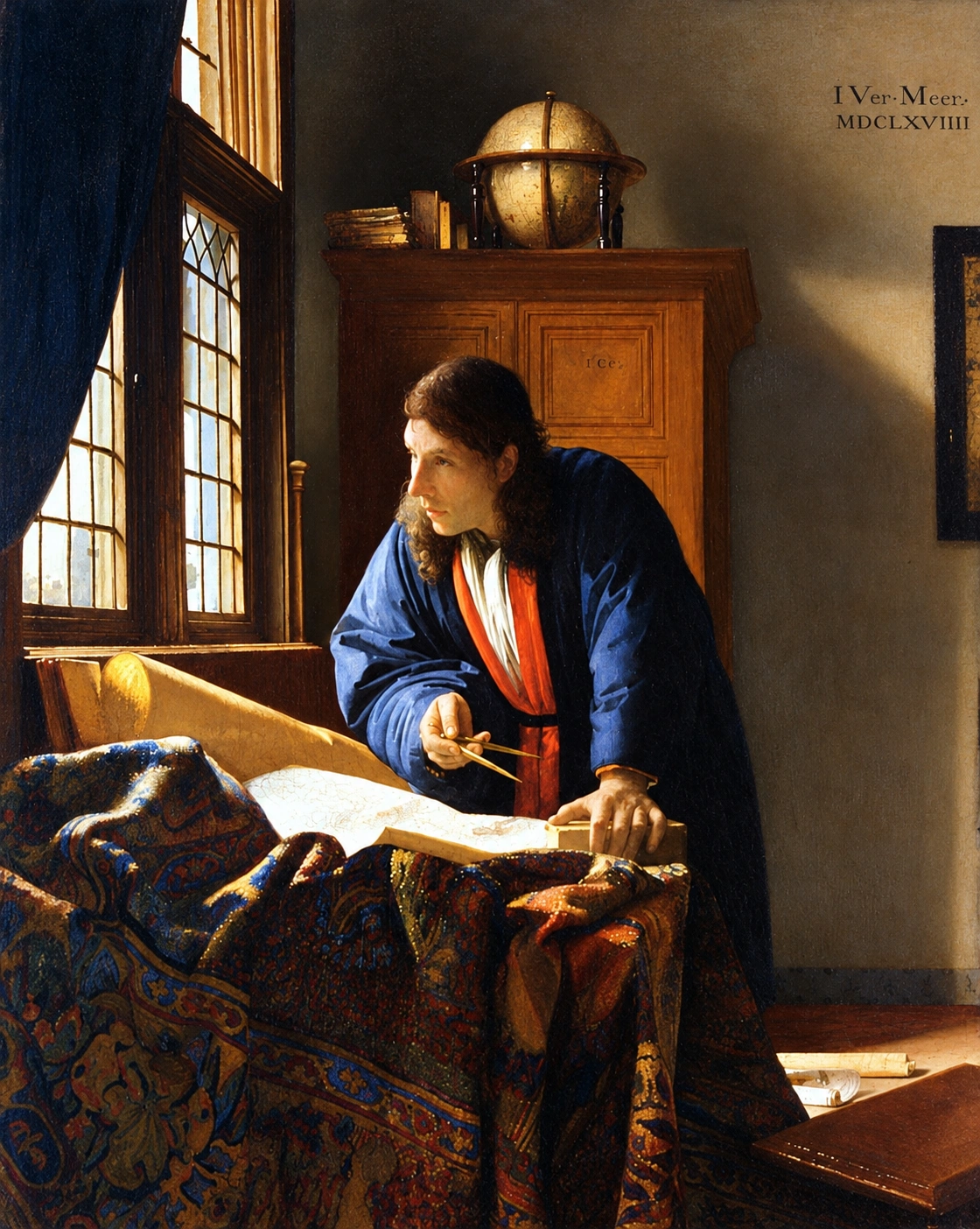
The Geographer by Johannes Vermeer: Vibrant Color Edit
Free to Download & Reuse: You are welcome to use this image! If you republish or share it online, you must include a direct link back to this webpage for attribution.
Original Image Source: wikiart.org
Introduction to "The Geographer" by Johannes Vermeer
“The Geographer,” painted in 1669 by Johannes Vermeer, is one of the most intellectually fascinating works of the Dutch Golden Age. Known for his extraordinary ability to capture light, atmosphere, and moments of quiet contemplation, Vermeer presents a scholar absorbed in the pursuit of geographical knowledge. Through its carefully arranged composition, richly textured interior, and subtle symbolism, the painting celebrates human curiosity and the expanding understanding of the world during the seventeenth century.
Unlike many of Vermeer’s celebrated paintings, which portray women engaged in domestic activities, “The Geographer” features a solitary male figure surrounded by instruments associated with scientific investigation. The painting reflects an era when exploration, cartography, and scientific discoveries were transforming European perceptions of the world. Vermeer transforms this intellectual subject into an intimate scene that invites viewers to contemplate the relationship between observation, knowledge, and discovery.
Historical Context: Geography and Science in the Dutch Golden Age
During the seventeenth century, the Dutch Republic emerged as a major center of international commerce, maritime exploration, and scientific innovation. Dutch merchants and navigators traveled across oceans, establishing extensive trading networks that connected Europe with Asia, Africa, and the Americas. Accurate geographical knowledge became essential for navigation, trade, and the growing ambitions of the Dutch maritime economy.
Cartography flourished during this period, with Dutch mapmakers producing some of Europe’s most sophisticated maps, atlases, and globes. Figures such as Willem Blaeu and Joan Blaeu contributed to the development of geographical knowledge through their influential publications. Scientific instruments, including dividers, compasses, and measuring devices, became increasingly important tools for understanding and representing the physical world.
Vermeer’s “The Geographer” reflects this intellectual environment while remaining deeply personal in its presentation. Rather than portraying an explorer navigating distant oceans, the artist depicts a scholar examining information within the privacy of his study. This contrast emphasizes that geographical discoveries depended not only on adventurous voyages but also on careful measurement, interpretation, and reflection.
Composition and the Geographer's Thoughtful Pose
The composition of “The Geographer” centers on a young scholar leaning forward over a table covered with geographical materials. His body turns toward the window, while his right hand holds a pair of dividers, an instrument used for measuring distances on maps and charts. His attentive expression suggests that he has momentarily interrupted his calculations to consider a new possibility.
Vermeer organizes the scene through a delicate balance of vertical and horizontal elements. The window on the left establishes the primary source of illumination, while the table and surrounding furniture provide a stable architectural framework. The scholar’s leaning posture introduces movement into an otherwise quiet interior, creating a sense of intellectual activity.
The geographer’s gaze is particularly important to the painting’s psychological impact. Instead of looking directly at his instruments, he appears to be contemplating something beyond the immediate objects before him. This moment of suspended concentration transforms the painting from a straightforward representation of scholarly work into a meditation on the creative processes underlying scientific discovery.
The Masterful Use of Natural Light
Light is among the most remarkable features of Johannes Vermeer’s “The Geographer.” Entering through the window on the left, soft daylight illuminates the scholar’s face, clothing, and the geographical documents spread across the table. The interplay between illuminated surfaces and subdued shadows establishes a convincing sense of depth while directing attention toward the central figure.
The window serves both a practical and symbolic purpose. As the visible source of natural illumination, it allows Vermeer to demonstrate his exceptional understanding of how light interacts with different materials. At the same time, the brightness entering the room can be interpreted as a metaphor for enlightenment, suggesting the arrival of knowledge through observation and reason.
Vermeer’s treatment of light avoids theatrical exaggeration. Instead, subtle tonal transitions create a peaceful atmosphere in which the smallest details acquire significance. The scholar’s illuminated forehead, the delicate reflections on the instruments, and the gentle highlights along his robe contribute to the painting’s remarkable visual coherence.
Color Palette and the Beauty of Vermeer's Technique
The color palette of “The Geographer” combines warm earth tones with cooler accents of blue, white, and muted gray. The scholar wears a loose blue robe with contrasting lighter fabric visible beneath it, creating a striking visual relationship between the figure and the surrounding interior. These carefully selected colors contribute to the painting’s atmosphere of concentration and refinement.
Warm browns dominate the furniture, wall surfaces, and darker architectural elements. Against these subdued tones, the illuminated sections of the scholar’s clothing become particularly expressive. Vermeer uses variations in brightness and color temperature to distinguish different materials while maintaining harmony throughout the composition.
The painting also demonstrates his extraordinary attention to texture. The folds of the robe appear soft and substantial, while the maps, wooden furniture, and scientific instruments possess distinct material qualities. These differences emerge through controlled brushwork and subtle changes in reflected light, revealing Vermeer’s sensitivity to the physical properties of everyday objects.
Scientific Instruments and Their Symbolic Meaning
The geographical instruments surrounding the scholar are central to the painting’s intellectual significance. The dividers held in his hand suggest the measurement of distances, an essential activity in cartography and navigation. Their presence identifies the subject as someone engaged in the systematic investigation of geographical space.
A terrestrial globe rests on the cabinet behind the geographer, reinforcing the painting’s association with exploration and global knowledge. The globe represents the Earth’s physical dimensions while also symbolizing humanity’s desire to understand distant territories. Within the context of seventeenth-century Dutch culture, such an object would have carried associations with maritime commerce, scholarship, and technological advancement.
The maps and documents scattered across the table further emphasize the importance of accumulated knowledge. They suggest a process in which observation and recorded information become the foundations of new discoveries. Together, these objects transform the interior into a visual representation of the scientific curiosity that characterized the Dutch Golden Age.
The Relationship Between "The Geographer" and "The Astronomer"
“The Geographer” is closely associated with another celebrated Vermeer painting, “The Astronomer,” completed in 1668. Both works depict male scholars engaged in intellectual activities within carefully arranged domestic interiors. Their similarities in composition, lighting, and subject matter have encouraged art historians to consider them companion paintings.
While “The Astronomer” examines humanity’s fascination with the heavens, “The Geographer” focuses on understanding the terrestrial world. The two subjects complement one another by presenting different branches of scientific inquiry. Together, they suggest a broader fascination with the natural universe and humanity’s ability to investigate it through observation and measurement.
The resemblance between the figures in both paintings has also generated speculation about their identities. Some scholars have proposed that the Dutch scientist Antonie van Leeuwenhoek may have served as a model, although this identification remains uncertain. Regardless of the sitter’s identity, Vermeer creates a compelling representation of intellectual curiosity and scientific ambition.
Knowledge, Discovery, and the Symbolism of the Window
Beyond its realistic depiction of a scholar at work, “The Geographer” contains a rich network of possible symbolic meanings. The open relationship between the interior and the outside world is especially significant. Although the geographer remains physically confined to his study, his instruments and calculations allow him to investigate places far beyond its walls.
The window becomes an important visual connection between these two realms. Through its light, the external world enters the scholar’s private environment, suggesting that knowledge begins with the observation of nature. His thoughtful gaze toward the illuminated space reinforces the idea that intellectual discovery requires both empirical evidence and imagination.
The painting can therefore be understood as a celebration of human reason. Vermeer does not portray scientific investigation as an impersonal collection of calculations but as an activity shaped by curiosity, patience, and creative thought. The geographer’s momentary pause becomes a powerful expression of the human desire to understand an increasingly interconnected world.
The Legacy of "The Geographer" in Art History
Today, “The Geographer” is housed in the Städel Museum in Frankfurt, Germany, where it remains one of Vermeer’s most admired paintings. Its combination of scientific subject matter, psychological subtlety, and extraordinary technical refinement distinguishes it within the artist’s relatively small surviving body of work. The painting also provides valuable insight into the intellectual culture of the seventeenth-century Dutch Republic.
Vermeer’s ability to transform a seemingly ordinary moment into an image of lasting significance is particularly evident here. Through light, composition, and carefully selected objects, he captures the excitement of discovery without depicting any dramatic external action. The result is a painting that encourages viewers to appreciate the quiet intensity of thought itself.
Conclusion: A Timeless Celebration of Human Curiosity
Johannes Vermeer’s “The Geographer” (1669) stands as a remarkable tribute to scientific inquiry and the pursuit of knowledge during the Dutch Golden Age. Its luminous interior, thoughtful central figure, and carefully arranged geographical instruments create a compelling portrait of intellectual exploration. Every element contributes to an atmosphere in which observation and imagination seem inseparable.
More than three centuries after its creation, the painting continues to resonate with viewers fascinated by the relationship between art and science. Vermeer reminds us that understanding the world requires moments of reflection as well as practical investigation. Through his extraordinary sensitivity to light and human expression, he transforms a scholar’s quiet contemplation into a timeless celebration of curiosity, discovery, and the enduring search for knowledge.