The Spinners (Las Hilanderas) by Diego Velázquez: Vibrant Color Edit
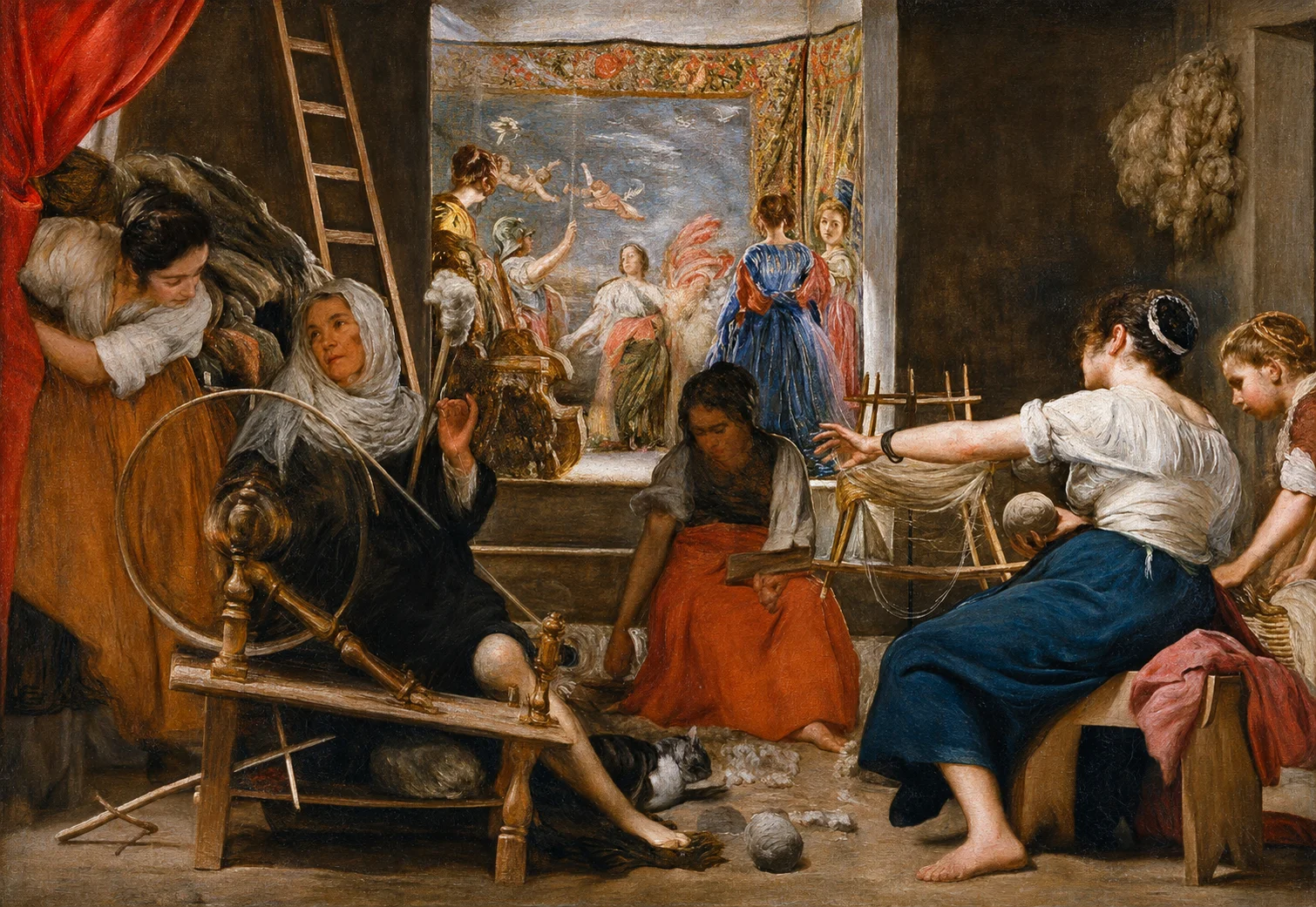
Free to Download & Reuse: You are welcome to use this image! If you republish or share it online, you must include a direct link back to this webpage for attribution.
Original Image Source: https://commons.wikimedia.org/wiki/File:Velazquez-las_hilanderas.jpg
Introduction to The Spinners (Las Hilanderas) by Diego Velázquez
The Spinners (Las Hilanderas), painted around 1656 by the Spanish Baroque master Diego Velázquez, is one of the most fascinating and intellectually complex paintings of the seventeenth century. At first glance, the composition appears to depict an ordinary textile workshop where several women are engaged in spinning wool and preparing thread. However, beneath this seemingly straightforward representation of everyday labor lies a sophisticated exploration of classical mythology, artistic creativity, and the relationship between human craftsmanship and divine power.
Created during the later years of Velázquez’s career, The Spinners demonstrates the artist’s extraordinary ability to combine naturalistic observation with symbolic storytelling. The painting draws viewers into a richly atmospheric interior where movement, light, and human activity create a convincing sense of life. As the eye travels deeper into the composition, the humble workshop gradually reveals a mythological narrative inspired by the ancient Greek story of Arachne and Athena.
Historical Context and Velázquez's Artistic Career
By 1656, Diego Velázquez had established himself as one of the most accomplished painters in Europe. Serving as court painter to King Philip IV of Spain, he enjoyed a prestigious position within the Spanish royal household and had developed a distinctive artistic language characterized by subtle brushwork, psychological insight, and remarkable technical freedom. His mature paintings frequently challenged traditional distinctions between portraiture, historical narrative, and scenes of everyday life.
The Spinners belongs to this remarkable final phase of Velázquez’s career, during which he also produced his celebrated masterpiece Las Meninas. Both paintings demonstrate his fascination with complex spatial arrangements and the relationship between artistic representation and reality. Rather than presenting their subjects through rigid academic conventions, Velázquez created compositions that invite viewers to discover multiple layers of meaning through careful observation.
The painting’s precise dating remains a matter of scholarly discussion, although it is generally associated with the late 1650s. Its original composition was also smaller than the canvas visible today, with additional sections incorporated during its later history. These changes have influenced how the work is perceived, particularly its architectural proportions and the relationship between the foreground and background.
The Composition: A Workshop Filled with Movement
The composition of The Spinners is organized into two distinct but interconnected spaces. In the foreground, five women occupy a dimly illuminated textile workshop, surrounded by spinning equipment, wool, and bundles of fabric. Their activities appear spontaneous and natural, creating the impression that the viewer has entered an active workplace rather than encountered a carefully arranged historical painting.
On the left, an older woman wearing a white head covering operates a spinning wheel. Her raised hand and attentive expression suggest concentration, while the rapidly rotating wheel introduces a powerful sensation of movement. Beside her, a younger woman bends toward a large mass of wool, her body partially concealed within the surrounding shadows.
The right side features a young woman wearing a white blouse and a rich blue skirt, seated while handling strands of fiber. Her illuminated arm stretches across the composition, directing attention toward the delicate material passing through her hands. Nearby, another figure works at the edge of the canvas, completing the impression of a workshop where each participant contributes to a shared process.
In the center, a woman wearing a reddish-orange skirt bends forward, creating a visual connection between the two sides of the foreground. Her position helps establish depth while introducing a striking concentration of warm color. Together, these figures form a rhythmic arrangement of gestures, fabrics, and intersecting lines that gives the painting its extraordinary vitality.
The Mythological Story of Arachne and Athena
Although The Spinners initially resembles a genre painting celebrating textile production, its deeper subject is commonly understood as the ancient myth of Arachne and Athena. The story appears in Ovid’s Metamorphoses, where Arachne, a gifted mortal weaver, becomes so confident in her abilities that she challenges Athena, the goddess of wisdom and craftsmanship, to a weaving competition.
Athena initially approaches Arachne disguised as an elderly woman, attempting to warn her against excessive pride. When Arachne refuses to acknowledge the goddess’s superiority, the two engage in a contest that tests their extraordinary weaving skills. Arachne produces a magnificent tapestry depicting the romantic deceptions and misconduct of the gods, provoking Athena’s anger despite the exceptional quality of the mortal woman’s work.
Velázquez incorporates this narrative through an ingenious arrangement of figures and spaces. The older woman operating the spinning wheel is often identified with Athena in disguise, while the younger woman working nearby is interpreted as Arachne. Their placement within an ordinary workshop transforms the familiar setting into a subtle representation of mythological rivalry.
The background strengthens this interpretation by presenting a second scene associated with the confrontation between Athena and Arachne. This layered approach allows Velázquez to portray different aspects of the myth within a single composition, encouraging viewers to move intellectually and visually between the everyday world and classical antiquity.
The Background Tapestry and Its Symbolic Importance
One of the most intriguing features of The Spinners is the brightly illuminated space visible beyond the foreground workshop. Several elegantly dressed women stand before a monumental tapestry, creating a dramatic contrast with the working figures occupying the darker interior. The rich garments, refined gestures, and luminous surroundings establish an atmosphere that seems almost theatrical.
The tapestry itself is essential to understanding the painting’s meaning. Its imagery refers to the myth of Europa, who was abducted by Zeus after the god transformed himself into a white bull. This subject is particularly significant because it recalls a celebrated composition by Titian, The Rape of Europa, which Velázquez would have known through the artistic collections and traditions of the Spanish court.
The connection to Titian introduces another dimension to the painting. By incorporating imagery associated with an earlier master, Velázquez reflects upon the relationship between artistic inheritance and individual achievement. Just as Arachne competes with Athena, painters establish their reputations through their ability to rival and reinterpret the accomplishments of their predecessors.
The elevated background also suggests a distinction between the physical labor required to produce textiles and the intellectual prestige associated with finished artistic creations. Yet Velázquez does not simply place one form of activity above the other. Instead, he establishes a visual dialogue in which the workshop and the tapestry become inseparable parts of the same creative process.
Light, Shadow, and the Spanish Baroque Style
Velázquez’s treatment of light is among the most remarkable aspects of The Spinners. The foreground is dominated by warm shadows and restrained illumination, while the background receives a brighter, cooler light that emphasizes its narrative importance. This contrast establishes spatial depth while guiding the viewer’s attention through the painting.
The artist avoids harsh, theatrical divisions between illuminated and shadowed areas. Instead, light seems to circulate naturally throughout the workshop, touching faces, clothing, wooden equipment, and scattered fibers. Subtle transitions between brightness and darkness give the figures a convincing physical presence.
The white blouse of the seated woman on the right is particularly striking against the surrounding shadows. Its loosely painted folds capture reflected light with remarkable economy, creating a sense of texture without excessive detail. Similarly, the white head covering of the older woman becomes a luminous focal point within the otherwise subdued left side.
These effects demonstrate Velázquez’s mature understanding of Baroque painting. Although the composition contains dramatic contrasts, its atmosphere remains grounded in careful observation. The resulting balance between realism and theatricality contributes significantly to the painting’s enduring fascination.
Brushwork, Color, and the Representation of Motion
The technical brilliance of The Spinners is especially apparent in Velázquez’s handling of brushwork. Rather than describing every object through precise outlines, he uses fluid strokes and carefully placed highlights to suggest form, texture, and movement. This approach creates an impression of immediacy that was remarkably innovative for the seventeenth century.
The spinning wheel on the left provides one of the most celebrated examples of motion in Baroque painting. Its spokes appear partially dissolved by their rapid rotation, producing a convincing visual effect resembling motion blur. Velázquez achieves this sensation through an extraordinary economy of painted marks, demonstrating his ability to suggest movement without sacrificing the coherence of the composition.
The painting’s color palette is equally sophisticated. Earthy browns, muted grays, warm ochres, and deep shadows dominate the workshop, while accents of red, blue, and white provide visual energy. The reddish curtain at the upper left and the vibrant skirt in the center introduce warmth, while the blue garment on the right creates a complementary contrast.
In the background, the colors become lighter and more varied, reinforcing the distinction between the two spaces. These subtle changes in hue and intensity help establish atmospheric perspective, allowing the viewer to experience the painting as a unified environment rather than a collection of separate figures.
The Celebration of Women's Labor and Artistic Skill
Beyond its mythological significance, The Spinners offers a compelling representation of women engaged in skilled physical labor. Velázquez portrays the workers with dignity and seriousness, emphasizing their concentration, coordination, and familiarity with the tools of their profession. Their activities are neither exaggerated nor sentimentalized, allowing the ordinary process of textile production to acquire an unexpected artistic importance.
The spinning and weaving of thread also serve as metaphors for the creative process itself. Just as the workers transform raw fibers into carefully constructed materials, painters transform pigments and brushstrokes into meaningful images. The connection between these activities suggests that artistic creation depends upon knowledge, discipline, and repeated physical practice.
This interpretation is especially meaningful within the cultural environment of seventeenth-century Spain, where painting’s status as a liberal art remained an important concern. Velázquez devoted considerable effort to establishing the intellectual dignity of his profession. By presenting craftsmanship alongside classical mythology, he may have been exploring the relationship between manual skill and artistic genius.
Illusion, Reality, and the Viewer’s Experience
One of Velázquez’s greatest achievements in The Spinners is his ability to blur the boundaries between illusion and reality. The foreground figures appear immersed in ordinary activity, seemingly unaware of the viewer’s presence. Behind them, the elevated mythological scene introduces a different level of representation, one that may belong simultaneously to theatrical performance, historical narrative, and artistic imagination.
The painting therefore invites viewers to question what they are actually witnessing. Is the background a continuation of the workshop, a representation of the mythological contest, or an image that exists within another image? Velázquez deliberately leaves room for several interpretations, transforming the act of looking into an intellectual experience.
This complexity connects The Spinners with broader concerns throughout the artist’s mature career. Like Las Meninas, the painting encourages reflection upon the relationship between the observer, the artist, and the represented world. Its apparent simplicity gradually gives way to an intricate meditation on perception and artistic meaning.
Conclusion: The Enduring Importance of The Spinners
The Spinners (Las Hilanderas) by Diego Velázquez remains one of the most extraordinary achievements of Spanish Baroque painting. Through its masterful composition, atmospheric lighting, innovative brushwork, and layered mythological symbolism, the work transforms a textile workshop into a profound exploration of artistic creativity. Its visual richness rewards both immediate appreciation and sustained interpretation.
The painting’s lasting power lies in its ability to unite seemingly opposing worlds. Ordinary labor becomes connected with divine mythology, physical craftsmanship becomes a metaphor for intellectual achievement, and naturalistic observation becomes inseparable from artistic illusion. Velázquez demonstrates that even the most familiar human activities can contain extraordinary philosophical and aesthetic significance.
More than three centuries after its creation, The Spinners continues to captivate audiences through its technical sophistication and interpretive mystery. It stands as a testament to Velázquez’s remarkable imagination and his ability to transform the visible world into an enduring meditation on creativity, skill, and the nature of art itself.