San Giorgio Maggiore at Dusk by Claude Monet: Vibrant Color Edit
Free to Download & Reuse: You are welcome to use this image! If you republish or share it online, you must include a direct link back to this webpage for attribution.
Original Image Source: wikiart.org
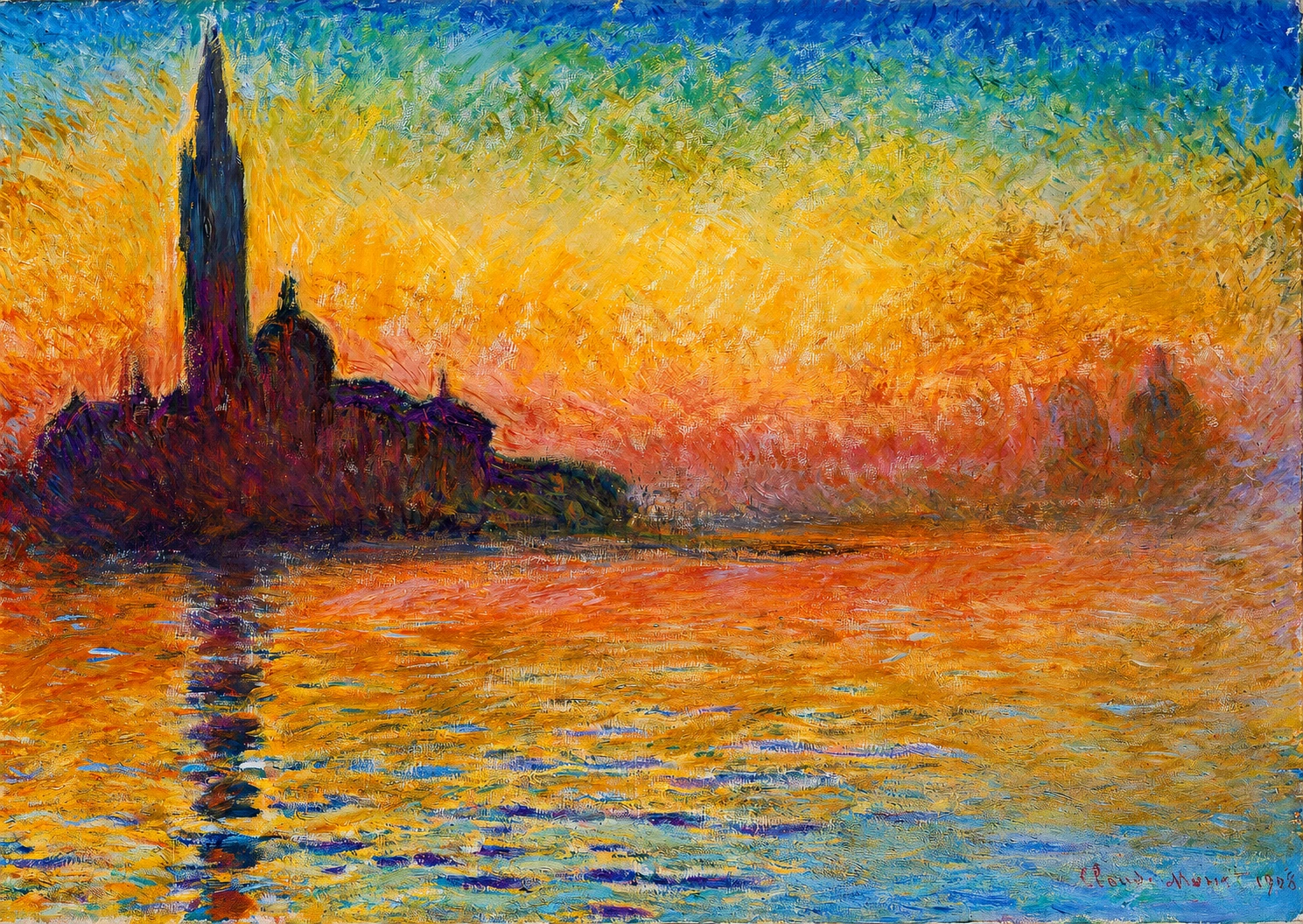
San Giorgio Maggiore at Dusk by Claude Monet
Claude Monet’s “San Giorgio Maggiore at Dusk” is one of the most atmospheric paintings from his Venetian period, created in 1908 during his stay in the city. The work shows the island church of San Giorgio Maggiore seen across the water, transformed by evening light into a glowing arrangement of color, shadow, and reflection. Rather than presenting Venice as a sharply described architectural scene, Monet turns it into a vision of dissolving forms. The church, the bell tower, the dome, the sky, and the lagoon all seem to vibrate together, as if the entire city were being absorbed into the last warmth of sunset.
The painting is built around contrast. On the left, the dark silhouette of San Giorgio Maggiore rises against a radiant sky. The tall campanile cuts upward like a deep blue and violet blade, while the lower buildings spread horizontally along the water. On the right, the city fades into mist and color, becoming less a physical place than a suggestion of atmosphere. Below, the lagoon reflects the sky in orange, gold, blue, turquoise, and violet. This balance between solid shadow and shimmering light gives the painting its emotional force. Venice appears both present and vanishing, monumental and fragile.
A Vision of Venice Through Light
Monet was not interested in recording every stone of the church or every architectural detail of the island. His true subject is light at a particular moment of the day. Dusk allows him to push color to an extraordinary intensity. The sky is not simply orange or blue. It is a layered field of yellow, rose, lavender, green, and deep ultramarine. The warm tones near the horizon suggest the fading sun, while the cooler blues at the top of the canvas create the sensation of evening settling over the city.
This use of color gives the scene a dreamlike quality. The buildings are dark, but they are not black in a flat or empty way. Their shadows contain purples, reds, blues, and browns, making them feel alive with reflected light. Monet understood that shadow is never merely the absence of light. In this painting, shadow becomes color itself. The church seems to absorb the fire of the sky and return it in cooler, deeper tones.
The water is equally important. The lagoon does not act like a mirror in a literal sense. Instead, it breaks the sky into thousands of small strokes. Orange and gold move across the surface, interrupted by flashes of blue and violet. The reflection of the bell tower stretches downward in dark, wavering marks, losing its architectural clarity as it touches the moving water. This reflected form helps connect the upper and lower halves of the composition, turning the whole painting into a rhythmic exchange between sky and lagoon.
Composition and Structure
Although the painting feels spontaneous, its composition is carefully organized. The mass of San Giorgio Maggiore sits to the left, creating a strong asymmetrical balance. The campanile dominates the vertical movement, while the horizon and water create a broad horizontal sweep. This structure gives the painting stability even as the brushwork remains loose and flickering.
The left side of the image is heavier and darker, while the right side is lighter and more open. This creates a visual journey from solidity to dissolution. The viewer’s eye begins with the recognizable church, then moves across the glowing sky and misty distance, then returns through the glittering surface of the water. The scene does not direct attention to a single fixed point. Instead, it encourages slow looking. The longer one looks, the more the colors seem to shift.
Monet’s handling of space is also important. Traditional perspective is softened. Depth is created less by precise drawing than by changes in temperature, brightness, and density. The foreground water is more active and textured, while the distant forms are hazier and less defined. The painting’s space feels believable, but it is held together by sensation rather than exact measurement.
Brushwork and Impressionist Technique
“San Giorgio Maggiore at Dusk” shows Monet’s mature Impressionist technique at a highly expressive level. The brushstrokes are visible throughout the canvas. In the sky, they move in short, restless touches that suggest vibrating air. In the water, they become more horizontal, following the movement of the lagoon. Around the church, the strokes are darker and denser, giving the silhouette weight without making it rigid.
This visible brushwork is one of the painting’s great strengths. It reminds the viewer that the image is not a polished illusion, but a painted experience. Monet allows the surface to remain alive. The texture of the canvas participates in the glow of the scene, especially in the lighter passages of the sky and water. The marks do not merely describe objects. They create the sensation of light striking the eye.
The color relationships are especially bold. Blue and orange dominate the painting, creating a complementary contrast that heightens the emotional intensity of the dusk. Purple appears throughout the shadows and reflections, binding the warm and cool areas together. The result is not naturalism in the strict academic sense, but it feels true to the experience of looking at Venice in changing light.
Mood and Meaning
The mood of the painting is both peaceful and dramatic. Venice is shown at the edge of night, when familiar forms begin to lose definition. The church remains recognizable, but it is partly swallowed by atmosphere. The sun’s glow seems to dissolve the world into color. This gives the work a meditative quality. It is not a busy city scene filled with boats and figures. It is a quiet encounter between architecture, water, and light.
There is also a sense of impermanence. Dusk is a fleeting moment. The colors will soon change, the reflection will vanish, and the silhouette will darken. Monet captures this temporary state with remarkable sensitivity. The painting is not about Venice as a permanent landmark. It is about Venice as an experience that exists for only a few minutes, shaped by weather, water, and fading light.
This is why the painting feels so modern. Monet reduces the city to relationships of color and sensation. The subject is still recognizable, yet it approaches abstraction. The church becomes a dark shape, the sky becomes a field of luminous strokes, and the water becomes a trembling surface of color. Monet’s Venice is not a tourist view. It is an optical and emotional event.
Legacy of the Painting
“San Giorgio Maggiore at Dusk” belongs to Monet’s larger interest in serial vision, the idea that the same subject can change completely depending on light, atmosphere, and time of day. Just as he painted haystacks, poplars, Rouen Cathedral, and water lilies under shifting conditions, he approached Venice as a place of constant transformation. The city’s reflective surfaces made it ideal for his late style. Stone, sky, and water could merge into one another, allowing Monet to explore the boundary between representation and pure color.
The painting remains powerful because it captures both a place and a feeling. Viewers recognize Venice, but they also feel the warmth of sunset, the coolness of approaching night, and the quiet movement of water. Monet turns a specific view into a universal image of transition. In “San Giorgio Maggiore at Dusk,” Venice becomes a city made of light, color, and memory.