Camille Monet On Her Deathbed by Claude Monet: Vibrant Color Edit
Free to Download & Reuse: You are welcome to use this image! If you republish or share it online, you must include a direct link back to this webpage for attribution.
Original Image Source: wikiart.org
A Portrait at the Edge of Impressionism
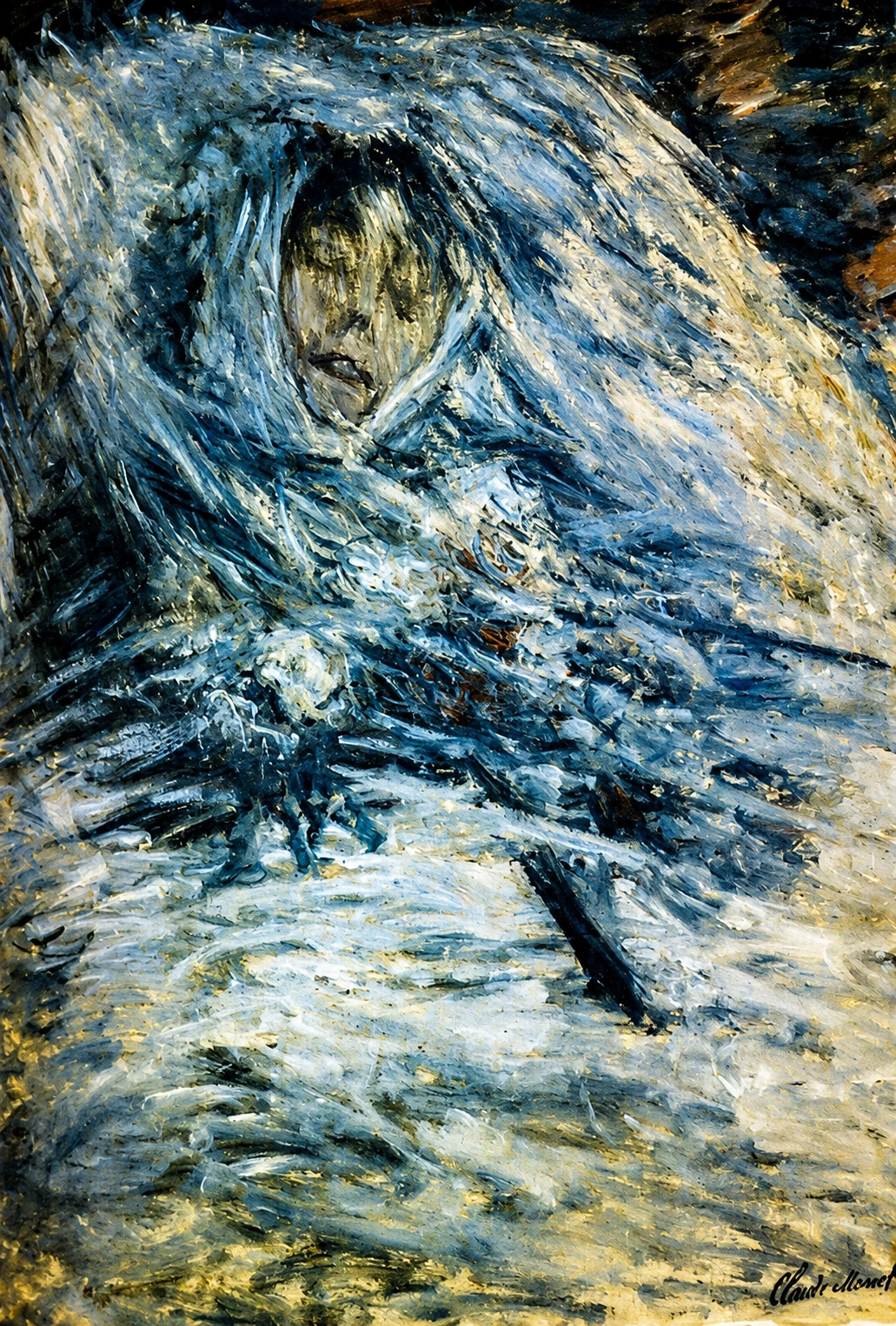
Claude Monet’s “Camille Monet On Her Deathbed,” painted in 1879, is one of the most intimate and unsettling works in the artist’s career. Known above all for luminous gardens, rivers, haystacks, and shifting effects of light, Monet is rarely associated with this kind of private, mournful subject. Yet this painting reveals that his interest in perception did not disappear in moments of grief. Instead, it became even more intense. The image shows Camille Monet, the artist’s first wife, lying in bed after her death, her face partly absorbed by pale fabric, shadow, and sweeping strokes of blue, gray, white, and green. Rather than creating a polished memorial portrait, Monet painted the experience of seeing someone loved through shock, sorrow, and unstable light.
Camille Monet and the Personal Meaning of the Painting
Camille had been central to Monet’s early life and art. She appeared in several of his paintings, sometimes as a fashionable figure in a garden, sometimes as a mother, sometimes as a quiet presence within domestic life. In those earlier works, she often belongs to the world of sunlight, fabric, movement, and modern leisure. In “Camille Monet On Her Deathbed,” that familiar presence is almost dissolved. Her identity remains visible, especially in the oval of the face, but the surrounding brushwork seems to pull her away from ordinary portraiture. The painting becomes not only an image of Camille, but also an image of Monet trying to understand absence while still looking at the person before him.
This makes the work deeply complex. It is tender, but not sentimental. It is observational, but not detached. Monet does not present Camille as an idealized figure, nor does he turn the scene into a grand historical drama. He stays close to the bed, close to the surface of the sheets, close to the fading tones of the room. The emotional power comes from this closeness. The viewer feels that the painting was made in a moment when private grief and artistic instinct could not be separated.
Color, Coldness, and the Fading of Form
The color palette is dominated by cool tones. Pale blues, silvery whites, gray greens, and dark blue blacks create an atmosphere of stillness and chill. These colors do not merely describe the bedclothes or the shadows of the room. They express the emotional temperature of the scene. Camille seems surrounded by a wave of cold light, as if the warmth of life has withdrawn and left behind only reflected color.
Monet’s use of white is especially striking. The white areas are not clean or simple. They are broken by blue, gray, beige, and green, making the sheets feel heavy, shifting, and alive with visual movement. This is one of the painting’s most haunting qualities: the brushwork remains active even though the subject is still. The restless strokes suggest the movement of the painter’s eye, not the movement of the body. Monet continues to perceive changes in tone, light, and texture, even in a scene defined by finality.
Brushwork and Emotional Instability
The brushwork in “Camille Monet On Her Deathbed” is loose, rapid, and almost turbulent. The strokes sweep across the surface in different directions, especially around Camille’s head and body. This gives the painting an unfinished, fragile quality. It does not feel carefully composed in the academic sense. Instead, it feels immediate, as though Monet painted while emotion and perception were still raw.
This technique is central to the work’s meaning. The face is present, but it is not sharply defined. The eyes, nose, and mouth emerge from thin, muted strokes, then seem to sink back into the surrounding fabric and shadow. Monet does not isolate the face from the rest of the painting. He allows it to merge with the bed, the veil-like fabric, and the surrounding atmosphere. This merging suggests the way grief can blur boundaries. The beloved person is still visible, but already slipping into memory.
Light as the True Subject
Although the painting is remembered because of its tragic subject, light remains one of its true concerns. Monet was fascinated by the way light changes everything it touches, and here that fascination becomes painfully intimate. He observes how light falls across Camille’s face and bedding, how pale tones reflect into one another, and how shadows break up solid form. The result is not a conventional deathbed portrait, but an Impressionist study of perception under emotional pressure.
This does not make the painting cold or heartless. On the contrary, its focus on light makes the grief more vivid. Monet seems unable to stop seeing as a painter, even in a moment of loss. The painting asks a difficult question: what does it mean to look carefully when the act of looking hurts? In this sense, the work is both a farewell and a record of artistic compulsion. Monet’s eye continues to search for color and light, even as his heart confronts loss.
Composition and the Weight of the Bed
The composition is close and compressed. Camille’s head appears near the upper center, framed by pale bedding that spreads outward like a shroud of brushstrokes. The lower part of the painting is filled with broad, broken marks that suggest the bed and blankets. There is little sense of surrounding space. The room does not open into a larger world. Everything is concentrated around the bed, making the viewer feel confined within the same intimate space as the painter.
This lack of distance gives the painting its emotional force. We are not looking at Camille from across a room. We are brought near, almost uncomfortably near. The image refuses the safety of a formal memorial portrait. Instead, it places us inside the immediacy of mourning, where details are partial, time feels suspended, and perception becomes fragmented.
A Different Side of Monet
“Camille Monet On Her Deathbed” is essential because it complicates the usual image of Monet. It reminds us that Impressionism was not only about pleasure, leisure, gardens, and sunlight. It was also a way of confronting reality as it appeared in the moment, even when that reality was painful. Monet’s broken brushwork, cool palette, and trembling forms make this painting one of his most personal works.
The painting does not offer comfort in a traditional way. It does not transform death into beauty through idealization. Instead, it finds visual truth in uncertainty. Camille’s face remains partly visible, partly disappearing, held between presence and absence. That fragile balance gives the painting its enduring power. It is a portrait of Camille, but also a portrait of Monet’s gaze at one of the most difficult moments of his life.