The Scream by Edvard Munch: Vibrant Color Edit
Free to Download & Reuse: You are welcome to use this image! If you republish or share it online, you must include a direct link back to this webpage for attribution.
Original Image Source: wikiart.org
The Scream by Edvard Munch: A Vision of Modern Anxiety
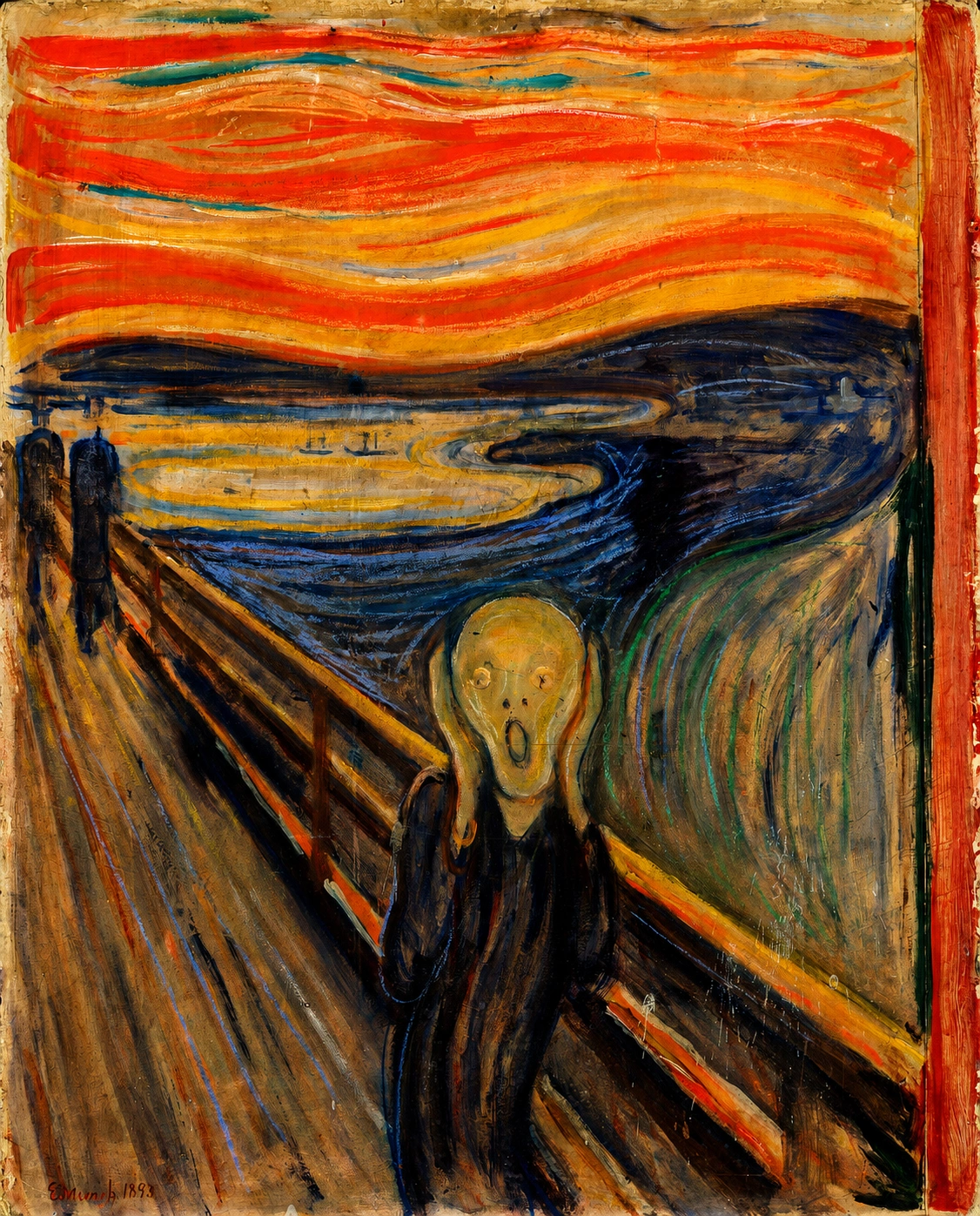
“The Scream” by Edvard Munch, painted in 1893, is one of the most recognizable images in the history of modern art. Its power comes from the way it transforms a simple scene into a psychological event. A figure stands on a bridge, hands pressed to the sides of the face, mouth opened in a cry that seems to fill the entire landscape. Behind this figure, two distant people continue walking, while the sky, water, road, and hills twist into restless waves of color. The painting is not only a depiction of fear. It is a visual expression of inner disturbance, alienation, and the terrifying intensity of human emotion.
Munch created “The Scream” during a period when many European artists were moving away from naturalistic representation and toward art that explored the inner life. Instead of painting the world as it appears to the eye, Munch painted the world as it feels to the mind under stress. The result is a work that looks both personal and universal. The figure has no clear identity, social class, age, or detailed individuality. This lack of specificity makes the image more haunting. The viewer does not simply look at someone else’s fear. The viewer is invited to recognize a state of mind that could belong to anyone.
Composition and the Force of the Bridge
The composition of “The Scream” is built around tension between depth and distortion. The bridge cuts sharply from the lower left into the middle distance, pulling the viewer’s eye toward the background. Its strong diagonal lines create a sense of rapid movement, almost as though the space itself is rushing past the central figure. This perspective gives the painting energy, but it also creates unease. The bridge should provide structure and stability, yet in Munch’s hands it becomes a path of psychological pressure.
The central figure stands close to the viewer, slightly off center, separated from the two background figures. This placement is important. The screaming figure appears isolated, even though other people are present. The two walkers in the distance seem unaware or indifferent. They continue calmly along the bridge while the foreground figure experiences a moment of overwhelming terror. Munch uses this contrast to suggest one of the painting’s deepest themes: the loneliness of suffering. Emotional crisis can feel invisible to others, even when it happens in plain sight.
The railing of the bridge intensifies this feeling. Its lines stretch backward with harsh insistence, almost trapping the figure within a narrow corridor. The bridge becomes more than a setting. It becomes a psychological space, a place where the human body is exposed, vulnerable, and unable to escape the pressure of the surrounding world.
Color as Emotional Shock
The color in “The Scream” is one of the painting’s most powerful features. Munch’s sky burns with streaks of red, orange, and yellow, creating an atmosphere that feels unnatural and explosive. These bands of color do not behave like ordinary clouds. They ripple across the top of the painting like waves of sound, fire, or emotional energy. The sky seems to echo the cry of the figure below, turning an individual scream into a cosmic event.
The contrast between the hot sky and the darker land and water below gives the painting much of its drama. Deep blues, browns, and purples form the shadowed fjord and landscape, while the bridge is filled with harsh streaks of brown, black, red, and ochre. These colors are not blended into smooth realism. They remain raw and visible, reminding the viewer of the painter’s hand and the urgency of the image.
The figure’s face is especially striking because of its pale, skull-like color. It appears almost drained of life, with hollow eyes and an open mouth. Against the fiery sky and dark surroundings, the face becomes a focal point of vulnerability. It is not painted as a beautiful or heroic face. It is fragile, simplified, and disturbing. This simplicity makes the emotion more direct.
The Human Figure and the Loss of Identity
The central figure in “The Scream” is often described as ghostly, mask-like, or skeletal. Its body curves and bends in a way that echoes the flowing lines of the landscape. The head is smooth and elongated, the eyes are round, and the mouth forms a dark oval. These features give the figure an almost inhuman quality, yet the emotion remains deeply human.
Munch avoids detailed anatomy because he is not interested in a realistic portrait. The figure represents a state of being. It is a body overwhelmed by sensation. The hands pressed against the head suggest an attempt to block out sound, fear, or inner pressure. At the same time, the open mouth suggests that the figure is releasing that pressure through a scream. The pose contains both defense and expression.
This loss of identity is central to the painting’s meaning. The figure does not appear as a confident individual standing in control of the world. Instead, it seems dissolved into the environment. The curved lines of the body mirror the waves of the sky and water, suggesting that the person and the landscape are emotionally connected. The scream is not only coming from the figure. It seems to pass through the entire scene.
Landscape as Psychological Mirror
The setting of “The Scream” is based on a view near Oslo, but Munch transforms the landscape into something visionary. The fjord, sky, hills, and bridge are recognizable, yet they do not behave like ordinary scenery. Everything bends, swirls, and vibrates. Nature becomes a mirror of mental turmoil.
This transformation is one reason the painting is so important in the development of Expressionism. Munch does not use landscape simply as background. He uses it to reveal emotion. The sky becomes anxiety. The water becomes unease. The road becomes pressure. The distance becomes isolation. Every part of the image contributes to the central mood.
The two figures in the background strengthen this psychological reading. They are upright, dark, and relatively stable compared with the distorted central figure. They belong to the everyday world, while the foreground figure belongs to a world of inner crisis. This separation gives the painting a haunting social dimension. It suggests that modern life can place people physically close to one another while leaving them emotionally distant.
Symbolism and Meaning
“The Scream” is often understood as a symbol of anxiety, existential fear, and modern alienation. Its meaning is not limited to one event or one biography. Munch gives visual form to the feeling of being overwhelmed by existence itself. The painting captures a moment when the boundary between inner emotion and outer reality collapses.
The bridge can be read as a symbol of passage, transition, or instability. The figure stands between land and water, between the city and nature, between human society and the vastness of the landscape. This in-between position adds to the feeling of vulnerability. The person is exposed on an open path, with no shelter and no clear destination.
The fiery sky may suggest sunset, but it also feels apocalyptic. Its unnatural intensity makes the world seem unstable. The painting does not show a specific disaster. Instead, it shows the emotional sensation of disaster. That is why “The Scream” remains so powerful. It does not need to explain the cause of fear. It shows what fear feels like when it consumes perception.
Why The Scream Still Matters
More than a century after its creation, “The Scream” continues to speak to viewers because it expresses feelings that remain painfully familiar. Anxiety, isolation, emotional overload, and the sense of being unheard are not limited to Munch’s time. The painting has become a modern icon because it turns private anguish into a clear, unforgettable image.
Its visual language is simple enough to be immediately recognizable, yet complex enough to support deep interpretation. The open mouth, the burning sky, the diagonal bridge, and the wavering landscape all combine into a single image of psychological intensity. Munch’s genius lies in making emotion visible without reducing it to explanation.
“The Scream” by Edvard Munch is not merely a famous painting. It is a landmark in the history of emotional art. It shows how color, line, composition, and distortion can express the invisible pressures of the mind. Its figure remains suspended forever in a moment of fear, but that fear has become a universal symbol. The painting endures because it gives shape to something difficult to say: the feeling that the world itself is crying out.