The Night Watch by Rembrandt: Vibrant Color Edit
Free to Download & Reuse: You are welcome to use this image! If you republish or share it online, you must include a direct link back to this webpage for attribution.
Original Image Source: wikiart.org
The Night Watch by Rembrandt: A Dramatic Portrait of Civic Power
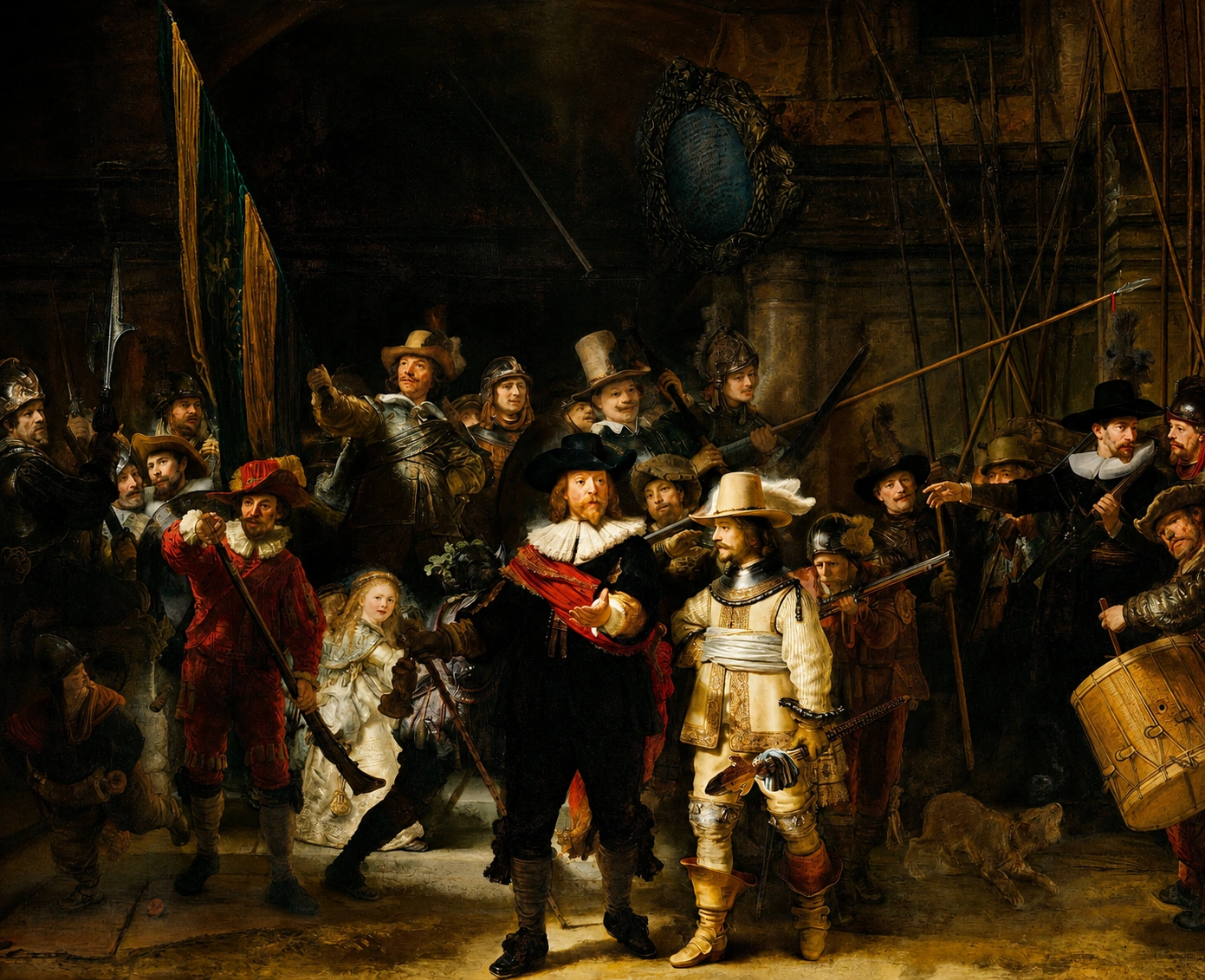
Rembrandt’s “The Night Watch,” painted in 1642, is one of the most famous works of the Dutch Golden Age and one of the most ambitious group portraits ever created. Although the painting is popularly known as “The Night Watch,” it does not actually show a night scene. The dark atmosphere came partly from age, varnish, and the painting’s dramatic use of shadow. Its fuller subject is the militia company of Captain Frans Banninck Cocq and Lieutenant Willem van Ruytenburch, a civic guard group in Amsterdam. Rather than presenting the men in a static row, Rembrandt transforms them into a living, moving force.
The painting’s greatness comes from this sense of action. Earlier Dutch militia portraits often arranged figures neatly around a table or in a formal lineup. Rembrandt broke from that tradition. He turned a group portrait into a theatrical historical moment. Men step forward, weapons rise, drums sound, banners unfurl, and light cuts through the darkness. The result is not simply a record of faces. It is a vision of civic identity, public duty, and human energy.
Composition and Movement
The composition of “The Night Watch” is organized around forward motion. Captain Frans Banninck Cocq stands near the center in black, extending his hand as if giving an order. Beside him, Lieutenant Willem van Ruytenburch appears in pale yellow and white, catching the strongest light in the painting. Their contrasting costumes create a striking visual balance. The captain’s dark clothing gives him authority and gravity, while the lieutenant’s bright attire gives the scene brilliance and movement.
Rembrandt builds the painting around diagonals rather than rigid symmetry. Spears, muskets, flags, arms, and glances point in different directions, creating a sense of organized disorder. The company seems to be assembling, not posing. This makes the viewer feel close to the action, as if the guards are about to march out of the picture space.
The figures are not all equally visible. Some faces are sharply lit, while others disappear into shadow. This uneven treatment was bold because group portrait commissions often depended on recognizable representation. Rembrandt, however, was more interested in the total drama of the image. He gives the group a collective life, even if some individuals are partly hidden.
Light, Shadow, and Theatrical Drama
Light is one of the most powerful forces in “The Night Watch.” Rembrandt uses illumination not only to reveal figures but also to guide meaning. The brightest areas fall on the lieutenant, the young girl near the left center, and selected weapons and faces. These highlights create a rhythm across the canvas, pulling the eye through the crowded scene.
The captain and lieutenant form the central command of the painting, but the mysterious girl is just as visually important. She glows with an almost supernatural brightness. Her small figure, golden hair, and pale dress stand out sharply against the surrounding darkness. She is not a normal participant in the militia action. Instead, she functions as a symbolic presence.
The girl carries signs associated with the company, including the claws of a chicken, which refer to the militia’s emblem. Her presence adds an allegorical layer to the painting. She represents the identity and spirit of the guard, turning the scene into more than a portrait of men with weapons. She becomes a living symbol of the company itself.
The Civic Guard and Dutch Identity
“The Night Watch” reflects the culture of seventeenth-century Amsterdam, a wealthy, confident, and highly organized city. Civic guard companies were important social institutions. They defended the city, participated in ceremonies, and gave prominent citizens a way to display status and public responsibility. Commissioning a large group portrait was both a personal honor and a civic statement.
Rembrandt captures this world with grandeur, but he avoids stiffness. The men are proud, armed, and richly dressed, yet they appear human and varied. Some look heroic, others distracted. Some seem ready for action, while others are caught in small gestures. This mixture of dignity and individuality is central to Rembrandt’s genius.
The painting suggests that civic power is not abstract. It is made of people, personalities, bodies, clothing, weapons, and movement. Amsterdam’s strength appears through the collective energy of its citizens. At the same time, Rembrandt reminds us that public identity is partly theatrical. The guards perform authority as much as they possess it.
Rembrandt’s Innovation in Group Portraiture
What makes “The Night Watch” revolutionary is its transformation of portraiture into narrative. Rembrandt does not simply show what the militia members looked like. He imagines them in motion, caught at a decisive instant. This gives the painting a cinematic quality centuries before cinema existed.
The captain’s gesture is especially important. His outstretched hand creates depth and command. It projects into the viewer’s space, making the scene feel immediate. The shadow of his hand even falls across the lieutenant’s bright clothing, linking the two men visually and psychologically. The captain commands, the lieutenant responds, and the company gathers around them.
This sense of timing gives the painting its emotional charge. The viewer is not looking at a finished parade but at the moment before action. The drum is being played, the banner is raised, the weapons are prepared, and the group is forming. Rembrandt finds drama in preparation rather than battle.
Color and Texture
The color palette of “The Night Watch” is dominated by deep browns, blacks, golds, reds, and warm flesh tones. These colors create a rich, shadowy atmosphere. The painting’s darkness is not empty. It is filled with texture, depth, and hidden detail. Armor gleams, fabric folds catch light, feathers soften the edges of hats, and metal weapons slice through the air.
The red sash of Captain Cocq and the golden costume of Lieutenant van Ruytenburch give the central group its visual power. These colors stand out against the darker crowd and help establish hierarchy. Rembrandt uses color to organize the scene emotionally. Warm tones create drama, while dark tones create mystery.
His brushwork also varies across the painting. Some passages are carefully described, while others are looser and more atmospheric. This helps separate the main figures from the background and gives the image a living surface. Rembrandt’s paint does not simply describe objects. It creates light, air, weight, and movement.
Misleading Title and Lasting Fame
The title “The Night Watch” has shaped how viewers understand the painting, even though it is misleading. The scene was long thought to take place at night because the painting appeared so dark. Later cleaning revealed a brighter image, closer to a daylight or interior scene with dramatic shadow. Still, the popular title remains powerful because it captures the painting’s mystery.
That mystery is part of its lasting appeal. “The Night Watch” feels both public and secretive, ceremonial and spontaneous. It shows a group of citizens, yet it has the intensity of a historical drama. The viewer can study it as a portrait, a civic image, a theatrical scene, or a symbolic composition.
The painting also became a defining image of Rembrandt himself. It shows his refusal to follow convention when a deeper artistic possibility was available. He accepted the challenge of a group commission and turned it into a masterpiece of movement, light, and human presence.
Conclusion
Rembrandt’s “The Night Watch” is more than a famous Dutch Golden Age painting. It is a bold reinvention of what a group portrait could be. Instead of arranging his subjects in orderly stillness, Rembrandt gives them action, drama, atmosphere, and symbolic meaning. Captain Cocq and Lieutenant van Ruytenburch lead the composition, but the painting’s true subject is collective energy.
Through light and shadow, Rembrandt creates a scene that feels alive. Through gesture and composition, he turns civic identity into visual theater. Through color and texture, he gives the image richness and depth. “The Night Watch” remains unforgettable because it captures not only the appearance of a militia company, but the feeling of a city in motion.