Olympia by Edouard Manet: Vibrant Color Edit
Free to Download & Reuse: You are welcome to use this image! If you republish or share it online, you must include a direct link back to this webpage for attribution.
Original Image Source: wikiart.org
Introduction
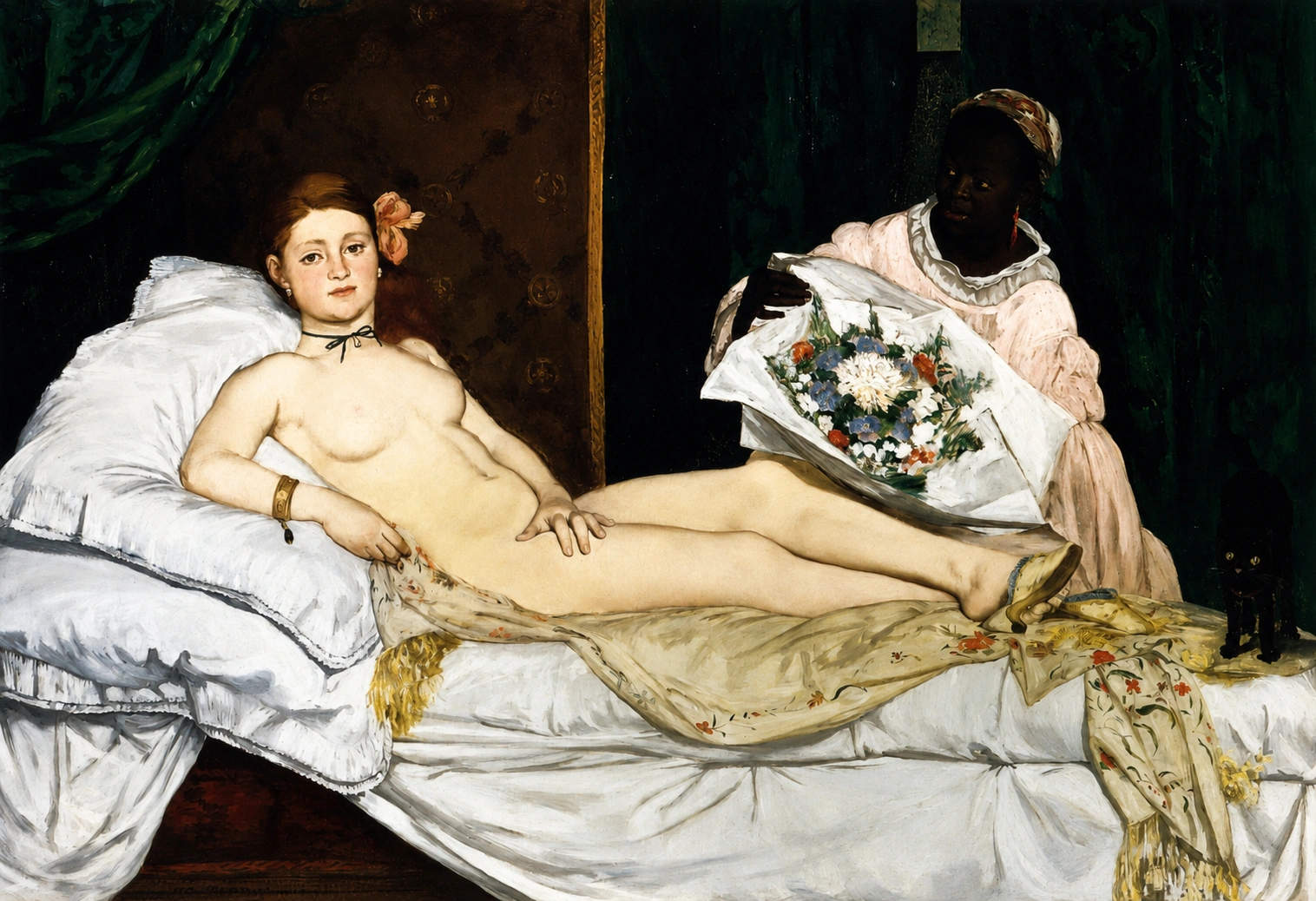
Édouard Manet’s “Olympia,” painted in 1863, is one of the most important and provocative works of nineteenth-century art. At first glance, the painting appears to follow a long European tradition of reclining female nudes, a subject that had been treated by artists such as Titian, Giorgione, and Ingres. Yet Manet transformed that familiar format into something startlingly modern. Instead of presenting an idealized mythological figure, he shows a contemporary woman who looks directly at the viewer with calm confidence. This direct gaze, combined with the plainness of the room, the visible presence of the maid, the bouquet, the black cat, and the sharp contrasts of light and dark, made “Olympia” feel less like a timeless fantasy and more like a confrontation with modern Paris.
The painting caused a scandal when it was exhibited at the Paris Salon in 1865. Viewers were not only disturbed by the subject, but also by Manet’s style. His brushwork seemed abrupt, his modeling flat, and his contrasts unusually harsh. Today, these qualities are part of what makes “Olympia” so powerful. The painting marks a turning point between academic tradition and modern art, challenging the viewer to reconsider beauty, class, gender, race, and the act of looking itself.
A Modern Reworking of the Classical Nude
“Olympia” is often compared to Titian’s “Venus of Urbino,” a Renaissance painting that also shows a reclining nude woman on a bed. Manet clearly knew this tradition, but he stripped it of its mythological softness. His figure is not Venus, a goddess removed from ordinary life. She is Olympia, a name associated in nineteenth-century Paris with courtesans and the urban world of paid intimacy. This shift from mythology to modern life is central to the painting’s impact.
The pose may come from classical art, but the atmosphere is entirely different. Olympia does not appear dreamy, passive, or distant. She is alert. Her face is sharply individualized, and her gaze is steady. She does not seem embarrassed, surprised, or unaware of being seen. Instead, she meets the viewer as if she already understands the situation. This gives the painting an unusual psychological force. Manet turns the traditional nude from an object of fantasy into a person who looks back.
The setting also removes the painting from the idealized world of old masters. The rumpled bed, pale sheets, dark background, slippers, bracelet, ribbon, and flower in her hair all belong to a specific social environment. Manet makes the scene feel contemporary, even ordinary. The result is not a smooth dream of classical beauty, but a modern image filled with social tension.
Olympia’s Gaze and the Power of Looking
One of the most striking features of “Olympia” is the woman’s gaze. She looks straight outward, directly at the viewer. This was one of the painting’s most unsettling aspects for its original audience. In many earlier nudes, the woman looks away, sleeps, or appears absorbed in herself. That distance allows the viewer to look without being challenged. Manet refuses that comfort.
Olympia’s expression is composed and controlled. Her gaze does not invite sentimentality. It also does not create the illusion that the viewer is invisible. Instead, the viewer becomes part of the scene. The painting suggests an exchange, a transaction, or at least a social relationship in which looking is not innocent. Olympia seems fully aware of being observed, and this awareness changes the meaning of the image.
Her hand placement also reinforces this sense of control. Rather than appearing relaxed in a purely decorative way, her body language feels guarded and deliberate. She occupies the bed with confidence, but she also controls how she is presented. Manet’s painting is therefore not simply about nudity. It is about visibility, power, and the uneasy relationship between the viewer and the subject.
The Role of the Maid and the Bouquet
The maid standing beside Olympia is essential to the painting’s meaning. She holds a bouquet, likely sent by a visitor or admirer. Her presence deepens the painting’s social complexity. She is not merely a background figure, but part of the structure of modern life that Manet is portraying. The bouquet suggests a world outside the room, a world of clients, gifts, money, and social performance.
The contrast between the two women is visually dramatic. Olympia’s pale body is sharply lit, while the maid’s face and figure are partly absorbed into the dark background. This contrast has often been discussed in relation to race and representation. Manet places a Black woman within the scene, but he also shows how nineteenth-century painting often used racial difference to heighten visual and social contrasts. The maid’s role reveals the unequal structures around Olympia’s world, including class, labor, and racial hierarchy.
At the same time, the maid’s gesture adds narrative tension. She brings flowers, but Olympia does not turn toward them. Her attention remains fixed on the viewer. The bouquet becomes less a romantic symbol than a sign of social exchange. It reminds us that the scene is not private in a sentimental sense. It belongs to the modern city, where intimacy, money, status, and performance are intertwined.
Color, Light, and Brushwork
Manet’s technique was as controversial as his subject. Instead of using smooth academic modeling, he built the painting with strong contrasts and visible simplification. Olympia’s body is rendered in pale tones against a very dark background. This creates a striking flatness that many Salon viewers found crude. Yet this flatness is exactly what gives the image its modern force.
The whites of the bed and pillows dominate the composition, creating a bright stage for the figure. The surrounding greens, blacks, creams, and floral accents add richness without softening the image too much. Manet does not hide the painted surface. The sheets, flowers, fabrics, and skin are not polished into illusionistic perfection. They remain visibly painted, reminding the viewer that this is a constructed image rather than a window into an ideal world.
The black cat at the foot of the bed is another important detail. In earlier art, a dog might symbolize fidelity, as in Titian’s “Venus of Urbino.” Manet replaces that symbol with a cat, alert and arched, adding a sense of tension and independence. The cat echoes Olympia’s own self-possession. It also contributes to the painting’s atmosphere of unease, making the scene feel watchful rather than serene.
Scandal and Modernity
The scandal of “Olympia” was not simply caused by the presence of a nude figure. Nudes were common in Salon painting. What shocked viewers was the way Manet removed the protective veil of mythology and ideal beauty. Olympia looked like a woman of contemporary Paris, not a goddess or allegorical figure. Her gaze was too direct, her body too plainly lit, and the social meaning of the scene too visible.
Manet forced his audience to confront the difference between accepted artistic conventions and real modern life. Academic painting often disguised desire through classical references. “Olympia” exposed that disguise. It showed that the traditional nude was not neutral, and that the viewer’s gaze carried social assumptions. This is why the painting remains so important. It does not simply reject the past. It uses the past to reveal the tensions of the present.
In this sense, “Olympia” helped open the door to modernism. Manet’s refusal to idealize his subject, his interest in contemporary life, and his bold handling of paint influenced later artists, including the Impressionists. The painting announces a new kind of art, one that does not depend on mythological distance or polished finish to be serious.
Conclusion
“Olympia” by Édouard Manet is a painting about confrontation. It confronts artistic tradition, social hypocrisy, and the viewer’s own position before the image. By adapting the classical reclining nude to the world of modern Paris, Manet created a work that was both shocking in its time and foundational for later modern art. Olympia’s direct gaze remains the center of the painting’s power. She is not presented as a distant ideal, but as a modern subject who understands that she is being seen.
The painting’s strength lies in its unresolved tensions. It is beautiful, but not conventionally graceful. It is intimate, but not sentimental. It borrows from tradition, but overturns tradition from within. Through its bold composition, sharp contrasts, and psychological directness, “Olympia” remains one of the defining images of modern painting.