Accolade by Edmund Blair Leighton: Vibrant Color Edit
Free to Download & Reuse: You are welcome to use this image! If you republish or share it online, you must include a direct link back to this webpage for attribution.
Original Image Source: wikiart.org
Introduction
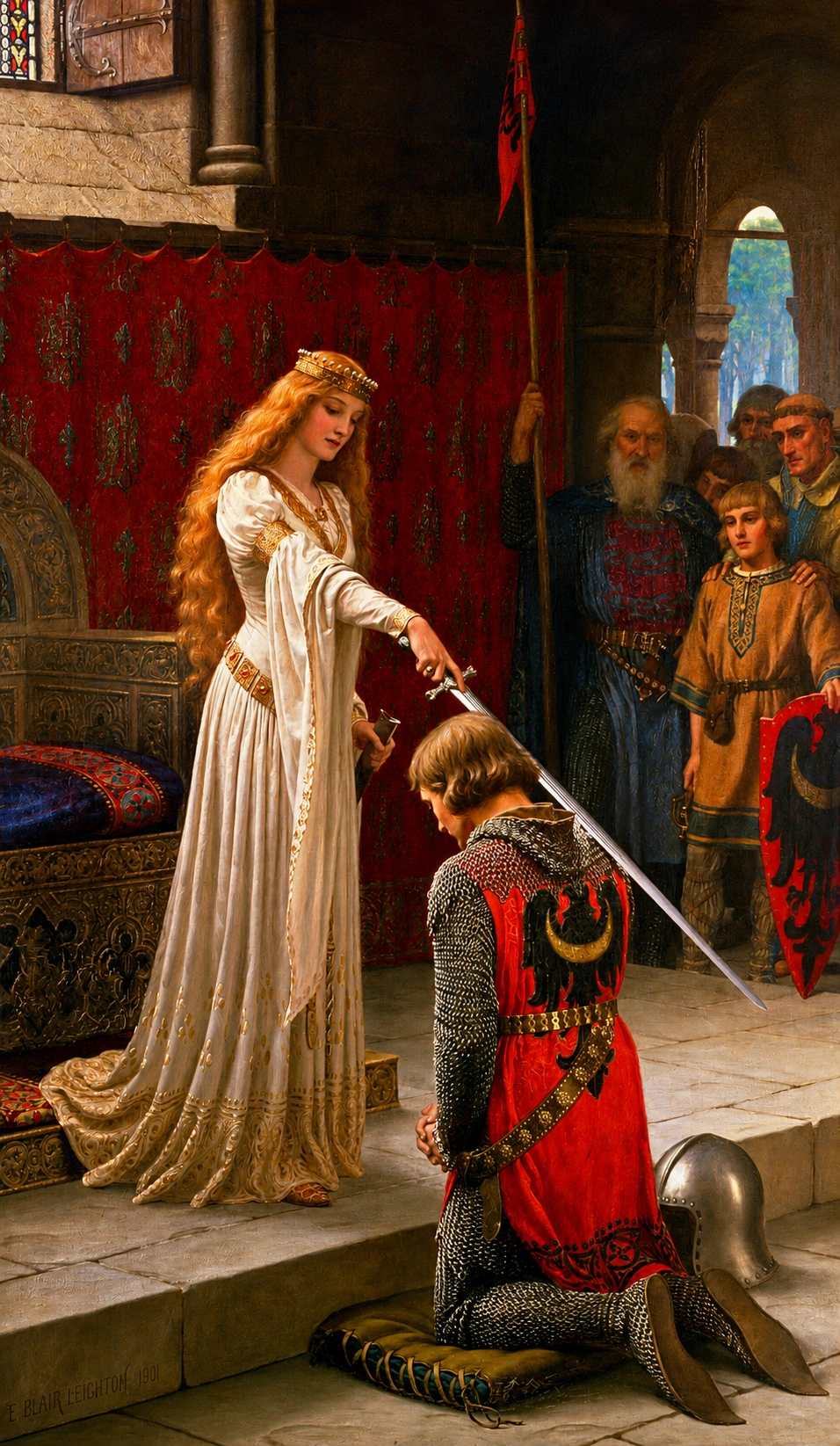
“Accolade” by Edmund Blair Leighton, painted in 1901, is one of the artist’s most recognizable images of medieval ceremony, romantic chivalry, and idealized historical beauty. The painting presents a young knight kneeling before a noblewoman or queen, who touches his shoulder with a sword in the formal act of knighthood. Around them, a small group of witnesses stands in the dim interior of a castle or chapel-like hall. The scene is theatrical, graceful, and emotionally restrained, yet it carries a powerful sense of devotion, honor, and transformation.
Leighton was known for creating richly detailed scenes inspired by the Middle Ages, especially moments of courtship, loyalty, ritual, and noble conduct. In “Accolade,” he does not show battle itself, but the symbolic moment that gives battle its moral meaning. The knight is not charging across a field or raising a weapon in victory. He is kneeling, silent, and obedient. The painting turns heroism into ceremony, suggesting that true nobility begins not with violence, but with discipline, humility, and service.
The Moment of Knighthood
The central action of “Accolade” is simple and instantly readable. A woman in a white gown places a sword upon the shoulder of a kneeling man in armor. This gesture marks the accolade, the ritual by which a warrior is made a knight. Leighton focuses on the stillness of the act, allowing the viewer to feel its solemn importance.
The knight’s bowed head is one of the most important emotional details in the painting. His posture shows reverence rather than pride. Though he wears chainmail and a vivid red surcoat decorated with a bold black eagle, he does not appear aggressive or triumphant. Instead, his body is folded downward in submission. His clasped hands and lowered gaze suggest that he understands the seriousness of the oath he is about to accept.
The woman performing the accolade stands above him with calm authority. Her expression is gentle but composed, and her movement is deliberate. She holds the sword not as a weapon of combat, but as an instrument of honor. This transformation of the sword from a tool of violence into a symbol of duty is central to the painting’s meaning.
The Noblewoman as Moral Authority
One of the most striking aspects of “Accolade” is the role given to the female figure. She is not a passive ornament in the scene. She is the person who grants the knight his status. Her white gown, golden hair, jeweled crown, and graceful pose make her appear almost otherworldly, yet her authority is clear. She occupies the higher step, commands the visual center of the painting, and controls the ritual through her gesture.
Her white dress creates an immediate association with purity, spiritual elevation, and noble virtue. The gold embroidery along the fabric adds richness without making her seem worldly or vain. She appears idealized, but not weak. Leighton presents her as the embodiment of the values the knight is meant to serve: justice, loyalty, refinement, and honor.
The relationship between the two figures is therefore not merely romantic. It is ceremonial and symbolic. The knight kneels before a woman who represents the ideal that gives his life direction. In this sense, “Accolade” reflects the Victorian fascination with chivalry as a moral code. The painting imagines the medieval past as a world where beauty, courage, and duty were joined together in visible rituals.
Color, Light, and Atmosphere
Leighton’s use of color is essential to the emotional impact of the painting. The contrast between the woman’s pale gown and the knight’s red surcoat creates a dramatic balance between purity and passion, serenity and action. The red fabric behind the woman intensifies this contrast, framing her pale figure and making her glow against the darker interior.
The lighting is soft but carefully directed. It falls most strongly on the woman’s face, hair, gown, and the knight’s armor. These illuminated areas guide the eye toward the ritual itself. The background remains darker and hazier, which gives the painting a dreamlike quality. The distant witnesses appear partially obscured, as if they belong to the shadows of history, while the main figures exist in a brighter zone of symbolic clarity.
The interior setting also contributes to the mood. Stone walls, carved furniture, patterned textiles, and arched openings create a convincing medieval atmosphere. Yet the setting is not merely decorative. The heavy architecture makes the ceremony feel ancient and permanent. The red tapestry behind the woman suggests royal or sacred importance, while the dim archway in the background adds depth and mystery.
Costume and Historical Imagination
“Accolade” is filled with details that reveal Leighton’s love of historical costume and decorative surfaces. The knight’s chainmail is painted with meticulous care, catching light in countless small links. His red surcoat, belt, sword, and helmet all contribute to the visual richness of the scene. The woman’s gown is equally elaborate, with delicate gold patterns that flow down the fabric and gather around her feet.
These details do not necessarily aim for strict archaeological accuracy. Instead, they create a persuasive fantasy of the medieval world. Leighton was less interested in documenting history than in evoking an idealized past. His Middle Ages are elegant, noble, and emotionally heightened. Every surface in the painting, from metal armor to embroidered cloth, supports the atmosphere of ceremony and refinement.
This approach helps explain why “Accolade” remains so popular. The painting satisfies a desire for beauty, order, and symbolic meaning. It presents history as a stage on which moral ideals can be seen clearly. In Leighton’s vision, the medieval past becomes a world of meaningful gestures, honorable vows, and radiant figures.
Composition and Visual Focus
The composition of “Accolade” is carefully arranged to emphasize hierarchy and ritual. The standing woman and kneeling knight form the central vertical and diagonal structure of the image. Her upright body rises like a column of light, while the knight’s bowed form creates a counter movement downward. The sword connects them physically and symbolically, forming a bright diagonal line that carries the viewer’s eye from her hand to his shoulder.
The steps are also important. They separate the noblewoman from the kneeling knight while making their interaction more dramatic. She stands on the raised platform, while he kneels below, visually expressing the transfer of authority. At the same time, the figures remain close enough to create intimacy. The ceremony feels public, but the emotional center is deeply personal.
The witnesses in the background reinforce the significance of the moment without distracting from it. Their faces and forms are softened by shadow, which keeps the viewer focused on the central pair. The shield on the right, the red banner, and the carved seat on the left all add balance and historical texture.
Meaning and Legacy
“Accolade” endures because it captures a powerful fantasy of honor at the moment it is formally recognized. The painting is not about physical conflict, but about the inner discipline expected of the knight. It shows a threshold moment, the passage from ordinary warrior to sworn servant of a higher ideal.
Leighton’s painting also speaks to the Victorian longing for a more noble and orderly past. At the beginning of the twentieth century, industrial modernity was changing society rapidly. Images like “Accolade” offered viewers a vision of stability, ritual, beauty, and moral clarity. The medieval world shown here may be imagined, but its emotional appeal is real.
The beauty of “Accolade” lies in its combination of romance and restraint. Nothing chaotic occurs, yet the scene feels momentous. A sword touches a shoulder, a head bows, a white gown catches the light, and a life is changed. Through this quiet ceremony, Edmund Blair Leighton transforms chivalry into an image of grace, duty, and timeless aspiration.