Charles IV of Spain and His Family by Francisco Goya: Vibrant Color Edit
Free to Download & Reuse: You are welcome to use this image! If you republish or share it online, you must include a direct link back to this webpage for attribution.
Original Image Source: wikiart.org
Introduction to Charles IV of Spain and His Family by Francisco Goya
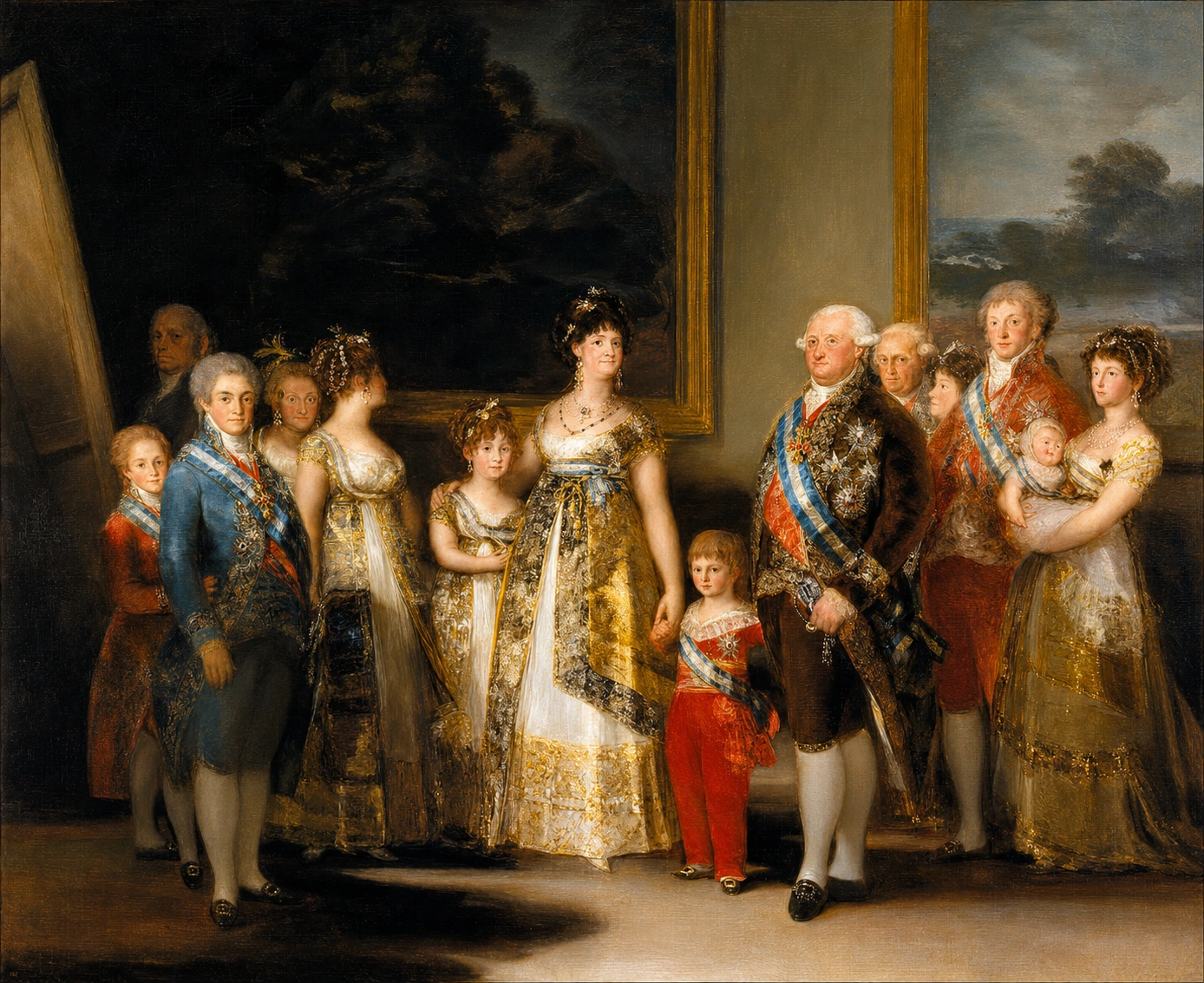
Charles IV of Spain and His Family, painted by Francisco Goya in 1800, is one of the most remarkable royal portraits in the history of Spanish art. This monumental composition presents King Charles IV of Spain surrounded by members of the Bourbon royal family, dressed in elaborate ceremonial clothing that reflects their wealth, status, and political authority. However, beneath the magnificent fabrics, glittering jewels, and formal arrangement lies a surprisingly honest portrayal of royal individuals, revealing Goya’s extraordinary ability to combine grandeur with psychological realism.
Created during a period of increasing political uncertainty in Spain, the painting offers a fascinating glimpse into the Spanish monarchy at the beginning of the nineteenth century. Rather than presenting the royal family as distant, idealized figures, Goya emphasizes their physical individuality and human characteristics. This distinctive approach has made Charles IV of Spain and His Family one of the most discussed masterpieces of European royal portraiture.
Historical Context of the Painting
Francisco Goya completed Charles IV of Spain and His Family in 1800, when he was serving as First Court Painter to the Spanish monarchy. King Charles IV had ruled Spain since 1788, inheriting a kingdom increasingly affected by the revolutionary upheavals sweeping across Europe. The French Revolution and the rise of Napoleon Bonaparte created enormous diplomatic pressures, threatening the stability of traditional European monarchies.
Although the Spanish royal family maintained an appearance of prosperity and continuity, political tensions were growing beneath the surface. Queen Maria Luisa of Parma exercised considerable influence at court, while Manuel Godoy, a powerful royal favorite, played a central role in Spanish government. These circumstances provide an important historical backdrop to Goya’s portrait, which captures the monarchy only a few years before its authority would be severely undermined.
The painting was commissioned as an official representation of the royal household, intended to celebrate dynastic unity and royal prestige. Yet Goya’s treatment of his subjects differs considerably from the flattering conventions traditionally associated with portraits of European rulers. His attention to individual faces and expressions creates a complex image in which political power and ordinary human vulnerability coexist.
Composition and Arrangement of the Royal Family
The composition of Charles IV of Spain and His Family is carefully organized around a group of figures standing together in an imposing palace interior. Rather than arranging the family in a perfectly symmetrical formation, Goya distributes the individuals across the canvas in a slightly irregular grouping. This creates a sense of natural interaction while preserving the formality expected of an official royal portrait.
Queen Maria Luisa occupies the visual center of the painting, immediately attracting attention through her luminous gown and commanding presence. King Charles IV stands slightly to her right, wearing a richly decorated dark uniform adorned with medals and colorful ceremonial sashes. Their positioning suggests an interesting balance of authority, with the queen appearing particularly prominent within the family gathering.
The children and other relatives surrounding the royal couple contribute to the painting’s dynastic significance. Some figures face the viewer directly, while others turn sideways or glance toward neighboring family members. These subtle variations prevent the composition from becoming rigid and allow each individual to retain a recognizable personality.
At the far left, Goya includes a shadowy self-portrait, standing behind the royal family near a large canvas. His discreet presence establishes a connection with the tradition of artists representing themselves within important court compositions. It also emphasizes his role as both participant and observer in the creation of royal imagery.
The Remarkable Use of Light and Color
One of the most striking features of Francisco Goya’s Charles IV of Spain and His Family is its extraordinary treatment of light. A concentrated illumination falls across the royal figures, transforming their luxurious costumes into shimmering surfaces of gold, silver, white, and deep blue. The surrounding interior remains comparatively dark, allowing the family to emerge dramatically from the background.
The queen’s magnificent gown demonstrates Goya’s exceptional ability to represent intricate materials through painterly effects. Golden embroidery, reflective ornaments, and delicate fabric textures appear almost tangible beneath the carefully distributed highlights. Rather than describing every decorative detail with mechanical precision, Goya creates an impression of brilliance through variations in color and brushwork.
King Charles IV’s dark uniform provides a powerful contrast to the lighter dresses worn by the women. His blue and red sash introduces a vibrant diagonal accent that directs attention toward his chest and ceremonial decorations. Similar colors appear throughout the composition, creating visual connections among different members of the royal household.
The warm golden tones of the clothing contrast beautifully with the muted browns and deep shadows of the palace interior. This controlled palette reinforces the distinction between the illuminated monarchy and its surrounding environment. It also demonstrates Goya’s sophisticated understanding of how color can establish hierarchy, atmosphere, and emotional intensity.
Royal Splendor and the Representation of Power
The elaborate clothing worn by the royal family plays a central role in communicating their elevated social position. Expensive textiles, embroidered gowns, precious jewels, and military decorations transform the figures into visible symbols of dynastic wealth. Every costume contributes to the impression of a monarchy deeply invested in ceremony and tradition.
Nevertheless, Goya avoids allowing these luxurious objects to completely overshadow the individuals wearing them. The faces remain surprisingly direct and recognizable, often displaying expressions that appear ordinary rather than heroic. This contrast between magnificent clothing and unidealized human appearance gives the painting much of its distinctive character.
King Charles IV presents himself with the ceremonial dignity expected of a reigning monarch, but Goya does not exaggerate his physical stature or facial features. Similarly, Queen Maria Luisa appears confident and imposing without being transformed into an idealized symbol of beauty. Their presence communicates authority through position and clothing rather than through conventional artistic perfection.
Psychological Realism and Individuality
Goya’s treatment of the royal family’s faces represents one of the painting’s greatest artistic achievements. Instead of presenting uniformly flattering expressions, he carefully distinguishes the age, appearance, and personality of each figure. The resulting portrait feels unusually intimate despite its formal and ceremonial purpose.
The children introduce a particularly interesting dimension of humanity into the composition. Their smaller bodies, youthful expressions, and varied gestures contrast with the dignified stillness of the adults. The young Francisco de Paula, standing between his parents, adds a sense of familial closeness to an otherwise imposing royal gathering.
For generations, viewers have debated whether Goya intended the portrait as a subtle criticism of the Spanish monarchy. Some interpretations emphasize the unflattering realism of certain faces, suggesting that the artist quietly exposed the vanity and limitations of royal authority. However, there is no conclusive evidence that the painting was intended as deliberate satire, and its apparent honesty can also be understood as an expression of Goya’s commitment to truthful observation.
The Influence of Diego Velázquez
Charles IV of Spain and His Family reveals the profound influence of Diego Velázquez, particularly his celebrated painting Las Meninas from 1656. Both compositions depict members of the Spanish royal household within an interior setting, and both include the artist standing beside a large canvas. These similarities establish a deliberate connection between two generations of Spanish court painters.
Like Velázquez, Goya explores the relationship between artistic representation, royal identity, and the act of observation. His inclusion of himself within the composition suggests that the painter possesses an important role in shaping how political authority is remembered. The portrait therefore becomes more than a simple record of royal appearances, offering a reflection on the relationship between art and power.
However, Goya’s approach is more direct and visually concentrated than the complex spatial arrangement of Las Meninas. The royal figures stand close to the picture plane, creating an immediate encounter with the viewer. This compressed arrangement intensifies the psychological presence of the family and reinforces the painting’s monumental character.
The Painting as a Reflection of a Changing Spain
Although Charles IV of Spain and His Family celebrates the Bourbon monarchy, its historical significance becomes particularly compelling when considered alongside the events that followed its creation. In 1808, the Spanish monarchy experienced a profound crisis as Napoleon intervened in Spanish affairs and the royal family became entangled in political upheaval. The subsequent Peninsular War transformed Spain and profoundly influenced Goya’s artistic development.
Viewed retrospectively, the portrait captures a moment of royal confidence before dramatic political change. The magnificent costumes and ceremonial decorations suggest stability, while the historical knowledge of the monarchy’s approaching crisis introduces an atmosphere of fragility. This tension gives the painting an emotional resonance that extends beyond its original function.
Goya would later produce disturbing images of warfare, violence, and human suffering, revealing a darker understanding of political authority and human behavior. Although this royal portrait belongs to an earlier phase of his career, its uncompromising observation already anticipates the psychological intensity of his later masterpieces.
Conclusion: The Enduring Importance of Goya's Royal Portrait
Francisco Goya’s Charles IV of Spain and His Family remains an extraordinary achievement because it combines the spectacular visual language of royal portraiture with an unusually direct representation of human individuality. Through his brilliant handling of light, luxurious fabrics, carefully arranged figures, and expressive faces, Goya created a painting that celebrates political authority while revealing the ordinary humanity beneath its ceremonial appearance. The result is a portrait that continues to invite questions about identity, power, and artistic truth.
Today, the painting is preserved in the Museo del Prado in Madrid, where it stands among the defining masterpieces of Spanish painting. Its historical importance extends beyond its representation of the Bourbon dynasty, offering a fascinating connection between the traditions of Velázquez and the emerging artistic sensibilities of the nineteenth century. More than two centuries after its completion, Charles IV of Spain and His Family continues to demonstrate Goya’s exceptional ability to transform an official commission into a compelling exploration of humanity and power.