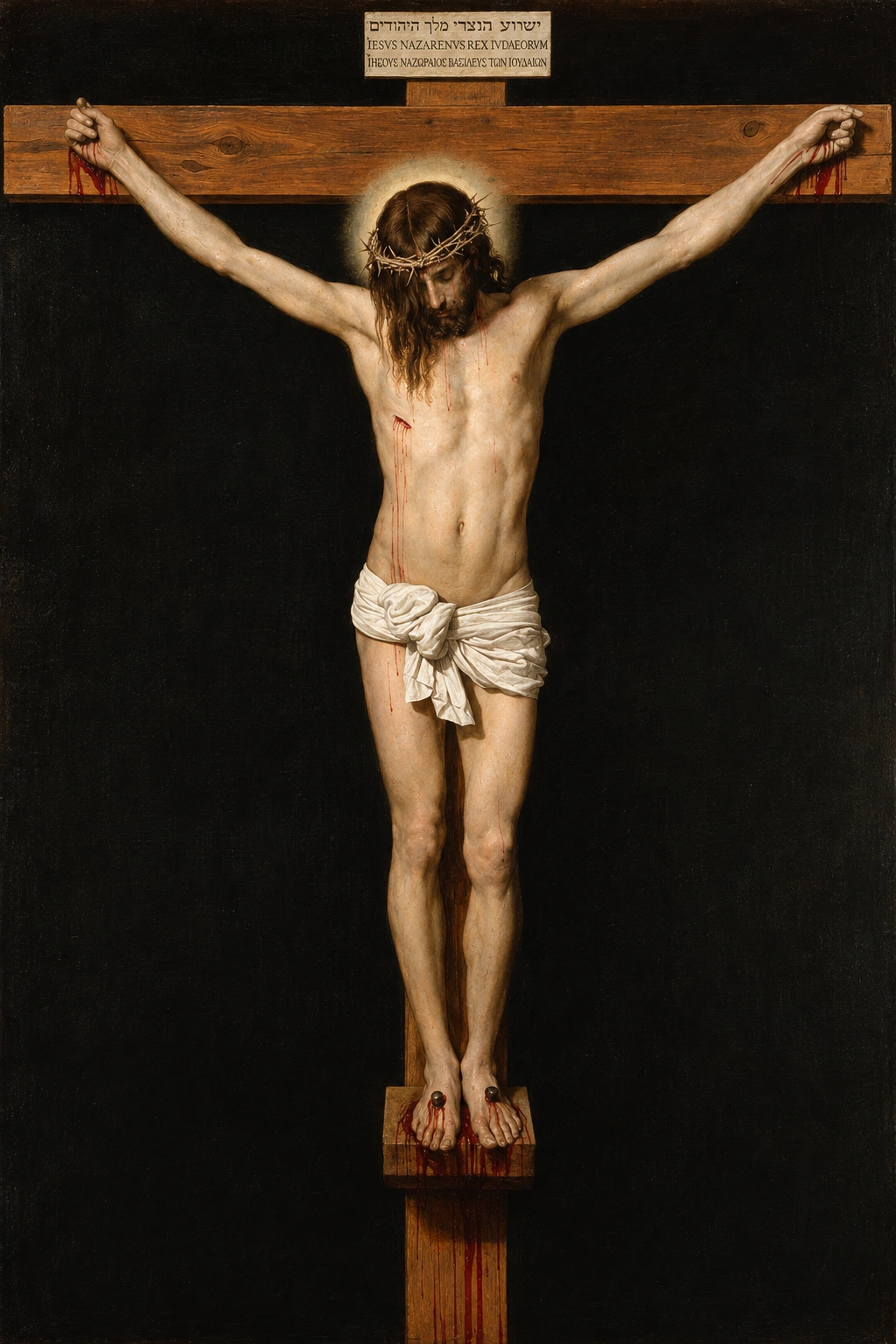
Christ on the Cross by Diego Velázquez: Vibrant Color Edit
Free to Download & Reuse: You are welcome to use this image! If you republish or share it online, you must include a direct link back to this webpage for attribution.
Original Image Source: wikiart.org
Introduction to Christ on the Cross by Diego Velázquez
Christ on the Cross, painted by Diego Velázquez in 1632, is one of the most powerful religious paintings of the Spanish Baroque period. Through its extraordinary realism, restrained emotional intensity, and masterful manipulation of light and darkness, the painting presents the crucifixion of Jesus Christ with remarkable dignity and solemnity. Rather than emphasizing the violence of the execution, Velázquez creates an atmosphere of profound silence, inviting viewers to contemplate the spiritual significance of Christ’s sacrifice.
The composition is striking in its simplicity. Christ hangs upon a wooden cross against an almost entirely black background, with no surrounding figures, landscape, or architectural elements to distract from his suffering. This deliberate isolation transforms the crucified figure into the absolute center of attention, allowing the viewer to appreciate both the physical beauty of the human body and the theological meaning of the crucifixion.
Created during the height of the Spanish Golden Age, Christ on the Cross reflects the artistic and religious ideals of seventeenth-century Spain. Velázquez combines meticulous anatomical observation with a deeply spiritual interpretation of his subject, producing an image that transcends conventional representations of the Passion. The painting remains a remarkable example of how artistic restraint can communicate an overwhelming sense of emotional and religious significance.
Historical Context and the Spanish Baroque Period
Diego Velázquez painted Christ on the Cross during a period when religious art occupied an essential position in Spanish cultural life. The Catholic Church encouraged artists to create devotional images capable of inspiring faith, encouraging meditation, and communicating the central teachings of Christianity. Religious paintings were expected to make sacred events emotionally accessible while maintaining dignity and theological clarity.
By 1632, Velázquez had established himself as a prominent painter at the Spanish royal court of Philip IV. His artistic development had been profoundly influenced by his earlier training in Seville, where naturalistic painting and carefully observed human figures were highly valued. His subsequent exposure to Italian art expanded his understanding of classical beauty, anatomical harmony, and monumental composition.
The influence of the Counter-Reformation is particularly important when examining this painting. Catholic religious imagery increasingly emphasized direct emotional engagement, encouraging viewers to develop a personal relationship with sacred subjects. In Christ on the Cross, Velázquez achieves this objective through simplicity, presenting Christ without dramatic theatricality or excessive expressions of agony.
The painting also reflects the broader characteristics of Spanish Baroque art, including strong contrasts between illumination and shadow, psychological depth, and a commitment to naturalistic representation. Nevertheless, Velázquez distinguishes himself through an unusually restrained approach that replaces dramatic movement with contemplative stillness.
Composition and the Power of Simplicity
The composition of Christ on the Cross is carefully organized around the vertical and horizontal structure of the wooden cross. Christ’s extended arms establish a broad horizontal line, while his elongated body follows the central vertical beam. These intersecting directions create a balanced arrangement that reinforces the sacred symbolism of the crucifixion.
Velázquez positions Christ almost perfectly at the center of the canvas, creating a sense of stability despite the physical suffering represented. The figure occupies most of the painting’s height, allowing the viewer to examine the carefully rendered anatomy, the folds of the white cloth, and the subtle variations of light across the body. This central placement also emphasizes Christ’s spiritual importance.
The surrounding darkness is one of the painting’s most distinctive characteristics. Unlike traditional crucifixion scenes featuring grieving figures, Roman soldiers, or the landscape of Golgotha, Velázquez eliminates nearly all narrative details. The absence of a recognizable setting gives the scene a timeless quality, suggesting that Christ’s sacrifice exists beyond any particular historical moment.
This extraordinary simplicity encourages prolonged contemplation. The viewer cannot escape the presence of the crucified figure, yet the image does not demand attention through exaggerated violence or theatrical expression. Instead, its emotional power emerges gradually through silence, balance, and an atmosphere of sacred isolation.
The Representation of Christ's Body
One of the most remarkable aspects of Christ on the Cross is Velázquez’s treatment of the human body. Christ is depicted with an idealized yet convincing anatomy, demonstrating the artist’s sophisticated understanding of muscular structure, bodily proportions, and the effects of gravity. His extended arms, slender torso, and elongated legs create a figure that appears both physically vulnerable and spiritually elevated.
The body is illuminated by a soft light that reveals subtle transitions between pale highlights and delicate shadows. Velázquez carefully models the muscles of the chest, abdomen, shoulders, and legs without exaggerating their definition. This approach produces a naturalistic representation that avoids the rigid idealization sometimes associated with earlier religious painting.
Christ’s head falls forward, partially obscured by long, dark hair. The crown of thorns rests upon his head, while faint traces of blood descend along his face and torso. These details communicate physical suffering without transforming the image into a graphic depiction of brutality.
The placement of Christ’s feet is equally significant. Each foot is secured separately to the cross, reflecting an iconographic tradition in which Christ is represented with four nails rather than three. This detail contributes to the painting’s distinctive appearance while reinforcing its relationship with Spanish devotional traditions.
Light and Darkness: The Spiritual Meaning of Chiaroscuro
Velázquez’s mastery of light is essential to the emotional impact of Christ on the Cross. The nearly black background creates an extraordinary contrast with Christ’s illuminated body, making the figure appear to emerge from an otherwise limitless darkness. This technique recalls the dramatic lighting associated with Baroque painting, although Velázquez employs it with exceptional subtlety.
The light falls gently across Christ’s shoulders, chest, abdomen, and legs, emphasizing the natural contours of his anatomy. Rather than producing harsh divisions between illuminated and shadowed areas, the artist creates gradual tonal transitions that give the body a convincing sense of volume. The resulting effect is both realistic and deeply poetic.
The contrast between light and darkness also invites a symbolic interpretation. Within Christian tradition, light frequently represents divine truth, redemption, and spiritual purity, while darkness can suggest suffering, death, and humanity’s fallen condition. Christ’s illuminated body may therefore be understood as a manifestation of divine presence within the darkness of human existence.
Importantly, Velázquez does not rely upon elaborate supernatural effects to communicate Christ’s divinity. The subtle glow surrounding his head and the luminous treatment of his skin are sufficient to establish a spiritual atmosphere. This restraint strengthens the painting’s emotional authenticity.
The Symbolism of the Cross and the White Loincloth
The wooden cross serves as both the central structural element and the principal religious symbol of the painting. Its broad horizontal beam and vertical support create a strong geometric framework that contrasts with the organic curves of Christ’s body. The visible wood grain and rough construction emphasize the physical reality of the crucifixion.
Above Christ’s head, a small inscription identifies him as Jesus of Nazareth, King of the Jews. The sign recalls the biblical account of the crucifixion and the title placed above Jesus by order of Pontius Pilate. Its inclusion provides historical and theological context within an otherwise remarkably minimal composition.
The white loincloth introduces another important visual and symbolic element. Its bright folds contrast with Christ’s pale skin and the dark background, drawing attention to the central portion of the figure. Velázquez renders the fabric with extraordinary precision, using carefully observed highlights and shadows to suggest its weight, texture, and movement.
White traditionally carries associations with purity and innocence in Christian art. Within this painting, the cloth can therefore be interpreted as reinforcing Christ’s spiritual perfection and sacrificial innocence. Its elaborate folds also provide a visual counterpoint to the smooth anatomical modeling of the body.
Emotional Restraint and the Depiction of Suffering
Unlike many Baroque crucifixion paintings, Christ on the Cross does not emphasize extreme physical agony. Although blood is visible around the wounds, Velázquez avoids excessive violence and dramatic facial expressions. Christ’s bowed head and relaxed posture suggest the solemn stillness of death rather than the immediate intensity of suffering.
This restrained approach gives the painting an extraordinary emotional depth. The viewer encounters a figure whose suffering is undeniable but whose dignity remains intact. The absence of theatrical gestures encourages a quieter emotional response based upon compassion, reverence, and reflection.
Christ’s facial features are partially concealed by his falling hair, preventing the viewer from fully interpreting his expression. This obscurity introduces a subtle psychological distance that strengthens the painting’s contemplative atmosphere. Rather than directing the viewer toward a single emotional response, Velázquez allows the image to inspire personal meditation.
The painting’s silence becomes one of its most powerful qualities. Without surrounding mourners, soldiers, or spectators, Christ appears entirely alone. His isolation reinforces the spiritual significance of sacrifice while emphasizing the intimate relationship between the sacred figure and the individual viewer.
Velázquez's Artistic Technique and Realism
The technical sophistication of Christ on the Cross demonstrates Velázquez’s exceptional ability to combine naturalistic observation with artistic idealization. His treatment of skin reveals delicate variations in color, including warm undertones, cooler shadows, and carefully controlled highlights. These subtle tonal relationships create a convincing impression of living flesh even within the stillness of death.
The artist’s brushwork is particularly effective in the rendering of the white cloth, dark hair, and wooden cross. Each material possesses a distinct visual character, allowing the viewer to recognize differences in texture without unnecessary decorative detail. This sensitivity to surface qualities reflects Velázquez’s broader commitment to the truthful representation of the visible world.
The painting also demonstrates his understanding of spatial illusion. Although the background contains virtually no recognizable depth, the careful modeling of Christ’s body creates a strong sense of three-dimensional presence. The figure appears physically suspended before the viewer, occupying a space that feels simultaneously tangible and mysterious.
Velázquez’s achievement lies in his ability to make technical perfection serve emotional and spiritual meaning. Every aspect of the painting, from its balanced composition to its delicate illumination, contributes to an atmosphere of solemn reverence.
Religious Significance and Lasting Artistic Legacy
Christ on the Cross occupies an important position within the history of Spanish religious painting. Its combination of anatomical beauty, emotional restraint, and spiritual intensity demonstrates the extraordinary possibilities of Baroque naturalism. Velázquez transforms a familiar biblical subject into an image of profound psychological and theological significance.
The painting is also notable for its influence upon later artistic and literary interpretations of the crucifixion. Its quiet atmosphere and idealized presentation of Christ have inspired generations of viewers to consider the relationship between physical suffering and spiritual transcendence. The Spanish writer Miguel de Unamuno famously responded to the painting in his poetic work El Cristo de Velázquez, published in 1920.
Ultimately, Christ on the Cross by Diego Velázquez is much more than a representation of a biblical event. It is a meditation on sacrifice, mortality, divine beauty, and the mysterious relationship between suffering and redemption. Through restrained expression, luminous realism, and profound compositional harmony, Velázquez creates an unforgettable vision of Christ that continues to inspire contemplation nearly four centuries after its creation.