Crucifixion of Saint Peter by Caravaggio: Vibrant Color Edit
Free to Download & Reuse: You are welcome to use this image! If you republish or share it online, you must include a direct link back to this webpage for attribution.
Original Image Source: wikiart.org
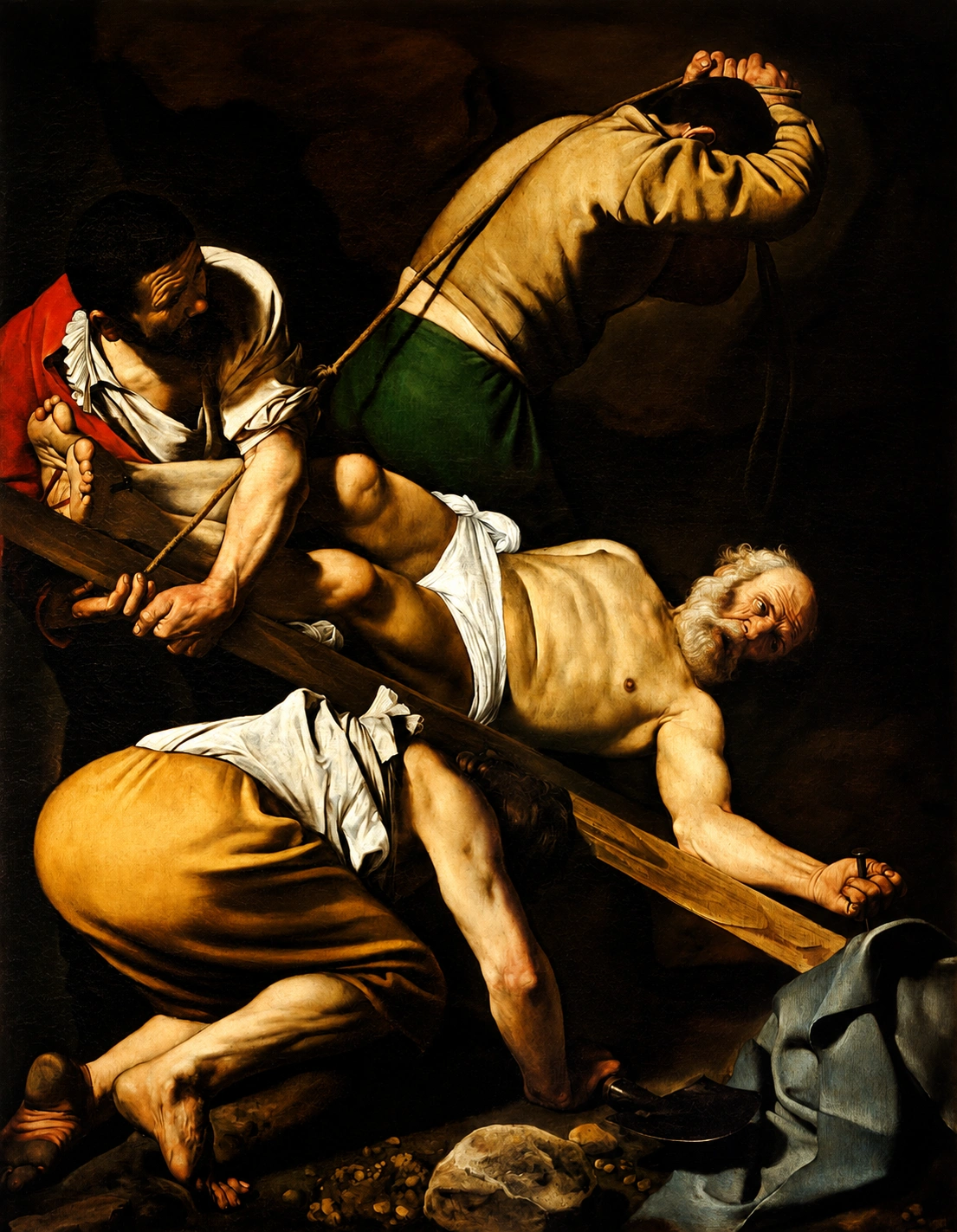
Crucifixion of Saint Peter by Caravaggio
Caravaggio’s “Crucifixion of Saint Peter,” painted in 1601, is one of the most powerful religious images of the Baroque period. Created for the Cerasi Chapel in Santa Maria del Popolo in Rome, the painting presents the martyrdom of Saint Peter with an intensity that feels immediate, physical, and deeply human. Rather than surrounding the apostle with heavenly light, angels, or grand architectural decoration, Caravaggio places the scene in a dark, cramped space where ordinary men struggle to raise a cross. The result is a painting that transforms a sacred event into an experience of weight, labor, fear, and spiritual endurance.
The subject comes from Christian tradition, which holds that Saint Peter was crucified in Rome during the reign of Emperor Nero. According to the story, Peter asked to be crucified upside down because he felt unworthy to die in the same manner as Christ. Caravaggio does not show the moment as a glorious triumph. Instead, he focuses on the awkward and difficult action of turning the cross into position. This choice makes the painting feel less like a distant legend and more like something happening directly before the viewer’s eyes.
A Composition Built on Strain and Diagonal Force
The entire painting is organized around the heavy diagonal of the wooden cross. It cuts across the canvas from the lower left toward the upper right, pulling every figure into a tense physical arrangement. Saint Peter’s body lies across this diagonal, pale and exposed against the surrounding darkness. His outstretched arm reaches toward the lower right corner, while his turned head looks outward with a mixture of pain, acceptance, and spiritual awareness.
Caravaggio avoids a balanced, symmetrical composition. The scene feels unstable because the cross is still being lifted. One man bends low at the bottom of the painting, his back turned toward the viewer as he pulls or supports the wood. Another figure on the left leans into the task, gripping the cross with visible effort. A third man at the top right pulls on a rope, his body turned away as he uses his weight to raise the structure. These figures do not appear theatrical or heroic. They are laborers performing a grim task, their faces partly hidden, their bodies defined by effort.
This emphasis on physical strain is essential to the painting’s impact. Caravaggio makes the viewer feel the heaviness of the cross, the tension of the rope, and the difficulty of the movement. The martyrdom is not presented as an abstract theological idea. It is shown as a real event involving flesh, wood, darkness, and force.
Chiaroscuro and the Drama of Light
Caravaggio’s use of chiaroscuro is one of the defining features of “Crucifixion of Saint Peter.” The background is almost completely dark, offering no clear setting and very little visual distraction. Out of this darkness, light falls sharply across Peter’s body, the workers’ clothing, and the wooden cross. The illumination does not come from a visible source, which gives it a spiritual and dramatic quality.
The light emphasizes Peter’s torso, face, arm, and legs, making him the visual and emotional center of the painting. His body appears vulnerable, yet also strangely calm when compared with the tense bodies around him. The workers are partly absorbed into shadow, suggesting that their individual identities matter less than the action they perform. They become instruments of the event, while Peter remains the figure through whom the painting’s spiritual meaning is revealed.
The contrast between darkness and light also reflects the contrast between earthly violence and divine faith. The world around Peter is shadowed, heavy, and harsh. Yet the light that touches him suggests a higher meaning beyond the visible scene. Caravaggio does not need angels or golden clouds to suggest holiness. He finds the sacred within the human body itself.
Saint Peter as an Old Man and Spiritual Witness
One of the most striking aspects of the painting is Peter’s age. Caravaggio presents him not as an idealized saint with a flawless body, but as an elderly man with a weathered face, gray beard, and exposed physical vulnerability. His body is powerful enough to remain convincing, but it is not idealized in the classical sense. The folds of his skin, the tension in his limbs, and the expression in his face all make him feel intensely real.
Peter’s gaze is especially important. He does not look upward in a conventional expression of heavenly rapture. Instead, he turns his face outward, toward the viewer’s space. This creates a direct emotional connection. The viewer is not allowed to remain detached. Peter’s expression seems to ask for recognition, reflection, and perhaps moral response. He is suffering, but he is not defeated. His face contains fear and pain, but also acceptance.
This realism makes the painting deeply moving. Peter’s sanctity is not shown through beauty or supernatural spectacle. It is shown through endurance. Caravaggio suggests that faith is not separate from bodily weakness. It exists within it.
The Ordinary Men Around the Saint
The three men raising the cross are painted with the same realism that Caravaggio gives to Peter. Their clothing is plain. Their bodies are muscular but not idealized. Their faces are partly hidden or turned away. They do not seem like monstrous villains. Instead, they appear as ordinary men absorbed in their work.
This choice makes the painting more unsettling. Caravaggio does not create a simple contrast between a holy saint and obviously evil tormentors. The men around Peter seem almost anonymous, as if they represent the machinery of human cruelty rather than individual hatred. Their focus is practical. They are concerned with lifting, pulling, and securing the cross. This ordinary quality makes the scene feel more believable and more morally complex.
The figure in the foreground, bent low with his back to the viewer, is especially important. His body occupies a large part of the lower canvas, grounding the scene in rough physical reality. By placing this figure so close to the viewer, Caravaggio brings the action into our own space. We seem to stand beside the workers, almost within reach of the cross.
Baroque Realism and Religious Intensity
“Crucifixion of Saint Peter” belongs fully to the Baroque world, where religious art often aimed to move the viewer emotionally and spiritually. Caravaggio’s approach was revolutionary because he rejected polished idealization in favor of direct human realism. He painted saints as people with weight, age, fear, and flesh. He turned sacred history into something immediate and bodily.
This realism served a religious purpose. The painting invites the viewer not only to admire Peter, but to feel the cost of faith. The darkness, the close composition, and the intense lighting all create a sense of inward pressure. There is no escape into decorative beauty. Everything is concentrated on the moment of martyrdom.
Caravaggio’s art often finds spiritual truth in uncomfortable places. Here, holiness appears not in triumphal glory, but in submission, humility, and endurance. Peter is physically lowered and inverted, yet spiritually elevated. The painting’s paradox is that humiliation becomes a form of victory.
Why the Painting Still Feels Modern
The lasting power of “Crucifixion of Saint Peter” comes from its refusal to soften the scene. Caravaggio strips away the distance between the viewer and the event. The figures are close, the space is dark, and the action is unresolved. The cross has not yet reached its final position. This unfinished movement keeps the painting alive.
The image also feels modern because of its psychological depth. Peter is not a symbol only. He is a person facing death with fear, dignity, and faith. The workers are not decorative figures. They are bodies under pressure. The darkness is not empty background. It is a force that surrounds the event and heightens its meaning.
Caravaggio’s “Crucifixion of Saint Peter” remains one of the greatest examples of religious drama in Western art. It shows martyrdom without sentimentality, faith without artificial beauty, and sanctity within the fragile reality of the human body. Through its stark composition, dramatic light, and unforgettable realism, the painting turns a sacred story into an intensely personal encounter.