Large Bathers by Paul Cezanne: Vibrant Color Edit
Free to Download & Reuse: You are welcome to use this image! If you republish or share it online, you must include a direct link back to this webpage for attribution.
Original Image Source: wikiart.org
Large Bathers by Paul Cezanne
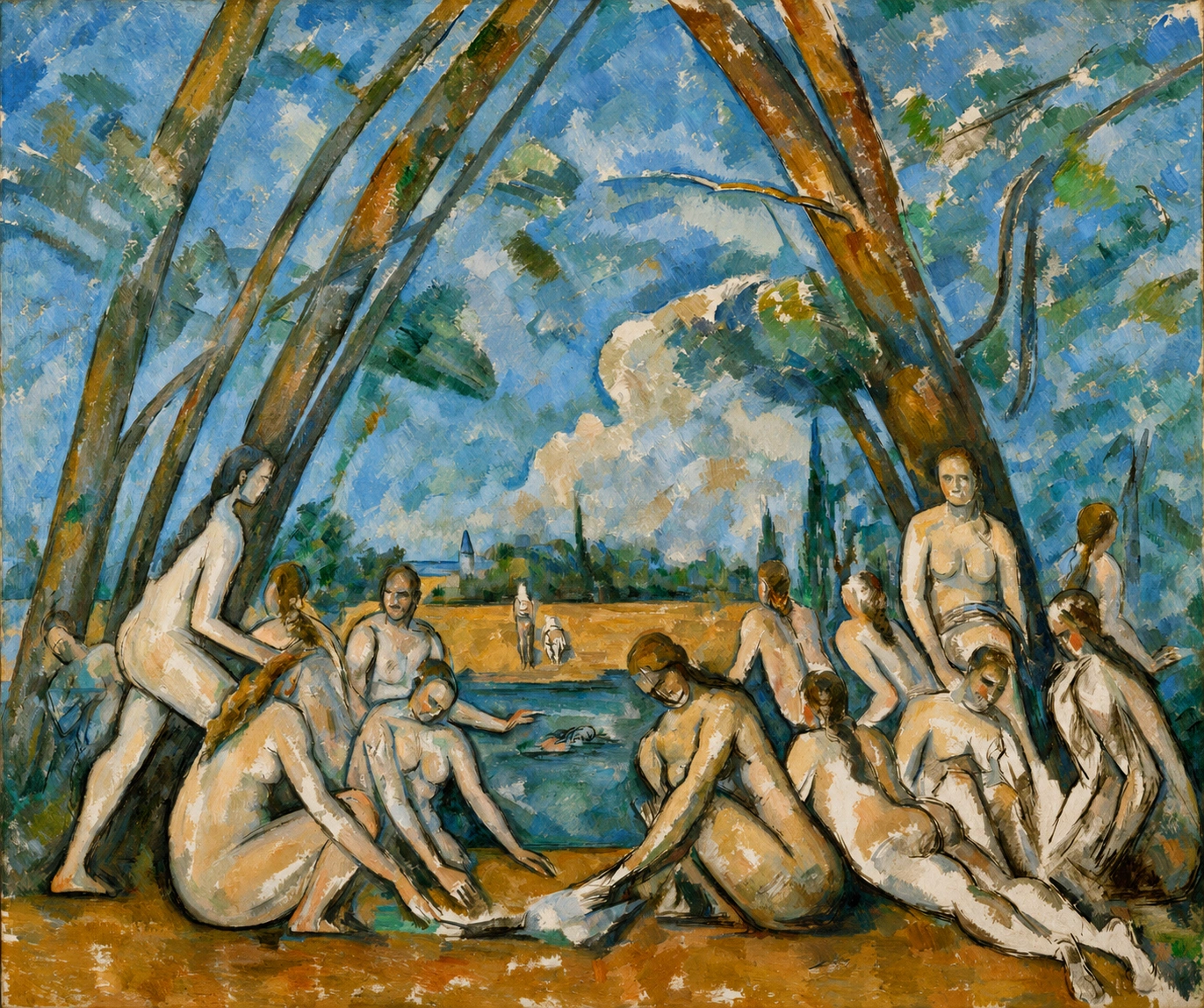
“Large Bathers” by Paul Cezanne, completed in 1906, stands among the most important paintings of the artist’s final years. It is a monumental image of human figures gathered in a landscape, yet it avoids the smooth idealism usually associated with classical bathing scenes. Instead of presenting the bathers as graceful mythological bodies, Cezanne turns them into structural forms within nature. The painting feels ancient, modern, unfinished, and complete all at once. Its power comes from the way bodies, trees, sky, water, and earth are joined into a single visual architecture.
The subject itself is traditional. Bathers had appeared throughout European art for centuries, often in scenes of Venus, Diana, nymphs, or pastoral leisure. Cezanne takes that familiar theme and strips away its narrative. There is no clear myth, no dramatic event, and no obvious story. The figures do not pose for the viewer in a conventional way. They seem absorbed into the landscape, almost as if they belong to the same natural order as the trunks, clouds, and riverbank. This makes “Large Bathers” less a scene of leisure than a meditation on form, rhythm, and the relationship between the human body and the natural world.
Composition and Structure
The first thing that gives the painting its authority is its strong triangular composition. The tall trees on both sides lean inward, creating an arch that frames the bathers below. These trunks act almost like the columns of a cathedral, turning the outdoor setting into a solemn, constructed space. The figures are arranged beneath this canopy, creating a broad base for the composition. The result is stable but not rigid. Everything seems carefully placed, yet the brushwork keeps the surface alive.
Cezanne does not organize the painting through traditional perspective alone. Instead, he builds the image through interlocking planes. The seated, crouching, and standing bodies form shapes that echo the angles of the trees. The backs, shoulders, arms, and legs create repeated curves and diagonals across the lower half of the canvas. In the distance, the water and landscape open into a lighter space, but even that background does not fully recede in a naturalistic way. It remains connected to the foreground through color and brushstroke.
This is one reason “Large Bathers” became so influential for modern art. Cezanne treats the painting as a constructed surface rather than a window into illusion. The bodies are not simply placed inside the landscape. They help build the landscape. The trees do not merely frame the figures. They become part of the same rhythm. The whole painting works like a carefully balanced arrangement of forms.
Color and Atmosphere
The color palette of “Large Bathers” is restrained but deeply expressive. Cezanne uses blues, greens, ochres, creams, and earthy browns to create a cool, luminous atmosphere. The sky and foliage are painted with broken patches of blue and green, while the ground glows with warm orange and brown tones. The figures are modeled with pale creams, muted pinks, grays, and ochres, which makes them feel both human and sculptural.
The contrast between warm and cool colors gives the painting much of its visual tension. The warm earth below anchors the bodies, while the cool blue atmosphere above gives the scene openness and depth. The figures are not separated from the landscape by hard outlines alone. They emerge through color relationships. A shadow on a body may echo a blue in the sky. A patch of ochre on the ground may reappear in the trees or skin tones. This repetition creates unity across the canvas.
Cezanne’s color does not describe light in the Impressionist sense. He is not primarily interested in a fleeting moment of sunlight. Instead, he uses color to give weight and structure to the scene. Every patch of paint seems to have a constructive purpose. Color becomes a way of building form.
The Human Figures
The bathers in this painting are intentionally simplified. Their bodies are not polished, anatomically precise figures in the academic tradition. Some faces are masklike. Some limbs are elongated or awkwardly bent. The bodies can seem heavy, angular, or unfinished. This is not a weakness in the painting. It is central to Cezanne’s vision.
By refusing conventional beauty, Cezanne makes the figures feel more elemental. They are not portraits of specific people. They are bodies as shapes, volumes, and presences. Their individuality is reduced so they can participate in the larger design of the painting. A bent back becomes a curve in the composition. A seated figure becomes a mass of warm and cool planes. A standing figure becomes a vertical echo of the trees.
There is also a sense of emotional distance. The bathers occupy the scene together, but they do not seem socially connected in a clear narrative way. They are near one another, yet each figure feels enclosed in its own quiet state. This gives the painting a dreamlike stillness. The scene is populated, but it is not lively in an ordinary sense. It feels timeless and ceremonial.
Brushwork and Surface
Cezanne’s brushwork is one of the painting’s most important features. The surface is made of visible, directional strokes that give the image a built, layered quality. Instead of hiding the process of painting, Cezanne lets the viewer see how the image has been constructed. The brushstrokes move across bodies, trees, clouds, and water with similar force, linking all parts of the painting.
This visible handling gives “Large Bathers” its modern feeling. The painting does not seek perfect finish. It retains a sense of searching. Forms appear solid in one area and dissolve in another. Edges are sometimes firm, sometimes uncertain. The result is a living surface where the act of painting remains visible.
This unfinished quality has often been seen as one of Cezanne’s great innovations. He was not trying to imitate nature in a purely realistic way. He was trying to find the underlying order within nature. In “Large Bathers,” that order is not smooth or decorative. It is tense, rough, and powerful.
Meaning and Legacy
“Large Bathers” can be understood as Cezanne’s attempt to renew the grand tradition of figure painting for the modern age. He takes a classical subject and transforms it through structure, color, and abstraction. The painting looks backward to Renaissance and classical compositions, but it also looks forward to Cubism and twentieth-century modernism.
The influence of this work is immense. Artists such as Picasso and Matisse admired Cezanne’s ability to rebuild the human figure and landscape through simplified forms. “Large Bathers” helped open the path toward a new kind of painting, one in which the arrangement of shapes could matter as much as the subject itself. It showed that a painting could be monumental without depending on historical drama, mythology, or perfect naturalism.
What makes the work so compelling is its balance between harmony and strangeness. The scene is calm, but not comfortable. The figures are grouped together, but not intimate. The landscape is beautiful, but also severe. The painting has the dignity of an ancient fresco and the restless energy of modern art.
Conclusion
“Large Bathers” by Paul Cezanne is one of the great achievements of modern painting because it transforms a familiar subject into a profound study of form, space, and perception. The bathers, trees, water, and sky are not separate elements arranged for decoration. They are parts of a larger visual structure, bound together by color, rhythm, and brushwork.
Cezanne’s 1906 painting does not offer easy beauty. Its figures are rough, its space is complex, and its surface remains visibly worked. Yet this is exactly what gives it lasting importance. “Large Bathers” captures the moment when traditional figure painting begins to change into something new. It is both a final statement and a beginning, a painting rooted in the past while pointing directly toward the future of modern art.