Philosopher in Meditation by Rembrandt: Vibrant Color Edit
Free to Download & Reuse: You are welcome to use this image! If you republish or share it online, you must include a direct link back to this webpage for attribution.
Original Image Source: wikiart.org
Introduction
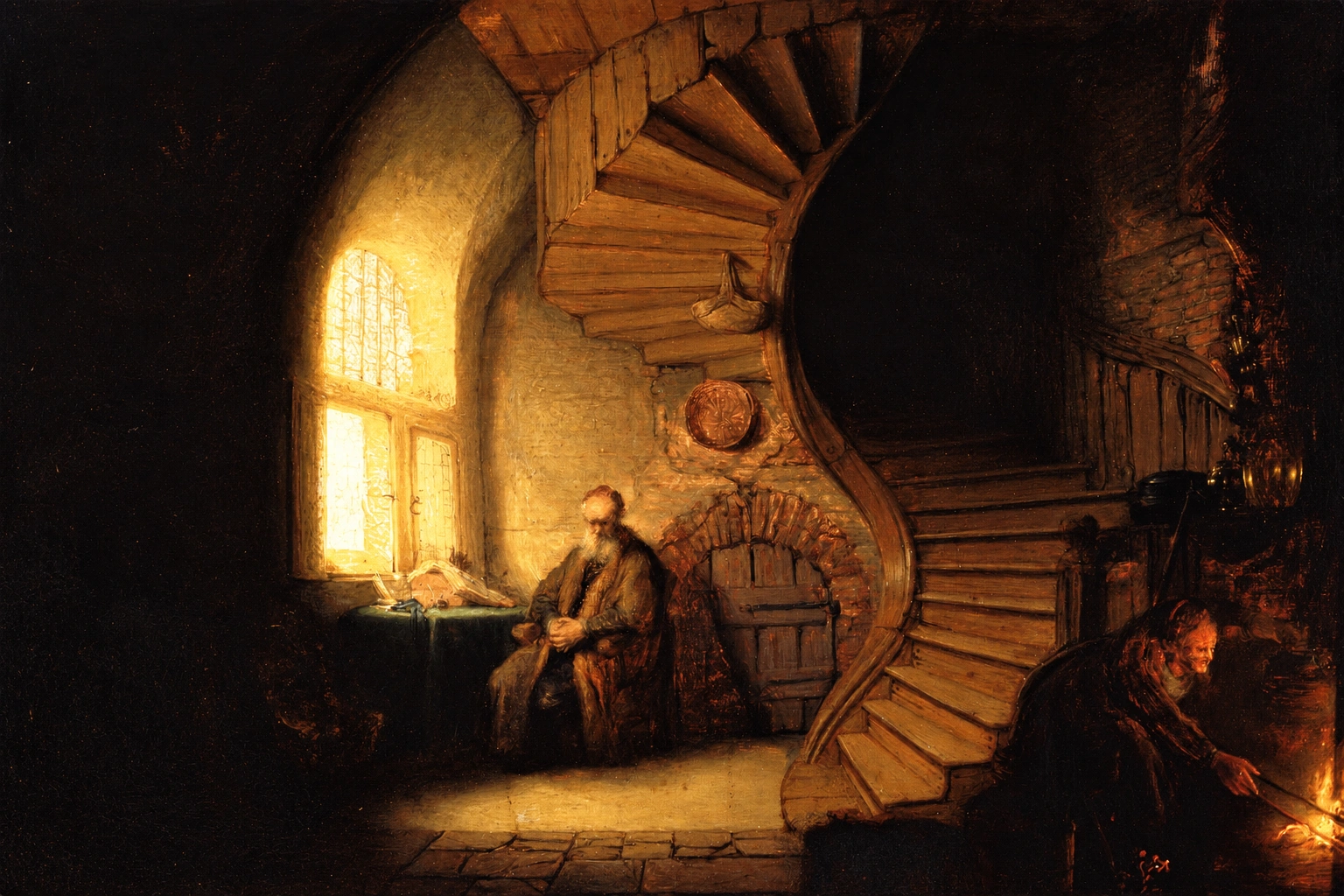
Rembrandt’s Philosopher in Meditation, painted in 1632, is one of the artist’s most atmospheric and mysterious interior scenes. Rather than presenting philosophy through books, academic symbols, or dramatic gestures, Rembrandt creates an environment in which quietness, light, architecture, and human solitude suggest the act of contemplation itself. The painting invites the viewer into a shadowy domestic space where a seated elderly man appears absorbed in thought beside a glowing window.
At first glance, the composition seems simple, yet the longer it is observed, the more complex it becomes. A monumental spiral staircase dominates the center of the room, while two small human figures occupy opposite sides of the composition. The contrast between the illuminated philosopher near the window and the darker figure near the fire transforms the interior into something almost symbolic, as though the room represents different aspects of knowledge, experience, and human existence.
The Philosopher and the Meaning of Meditation
The seated man on the left is traditionally interpreted as the philosopher referred to in the painting’s title. He sits quietly near the window with his hands resting before him, seemingly withdrawn from the physical activity taking place elsewhere in the room. His posture does not suggest sleep or distraction. Instead, Rembrandt gives him the stillness of someone whose attention has turned inward.
There is no obvious narrative explaining what he is thinking about, and that uncertainty is essential to the painting’s power. Rembrandt does not show the philosopher writing or reading, which would have provided clear evidence of intellectual activity. Instead, thought itself becomes invisible. The viewer is therefore encouraged to imagine the mental world hidden behind the philosopher’s calm exterior.
This approach makes Philosopher in Meditation feel unusually intimate. The subject is not knowledge as a public display, but thought as a private experience. Rembrandt suggests that wisdom may emerge through silence, patience, and observation rather than through spectacle.
Rembrandt's Dramatic Use of Light
Light is arguably the most important element in the painting. A warm golden glow enters through the tall window on the left, illuminating the philosopher and a small portion of the surrounding room. The rest of the interior gradually dissolves into deep brown, black, and amber shadows.
Rembrandt was famous for using strong contrasts between light and darkness, and this technique gives the scene both physical depth and emotional intensity. The window does not simply illuminate objects. It seems to create a small island of clarity within an otherwise mysterious world.
The philosopher occupies this illuminated area, strengthening the traditional association between light and knowledge. Yet Rembrandt avoids making the symbolism overly obvious. The room is not divided neatly between enlightenment and ignorance. Instead, light slowly blends into darkness, suggesting that knowledge itself may be partial and that understanding often exists alongside uncertainty.
The warm tone of the illumination is equally important. Rather than using cold daylight, Rembrandt fills the room with glowing yellows, ochres, and browns. The result creates a feeling of age, quietness, and timelessness, making the interior seem separated from the outside world.
The Spiral Staircase as the Visual Center
The enormous spiral staircase is the most distinctive feature of Philosopher in Meditation. Rising through the middle of the composition, it twists upward into darkness until its destination becomes impossible to see. Its curved structure immediately attracts the viewer’s attention and gives the painting an unusual sense of movement.
The staircase can be interpreted as more than an architectural feature. Its upward movement naturally suggests ideas of intellectual discovery, spiritual searching, and the gradual pursuit of understanding. Like philosophical thought, the staircase follows a path that turns repeatedly and eventually disappears beyond what can be clearly perceived.
Its shape also creates a striking contrast with the philosopher. The elderly man remains completely still, while the staircase appears almost to rotate visually around the center of the room. Rembrandt therefore combines physical stillness with implied movement. The philosopher’s body remains motionless, but his thoughts may be imagined as traveling somewhere beyond the visible world.
The staircase also divides the room without completely separating it. Light remains concentrated to the left, while darkness grows heavier toward the right. The twisting architecture becomes a transition between these different zones, connecting the illuminated philosopher with the mysterious shadows beyond him.
The Mysterious Figure by the Fire
On the lower right side of the painting, another figure appears beside a small fire. This person is much less clearly visible than the philosopher and seems absorbed in a practical domestic task. The orange light of the fire creates a second source of illumination, although it is much smaller and more localized than the light entering through the window.
This second figure creates an important balance within the composition. The philosopher represents stillness and contemplation, while the figure near the fire introduces labor and ordinary domestic life. Rembrandt places both forms of human activity within the same interior, suggesting a world in which intellectual reflection and everyday existence coexist.
The two sources of light also create an intriguing visual dialogue. The philosopher receives light from outside, while the figure on the right works beside a fire produced within the home. Natural illumination and human-made illumination therefore occupy opposite sides of the painting, giving the scene an additional layer of visual and symbolic complexity.
Composition and Sense of Space
Rembrandt constructs the room so that the viewer feels almost physically present inside it. The foreground remains extremely dark, creating the impression that we are standing in another shadowy part of the interior and looking toward the philosopher from a distance. This makes the scene feel private, as though we have quietly entered a moment that was never intended for an audience.
The curved staircase organizes much of the composition. Its sweeping form leads the eye upward before directing attention back toward the figures below. At the same time, the rectangular window provides a strong geometric contrast to the staircase’s curves.
Rembrandt also uses empty darkness as an active part of the composition. Large areas contain relatively little visible detail, yet these spaces are essential to the mood of the painting. Darkness becomes almost tangible, surrounding the figures and making the illuminated sections appear more precious.
Color Palette and Atmosphere
The palette of Philosopher in Meditation is restrained but remarkably expressive. Rembrandt relies primarily on deep browns, muted blacks, golden yellows, and earthy ochres. Instead of using numerous bright colors, he creates richness through subtle variations of warm tones.
The limited palette unifies the interior and enhances its sense of age. Walls, furniture, clothing, and architectural details seem to emerge from the same warm darkness. This creates the impression that everything within the room belongs to a single atmospheric environment.
Golden light around the window provides the strongest color contrast. Because the surrounding darkness is so extensive, even relatively muted yellow tones appear intensely luminous. Rembrandt demonstrates that dramatic color does not necessarily require bright pigments. Contrast itself can make restrained colors feel powerful.
Time, Age, and Human Experience
The elderly appearance of the philosopher contributes strongly to the painting’s contemplative character. Age traditionally carries associations with memory, experience, mortality, and accumulated knowledge. Rembrandt frequently explored older faces because wrinkles, shadows, and changes in expression allowed him to investigate both physical appearance and psychological depth.
Here, however, the philosopher’s individuality is less important than his state of reflection. His small scale compared with the enormous staircase and surrounding darkness emphasizes the limited physical presence of a single human being within a much larger world. The architecture seems permanent, while the philosopher appears temporary.
This contrast introduces a subtle awareness of time. The philosopher may have accumulated decades of experience, yet the darkness surrounding him remains immense. The painting consequently suggests that even a long human life can reveal only a small portion of existence.
A Painting About the Mystery of Thought
One reason Philosopher in Meditation remains so compelling is that Rembrandt refuses to explain it completely. The viewer is given a philosopher, a staircase, a window, a fire, and a mysterious domestic interior, but no definitive story connects them. Meaning emerges through atmosphere rather than narrative.
The painting can therefore be understood as a meditation on meditation itself. Just as the philosopher appears to contemplate something unseen, the viewer is encouraged to contemplate the painting without receiving a final answer. The spiral staircase reinforces this experience because the eye follows it upward only to lose it in darkness.
Rembrandt transforms an ordinary interior into a psychological landscape. Light becomes understanding, darkness becomes uncertainty, the staircase becomes a possible path toward knowledge, and the two human figures represent different forms of engagement with the world. Yet none of these interpretations completely resolves the mystery, which is precisely why the painting continues to reward extended viewing.
Conclusion
Rembrandt’s Philosopher in Meditation is a powerful example of how a seemingly quiet interior can contain profound emotional and intellectual depth. Through carefully controlled light, a restrained color palette, mysterious architecture, and the contrast between contemplation and domestic activity, Rembrandt creates a scene that feels both intimate and universal.
The philosopher’s silence becomes the emotional center of the work, while the staircase and surrounding darkness expand the painting beyond the boundaries of a simple room. Ultimately, Philosopher in Meditation does not tell viewers what the philosopher has discovered. Instead, it places them within the same atmosphere of uncertainty and reflection, encouraging them to experience contemplation for themselves.