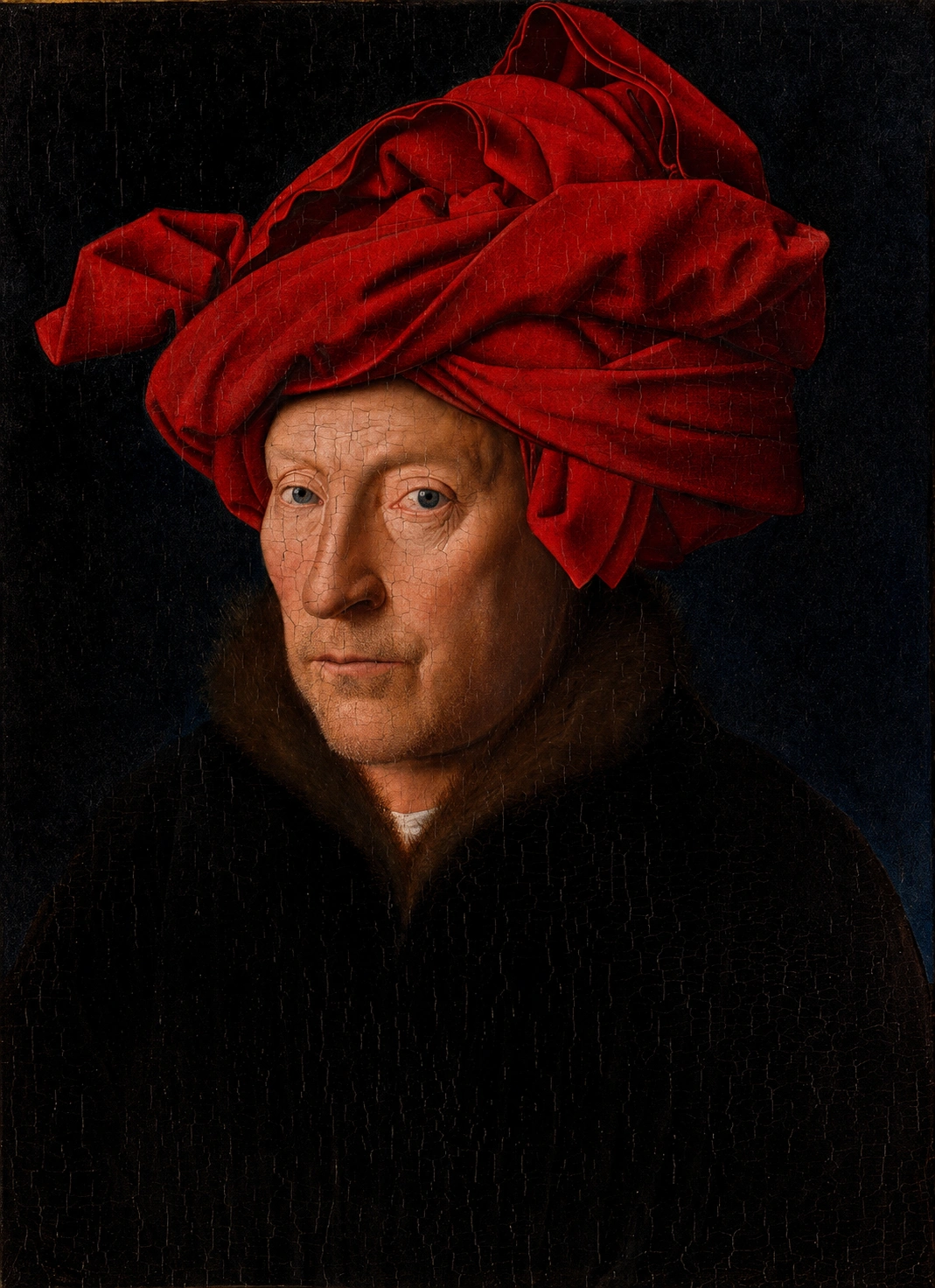
Portrait of a Man in a Red Turban by Jan van Eyck: Vibrant Color Edit
Free to Download & Reuse: You are welcome to use this image! If you republish or share it online, you must include a direct link back to this webpage for attribution.
Original Image Source: commons.wikimedia.org
Introduction
Jan van Eyck’s Portrait of a Man in a Red Turban, painted in 1433, is one of the most compelling portraits of the Northern Renaissance. The painting presents a man at close range, dressed in a dark garment and wearing an elaborate red headdress. Nothing distracts from his face. The background is almost completely black, the clothing merges into the surrounding darkness, and the vivid folds of the red fabric frame the sitter’s pale features.
Although the man’s identity has never been conclusively established, the portrait is frequently discussed as a possible self-portrait of Jan van Eyck. This interpretation remains uncertain, yet the directness of the sitter’s gaze and the painting’s unusually personal atmosphere have encouraged generations of viewers to imagine the artist studying his own reflection. Whether it represents Van Eyck himself or another individual, the work demonstrates his extraordinary ability to combine physical precision with psychological intensity.
The Man’s Direct and Unforgettable Gaze
The most striking feature of Portrait of a Man in a Red Turban is the sitter’s gaze. His eyes look directly toward the viewer, creating an immediate sense of contact. In many early fifteenth-century portraits, sitters were represented in profile or with their eyes turned away. Van Eyck instead places the man in a three-quarter position while allowing him to confront the viewer openly.
His expression is controlled and serious. He does not smile, but he does not appear hostile. His narrow lips, slightly lowered eyelids, and steady gaze suggest concentration. The face seems alert, as though the man is carefully observing whoever stands before him. This quality makes the portrait feel less like a fixed image and more like an encounter between two people.
The asymmetry of the eyes strengthens the sense of realism. They are not presented as idealized or perfectly balanced forms. Each eye has its own shape, shadow, and degree of openness. These subtle irregularities give the sitter a convincing human presence.
The Possibility of a Self-Portrait
The painting is often identified as a possible self-portrait because of its direct gaze and intimate presentation. An artist working from a mirror would naturally appear to look outward at the viewer. The close framing may also reflect the limited view available through a mirror.
If this interpretation is correct, the painting offers a rare vision of Jan van Eyck as he saw himself. Rather than presenting an idealized image of artistic genius, he would have recorded the signs of age and experience with remarkable honesty. The sitter’s skin is uneven, his eyes are slightly reddened, and fine lines appear across his forehead and around his mouth.
The painting’s original frame also contains the inscription “Als Ich Can,” usually translated as “As I can” or “As best I can.” This phrase was Van Eyck’s personal motto and appears on several works associated with him. Its presence gives the portrait an additional sense of artistic identity and personal authorship, even though it does not prove that the sitter is Van Eyck himself.
The Brilliant Red Turban
The red headdress dominates the upper portion of the composition. Despite the painting’s traditional title, the fabric is probably not a turban in the modern sense. It is more accurately understood as a chaperon, a fashionable form of medieval headwear created by wrapping and arranging a long piece of cloth.
Van Eyck transforms this garment into a spectacular display of color, texture, and structure. The folds twist across one another, forming deep shadows and sharply defined ridges. Some sections of the cloth project outward, while others curve around the head in broad, sculptural masses. The headdress almost appears to have a life of its own.
The intense red creates a dramatic contrast with the black background and the sitter’s dark clothing. It draws attention toward the head while also framing the face. The red is not flat or uniform. Van Eyck uses variations of crimson, scarlet, burgundy, and near-black shadow to suggest the weight and thickness of the material.
The complicated arrangement of the fabric may also demonstrate the artist’s skill. Painting such folds required careful observation and technical control. The headdress therefore functions both as clothing and as a visual declaration of Van Eyck’s mastery.
Extraordinary Realism and Surface Detail
Jan van Eyck was celebrated for his ability to describe the visible world with astonishing precision. In this portrait, he records tiny details that many artists might have softened or ignored. The sitter’s wrinkles, pores, facial hairs, and uneven skin tones are all visible.
The face is not idealized according to classical standards of beauty. The nose is long and prominent, the lips are thin, and the skin shows signs of age. Yet these details are never treated cruelly. Van Eyck’s realism gives dignity to individuality. The man becomes memorable because his appearance is so specific.
Fine highlights along the eyelids and pupils make the eyes appear moist and alive. Delicate transitions of light across the cheeks create the impression of solid flesh. Subtle shadows around the mouth and beneath the nose give the face depth without relying on harsh outlines.
The painting’s visible network of age-related cracks does not belong to Van Eyck’s original design, but it now adds another layer of historical presence. Beneath these cracks, the careful modelling of the face and headdress remains remarkably powerful.
Light, Darkness, and Three-Dimensional Form
The portrait’s lighting is controlled and concentrated. Light falls across the man’s face from the left side of the composition, illuminating his forehead, nose, cheeks, and chin. The opposite side remains darker, creating a strong sense of volume.
The black background removes any suggestion of a specific room or landscape. Without furniture, architecture, or symbolic objects, the viewer must concentrate entirely on the sitter. His face and headdress appear to emerge from the darkness.
The dark garment contributes to this effect. Its broad shape is visible, but most of its surface remains subdued. The clothing anchors the composition while preventing the lower half of the painting from competing with the face. This contrast between darkness and illumination creates a visual hierarchy in which the sitter’s eyes become the emotional center.
Van Eyck’s Oil Painting Technique
Van Eyck did not invent oil painting, but he played an important role in developing its expressive possibilities. By applying thin, translucent layers of oil paint, he could build subtle colors, luminous skin tones, and delicate transitions between light and shadow.
This technique is especially effective in the face. The skin seems to contain several layers of color rather than a single painted surface. Warm reddish tones appear beneath cooler highlights, creating the impression of living flesh. The shadows remain transparent enough to preserve depth and luminosity.
The red fabric also benefits from this method. Glazes deepen the shadows without making the folds appear heavy or dull. Highlights placed over darker layers create sharp edges and rich variations in texture. The result combines visual precision with a jewel-like intensity.
Psychological Depth and Human Presence
The portrait’s realism extends beyond physical appearance. Van Eyck creates the impression of an active mind behind the sitter’s face. The man appears thoughtful, disciplined, and observant. His expression does not reveal a specific emotion, but it invites interpretation.
There is also a tension between openness and reserve. The sitter looks directly at the viewer, yet he reveals little about himself. His identity, thoughts, profession, and social position remain uncertain. This mystery gives the portrait much of its lasting fascination.
The close viewpoint intensifies this psychological effect. The man occupies nearly the entire composition, leaving little distance between himself and the viewer. His presence feels immediate, but his personality cannot be easily defined. Van Eyck records the visible surface with great clarity while preserving the sitter’s inner privacy.
The Portrait’s Importance in Renaissance Art
Portrait of a Man in a Red Turban represents an important stage in the development of European portraiture. Van Eyck shows that a portrait could be more than a record of rank, wealth, or social identity. It could become a profound investigation of individual presence.
The painting’s dark background, close framing, three-quarter pose, and direct gaze influenced later portrait traditions. These elements allowed artists to create a stronger relationship between sitter and viewer. Rather than appearing as a distant symbol of authority, the individual could seem physically and psychologically present.
Van Eyck’s combination of technical brilliance and honest observation helped establish a new standard for portrait painting. His sitter is not transformed into an ideal figure. He remains particular, imperfect, and unmistakably human.
Conclusion
Jan van Eyck’s Portrait of a Man in a Red Turban is a masterpiece of observation, technique, and psychological insight. Its composition is simple, yet every detail contributes to its intensity. The dark setting isolates the sitter, the brilliant red headdress commands attention, and the direct gaze creates an unforgettable encounter.
Whether the painting is truly a self-portrait remains uncertain. Its power does not depend on solving that mystery. The work endures because Van Eyck presents an individual with extraordinary honesty while allowing his inner life to remain elusive. The sitter appears close enough to touch, yet he remains separated from the viewer by centuries of unanswered questions.