The Blue Boy by Thomas Gainsborough: Vibrant Color Edit
Free to Download & Reuse: You are welcome to use this image! If you republish or share it online, you must include a direct link back to this webpage for attribution.
Original Image Source: wikiart.org
A Complete Analysis of “The Blue Boy” by Thomas Gainsborough
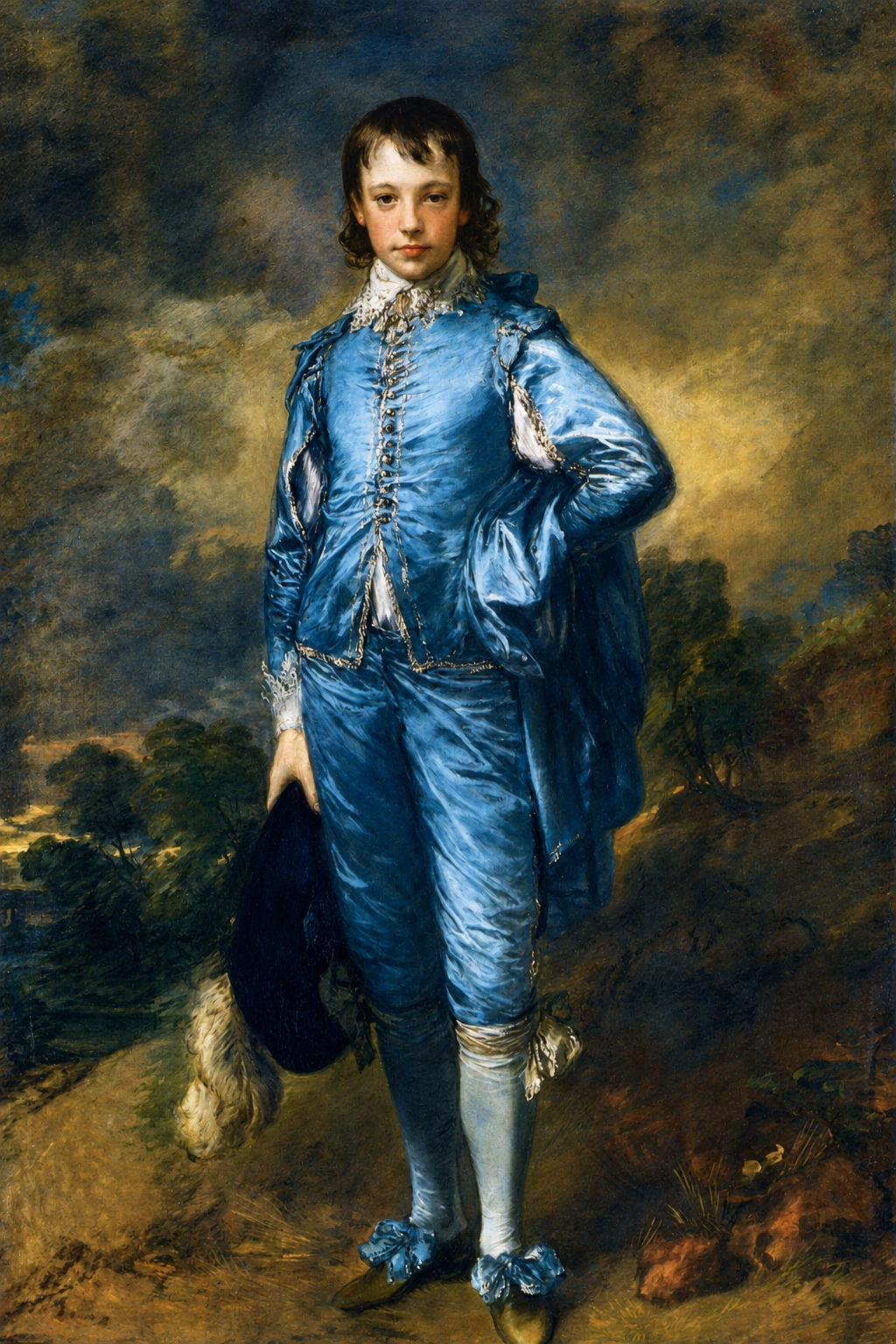
Thomas Gainsborough’s “The Blue Boy,” painted around 1770, is one of the most recognizable portraits in British art. The painting presents a young boy standing confidently in a shimmering blue satin costume, set against a dramatic landscape of dark clouds, trees, and glowing distance. Although the sitter is traditionally identified as Jonathan Buttall, the son of a wealthy hardware merchant, the painting has grown far beyond the identity of its subject. It has become an image of elegance, youth, aristocratic performance, and painterly brilliance.
At first glance, the portrait seems simple: a boy in blue, standing in a landscape. Yet its power comes from the tension between natural youth and theatrical display. Gainsborough does not show the boy in ordinary eighteenth-century clothing. Instead, he dresses him in a costume inspired by seventeenth-century court fashion, especially the style associated with Anthony van Dyck. This historical costume gives the portrait a romantic and nostalgic quality. The boy appears not merely as a child of Gainsborough’s own time, but as a figure who belongs to a broader dream of aristocratic refinement.
The Pose and Presence of the Sitter
The boy stands with one hand on his hip and the other holding a large dark hat decorated with feathers. His posture is assured, almost adult, yet his youthful face keeps the portrait from becoming stiff or overly formal. This contrast is central to the painting’s charm. Gainsborough gives the sitter the dignity of a nobleman, but also preserves the softness and vulnerability of childhood.
The direct gaze is especially important. The boy looks outward with calm self-possession, as though fully aware of being observed. His expression is neither smiling nor severe. It carries a slight reserve, a quiet confidence that makes him feel alive rather than simply posed. Gainsborough avoids turning him into a decorative figure. Even in costume, he has psychological presence.
The full-length format also increases the portrait’s grandeur. Full-length portraits were often associated with status, wealth, and public identity. By placing a young boy in this format, Gainsborough elevates him into a figure of importance. The portrait becomes a statement about family aspiration, social identity, and the performance of gentility.
The Brilliance of the Blue Costume
The most memorable feature of the painting is the blue costume. Gainsborough uses the satin fabric as a display of technical skill, turning the clothing into a field of light, texture, and movement. The blue is not flat or uniform. It shifts from pale silver-blue highlights to deep shadowed tones, creating a surface that seems to shimmer as the eye moves across it.
The costume also gives the painting its visual unity. The jacket, breeches, cape, stockings, and ribbons all participate in the same blue harmony. This creates a striking contrast with the dark, earthy landscape behind him. The boy almost appears illuminated from within, his clothing catching and reflecting light in a way that separates him from the surrounding world.
The blue is elegant but not artificial. Gainsborough’s brushwork keeps the fabric lively and fluid. The folds are suggested with loose, confident strokes rather than hard outlines. This gives the costume a sense of movement, as though the boy has just paused briefly before continuing forward. The painting’s beauty depends not only on color, but on the visible energy of the paint itself.
Van Dyck’s Influence and the Language of Aristocracy
“The Blue Boy” is often discussed in relation to Anthony van Dyck, the Flemish painter who became famous for his portraits of the English aristocracy in the seventeenth century. Gainsborough admired Van Dyck’s elegance, elongated figures, graceful poses, and refined sense of costume. In “The Blue Boy,” this influence is unmistakable.
The historical clothing is not simply fancy dress. It connects the boy to an older tradition of aristocratic portraiture. By borrowing from Van Dyck’s visual language, Gainsborough gives Jonathan Buttall an aura of inherited nobility, even though the sitter came from a prosperous commercial family rather than the highest aristocracy. This makes the painting especially interesting as a social image. It reflects a world in which wealth, taste, and cultural performance could help construct status.
The portrait also shows Gainsborough’s confidence as a rival to earlier masters. He does not merely imitate Van Dyck. He transforms the old style through his own lighter touch, his sensitivity to color, and his more atmospheric handling of landscape. The result is both a tribute and a declaration of artistic independence.
Landscape, Atmosphere, and Mood
The background plays a major role in the painting’s emotional effect. Behind the bright figure is a stormy, shadowed landscape, with dark trees, rolling ground, and a dramatic sky. The landscape is not described in precise detail. Instead, it creates mood. Gainsborough was also a gifted landscape painter, and here he uses the setting to deepen the portrait’s drama.
The cloudy sky gives the image a romantic atmosphere. It makes the boy seem almost heroic, as though he stands at the edge of a larger world. The distant glow on the horizon adds warmth and depth, preventing the darkness from becoming oppressive. This contrast between the luminous costume and the brooding background gives the painting much of its visual drama.
The landscape also helps prevent the portrait from feeling purely decorative. The boy is not placed in a neutral studio setting. He exists within nature, surrounded by movement, shadow, and air. This gives the portrait a poetic quality. It suggests that youth itself is temporary, bright, and delicate against the larger forces of time and nature.
Brushwork and Painterly Freedom
One of the greatest pleasures of “The Blue Boy” is Gainsborough’s brushwork. The painting is elegant, but it is not rigid. The costume, hair, lace, feathers, and background are all handled with a lively freedom. Up close, many details are built from loose strokes and flickers of paint. From a distance, these strokes resolve into satin, lace, skin, and landscape.
This painterly quality gives the portrait freshness. Gainsborough’s art depends on suggestion as much as description. He does not need to define every thread of fabric or every leaf in the trees. Instead, he creates the impression of richness through movement and contrast. The viewer experiences the painting as both an image and a performance of artistic skill.
The face is more carefully controlled than the costume or background, which helps focus attention on the sitter’s identity. The softness of the cheeks, the delicate mouth, and the calm eyes all stand out against the more energetic treatment of the clothing and setting. Gainsborough balances refinement with spontaneity, creating a portrait that feels formal yet alive.
Why “The Blue Boy” Remains Famous
“The Blue Boy” remains famous because it combines immediate visual appeal with historical complexity. Its blue costume is unforgettable, its pose is elegant, and its mood is romantic. Yet beneath that beauty lies a sophisticated meditation on status, identity, youth, and artistic tradition.
The painting also captures the theatrical nature of portraiture. Jonathan Buttall is not shown as he would have appeared in everyday life. He is transformed into an idealized figure, dressed in the language of aristocratic memory. Gainsborough uses costume, pose, color, and landscape to create a fantasy of refinement. At the same time, the boy’s face keeps the image human. He is both a symbol and a person.
This balance is what gives “The Blue Boy” its lasting power. It is grand without being cold, decorative without being empty, and nostalgic without feeling lifeless. Gainsborough turns a commissioned portrait into an image of enduring beauty. The painting celebrates the brilliance of blue satin, the grace of youth, and the ability of art to turn social performance into poetry.