The Card Players by Paul Cézanne: Vibrant Color Edit
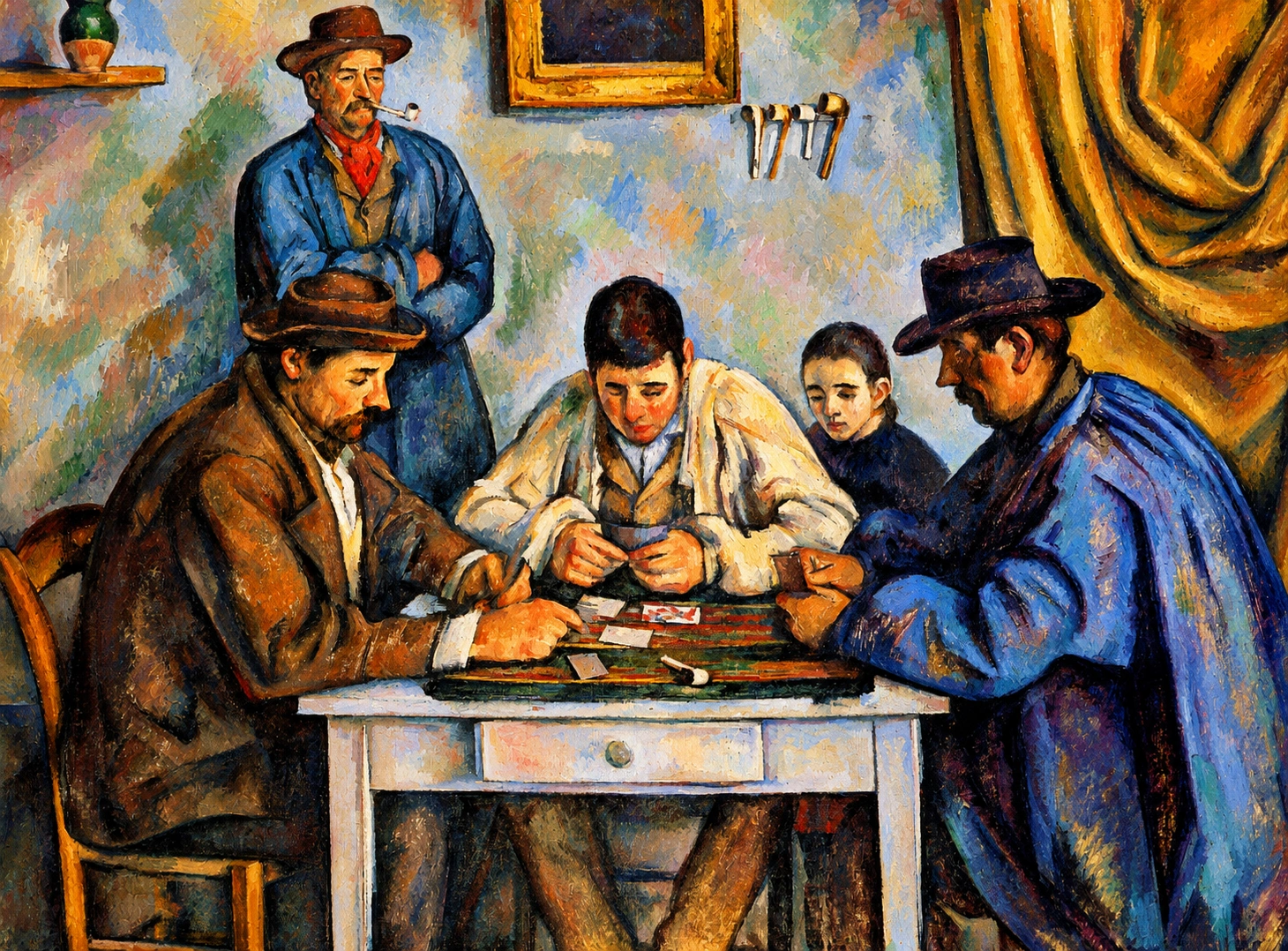
Free to Download & Reuse: You are welcome to use this image! If you republish or share it online, you must include a direct link back to this webpage for attribution.
Original Image Source: wikiart.org
A Complete Analysis of “The Card Players” by Paul Cézanne
Paul Cézanne’s “The Card Players,” painted in 1892, is one of the most quietly powerful images in modern art. At first glance, the painting presents a simple rural scene: men gathered around a table, absorbed in a card game, while two background figures look on. Yet the work is far more than a genre scene of ordinary leisure. Cézanne turns a modest everyday activity into a study of form, concentration, balance, and human presence. The painting feels still, almost solemn, as though the players are not merely passing time but participating in a ritual of silence and patience.
The subject comes from the world of Provence, the region of southern France where Cézanne was born and to which he remained deeply attached. Rather than choosing glamorous models or dramatic historical themes, he focused on peasants, laborers, and local men whose lives were tied to routine, work, and community. In “The Card Players,” these figures are not caricatured or sentimentalized. They are presented with gravity. Their heavy bodies, broad hats, folded arms, and downward gazes give them a monumental quality. Cézanne seems to suggest that ordinary people, when seen with enough seriousness, can possess the dignity of classical figures.
Composition and Structure
The composition is built around the white table at the center of the room. It anchors the painting visually and psychologically. The players lean toward it, and nearly every line of attention leads back to the cards. The table becomes a stage for concentration, but also a geometric foundation. Its straight edges contrast with the curved hats, bent arms, rounded backs, and draped curtain on the right. Cézanne was deeply interested in how forms could be organized on the canvas, and here the table gives the scene a stable, architectural order.
The figures are arranged in a compact grouping, creating a strong sense of inward focus. The seated man on the left bends toward the game, his hat casting shadow over his face. The central figure, dressed in a light shirt, holds his cards close and becomes the brightest human presence in the scene. The man on the right, wrapped in a blue-gray garment, appears heavier and more sculptural, his body forming a large mass that balances the composition. Behind them, the standing man and the younger observer add depth, making the room feel occupied but not crowded.
This arrangement gives the painting a remarkable sense of calm tension. No one gestures dramatically. No one smiles or speaks. The game is not presented as entertainment in a lively tavern, but as a moment of intense stillness. Cézanne removes unnecessary anecdote, leaving behind the essence of attention.
Color and Atmosphere
The color palette is warm, earthy, and restrained. Browns, ochres, muted blues, dull reds, and creamy whites dominate the scene. These colors connect the figures to the walls, furniture, and interior space, making the entire painting feel unified. The red scarf around the standing man’s neck, the warm tones of the curtain, and the flushed faces of the players add quiet accents of life within the otherwise subdued atmosphere.
Cézanne’s brushwork gives the painting a textured, almost constructed appearance. The wall is not a flat background but a surface alive with patches of color. The curtain on the right is built from strokes of gold, brown, and orange, creating a heavy decorative presence. The clothing is similarly modeled through layered touches of paint rather than smooth illusion. This technique makes the painting feel solid and physical, as though each figure has been slowly assembled out of planes and color relationships.
The lighting is soft and indirect. There is no sharp spotlight or dramatic shadow. Instead, the entire room is filled with a gentle, dense atmosphere. This contributes to the painting’s contemplative mood. The scene feels enclosed, private, and timeless.
The Figures and Their Silence
One of the most striking qualities of “The Card Players” is the emotional reserve of the figures. Cézanne does not reveal much about their thoughts. Their faces are serious, absorbed, and somewhat mask-like. The viewer is invited to look closely, but not to enter their inner lives too easily. This distance gives the painting its mystery.
The central player is especially important. His light clothing makes him the visual focus, and his downward gaze emphasizes the psychological center of the work. He is not performing for the viewer. He is entirely absorbed in the cards, as if the outside world has disappeared. The player on the left seems equally concentrated, while the man on the right appears more shadowed and closed off. Together, they form a triangle of attention around the game.
The background figures change the mood of the painting. The standing man with crossed arms watches from behind, while the younger figure looks out more directly. Their presence adds a subtle social dimension. This is not a private duel between two players, but a shared scene of observation and patience. The game becomes part of a larger communal rhythm.
Cézanne’s Modern Approach
Although the subject is traditional, Cézanne’s treatment is modern. Earlier paintings of card players often emphasized humor, drama, cheating, drinking, or moral lessons. Cézanne avoids these narrative devices. He is less interested in telling a story than in building a visual structure. The people, table, walls, curtain, and objects are all treated as interlocking forms.
This is one reason the painting is so important in the development of modern art. Cézanne moves away from simple naturalism and toward a new understanding of painting as construction. The figures are recognizable, but they are also composed of simplified shapes and planes. Bodies become volumes. Faces become structured surfaces. Space becomes compressed and ordered. These qualities would later influence artists who pushed painting toward Cubism and abstraction.
Yet “The Card Players” never feels cold or purely analytical. Its greatness lies in the balance between human subject and formal design. Cézanne respects the humanity of the players while also transforming the scene into a meditation on shape, color, and perception.
Meaning and Interpretation
The painting can be read as an image of patience, routine, and rural dignity. The card game suggests leisure, but not idleness. These men appear grounded, accustomed to work, and comfortable with silence. Their world is modest, but Cézanne gives it weight. The room, the clothing, and the gestures all suggest a life removed from modern urban spectacle.
There is also a deeper sense of time in the painting. The players seem suspended in a moment that could last forever. The cards are small, but they command everyone’s attention. This contrast between the ordinary object and the seriousness of the participants gives the painting its quiet power. Cézanne makes the simple act of playing cards feel almost ceremonial.
“The Card Players” is not dramatic because something is happening. It is dramatic because everything is held in balance. The men, the table, the colors, and the space all seem to settle into a state of complete concentration. The painting asks the viewer to slow down and notice the monumentality of ordinary life.
Lasting Importance
“The Card Players” remains one of Paul Cézanne’s most admired works because it reveals the essence of his art. It combines humble subject matter with profound formal intelligence. It shows his love of Provence, his interest in ordinary people, and his revolutionary approach to pictorial structure. Nothing in the scene feels accidental. Every figure, object, and color contributes to the larger harmony.
The painting’s beauty is not decorative in a simple sense. It is a beauty of weight, silence, and construction. Cézanne gives the viewer a world that feels both real and carefully ordered, familiar and mysterious. In this quiet room, around a modest table, he created one of the great images of modern painting.