The Raft of the Medusa by Théodore Géricault: Vibrant Color Edit
Free to Download & Reuse: You are welcome to use this image! If you republish or share it online, you must include a direct link back to this webpage for attribution.
Original Image Source: wikiart.org
The Raft of the Medusa by Théodore Géricault
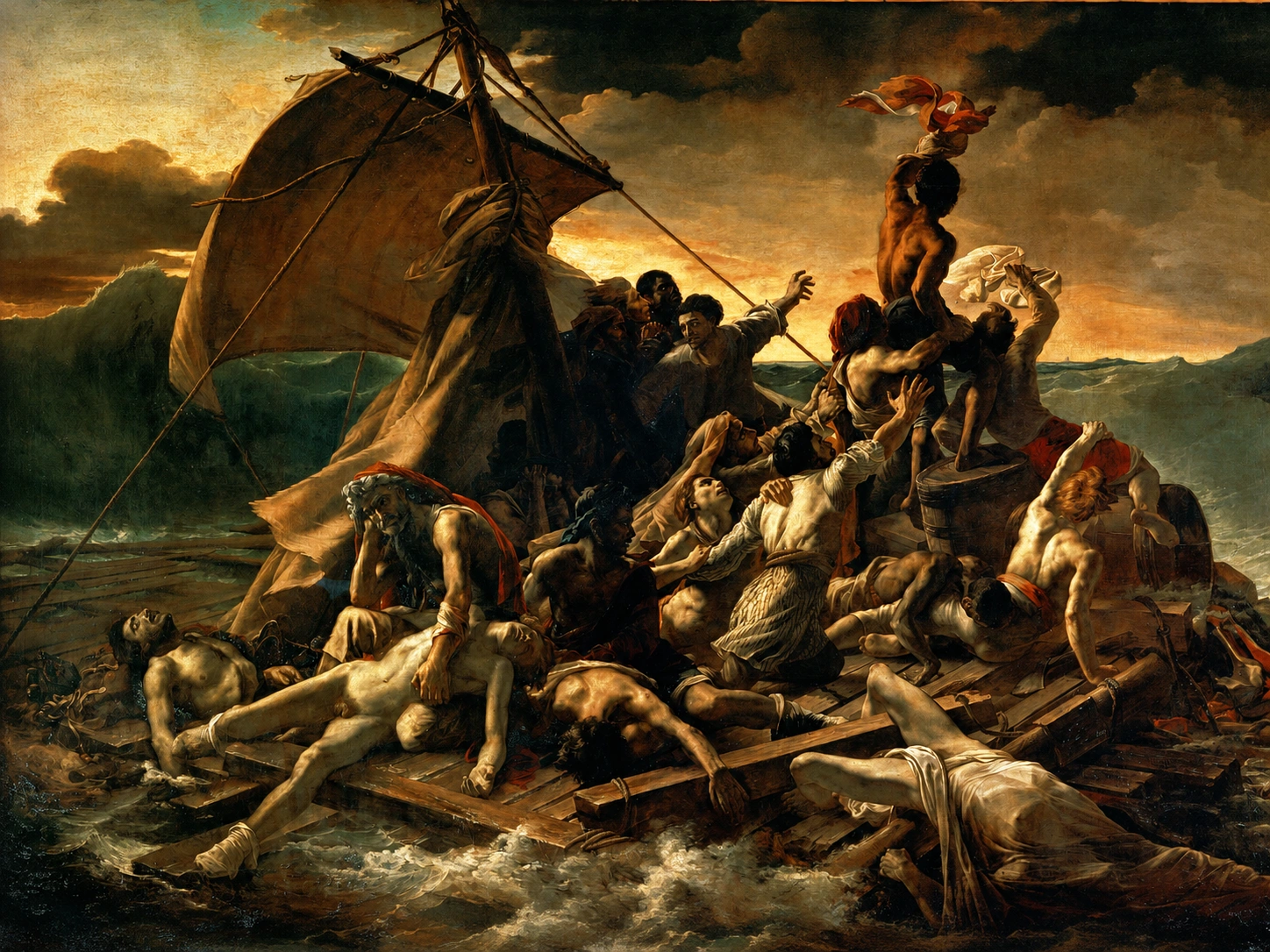
“The Raft of the Medusa” by Théodore Géricault, painted in 1819, is one of the most powerful images of human suffering, political failure, and desperate hope in nineteenth-century art. The painting depicts survivors of the French naval frigate Méduse, which ran aground off the coast of West Africa in 1816. After the shipwreck, a makeshift raft was built for those who could not fit into the lifeboats. Géricault transformed this modern disaster into a monumental history painting, giving a recent scandal the scale and emotional force usually reserved for ancient heroes, biblical tragedies, or national victories.
The work immediately stands out because it refuses comfort. Instead of showing rescue, order, or patriotic glory, Géricault presents a scene balanced between collapse and possibility. Bodies lie across the raft in exhaustion, grief, and near defeat, while a group at the upper right strains toward a distant ship on the horizon. The painting captures the instant when survival is still uncertain. This tension between despair and hope is what gives “The Raft of the Medusa” its lasting power.
A Modern Tragedy Painted Like an Epic
In early nineteenth-century France, large history paintings were often expected to celebrate noble subjects from mythology, religion, or state history. Géricault made a radical choice by focusing on a contemporary event that embarrassed the French government. The wreck of the Méduse became a symbol of incompetence, privilege, and official failure, especially because the captain had received his position through political connections rather than proven skill.
By painting the disaster on such a vast scale, Géricault elevated the victims into the realm of public memory. The men on the raft are not anonymous wreckage. They become figures of national conscience. Their suffering accuses the society that abandoned them. The painting is therefore not only a maritime scene, but also a political statement. It asks viewers to confront the cost of poor leadership and the fragility of civilization when institutions fail.
Composition and Dramatic Structure
The composition of “The Raft of the Medusa” is built around two opposing movements. One movement sinks downward into death, despair, and physical collapse. The other rises upward toward hope, action, and survival. At the lower left, limp bodies and grieving figures weigh the image down. At the upper right, a man waves cloth toward the distant rescue ship, creating the emotional climax of the scene.
Géricault organizes the figures into a powerful pyramid. The base of the pyramid is formed by bodies stretched across the raft, while the peak is the raised figure signaling for help. This structure gives the painting both chaos and order. At first glance, the raft seems overwhelmed by confusion, but closer viewing reveals a carefully designed arrangement. Every arm, torso, sail, rope, and gesture contributes to the upward pull of the composition.
The diagonal lines are especially important. The tilted mast, the slant of the sail, and the gestures of the survivors all push the viewer’s eye across the canvas. This creates a sense of instability, as though the raft itself is being tossed by waves and history at the same time. The sea surrounds the figures, but the true drama is human. The storm is not only in the sky. It is in the struggle between surrender and resistance.
Light, Color, and Atmosphere
Géricault uses a dark, earthy palette filled with browns, greens, blacks, ochres, and muted flesh tones. The colors create a heavy atmosphere, suggesting damp wood, storm clouds, exhausted bodies, and fading daylight. Yet the painting is not entirely dark. A band of golden light near the horizon breaks through the clouds, giving the scene a tragic glow.
This contrast between shadow and light is central to the painting’s meaning. The bodies in the foreground are surrounded by darkness, while the raised figures reach toward the illuminated distance. Light becomes a symbol of possibility, but not certainty. The distant ship is almost invisible, which makes the hope of rescue feel painfully fragile.
The color also adds realism. Géricault avoids decorative brightness. His tones feel physical, weighty, and raw. The raft appears wet and unstable. The sky feels oppressive. The human figures are modeled with strong chiaroscuro, giving them sculptural presence. This combination of Romantic drama and observed detail helps the painting feel both theatrical and disturbingly believable.
The Human Body as Emotional Language
The bodies in “The Raft of the Medusa” are not passive academic studies. Each figure expresses a different stage of suffering, grief, resistance, or hope. Some lie motionless across the raft. Others turn upward, reach outward, or support one another. The variety of poses gives the painting its emotional complexity.
The bodies in “The Raft of the Medusa” are not passive academic studies. Each figure expresses a different stage of suffering, grief, resistance, or hope. Some lie motionless across the raft. Others turn upward, reach outward, or support one another. The variety of poses gives the painting its emotional complexity.
One of the most moving figures is the older man in the lower left, who sits in grief with a body across his lap. His pose recalls religious images of mourning, especially the Pietà. Through this reference, Géricault connects modern suffering to a long visual tradition of lamentation. The painting becomes more than a report of an event. It becomes an image of human loss itself.
Romanticism and Political Anger
“The Raft of the Medusa” is often considered a defining work of French Romanticism. Romantic art favored intense emotion, dramatic subjects, individual struggle, and the sublime power of nature. Géricault’s painting contains all of these qualities, but it also has a sharper political edge. The sea and sky create the sublime setting, but the real terror comes from human abandonment.
Unlike the polished balance of Neoclassical painting, Géricault’s work feels unstable and urgent. The figures twist, lean, collapse, and strain. The composition does not soothe the viewer. It pulls the viewer into crisis. This emotional intensity made the painting shocking when it was first exhibited. It was not an easy image of national greatness. It was a reminder of suffering that many people in power would rather forget.
Géricault’s sympathy clearly lies with the victims. The painting gives dignity to people who were treated as disposable. It also includes a Black survivor at the peak of the composition, waving toward rescue. In the context of post-revolutionary France and debates over slavery and human rights, this choice carries symbolic weight. Hope is placed in the hands of a figure who stands above the wreckage, turning survival into a broader image of human endurance.
Why The Raft of the Medusa Still Matters
More than two centuries after it was painted, “The Raft of the Medusa” remains unforgettable because it speaks to crises that are still recognizable. It is about leadership failure, social inequality, collective panic, and the struggle to preserve dignity in extreme conditions. It shows people abandoned by systems that were supposed to protect them.
The painting also matters because it changed what history painting could be. Géricault proved that modern events could carry the emotional and moral weight of ancient epics. He turned journalism, politics, and human suffering into grand art without softening their impact. The result is a painting that feels both historical and immediate.
“The Raft of the Medusa” is not simply a depiction of shipwreck survivors. It is a meditation on hope at the edge of catastrophe. Its power comes from the fact that the viewer sees both defeat and resistance in the same image. The raft is crowded with suffering, but the raised arm at the top refuses silence. That gesture, small against the sky yet monumental in meaning, is the heart of the painting. It insists that even in disaster, the human will to be seen, heard, and saved can still rise above the wreckage.