The School of Athens by Raphael: Vibrant Color Edit
Free to Download & Reuse: You are welcome to use this image! If you republish or share it online, you must include a direct link back to this webpage for attribution.
Original Image Source: wikiart.org
The School of Athens by Raphael
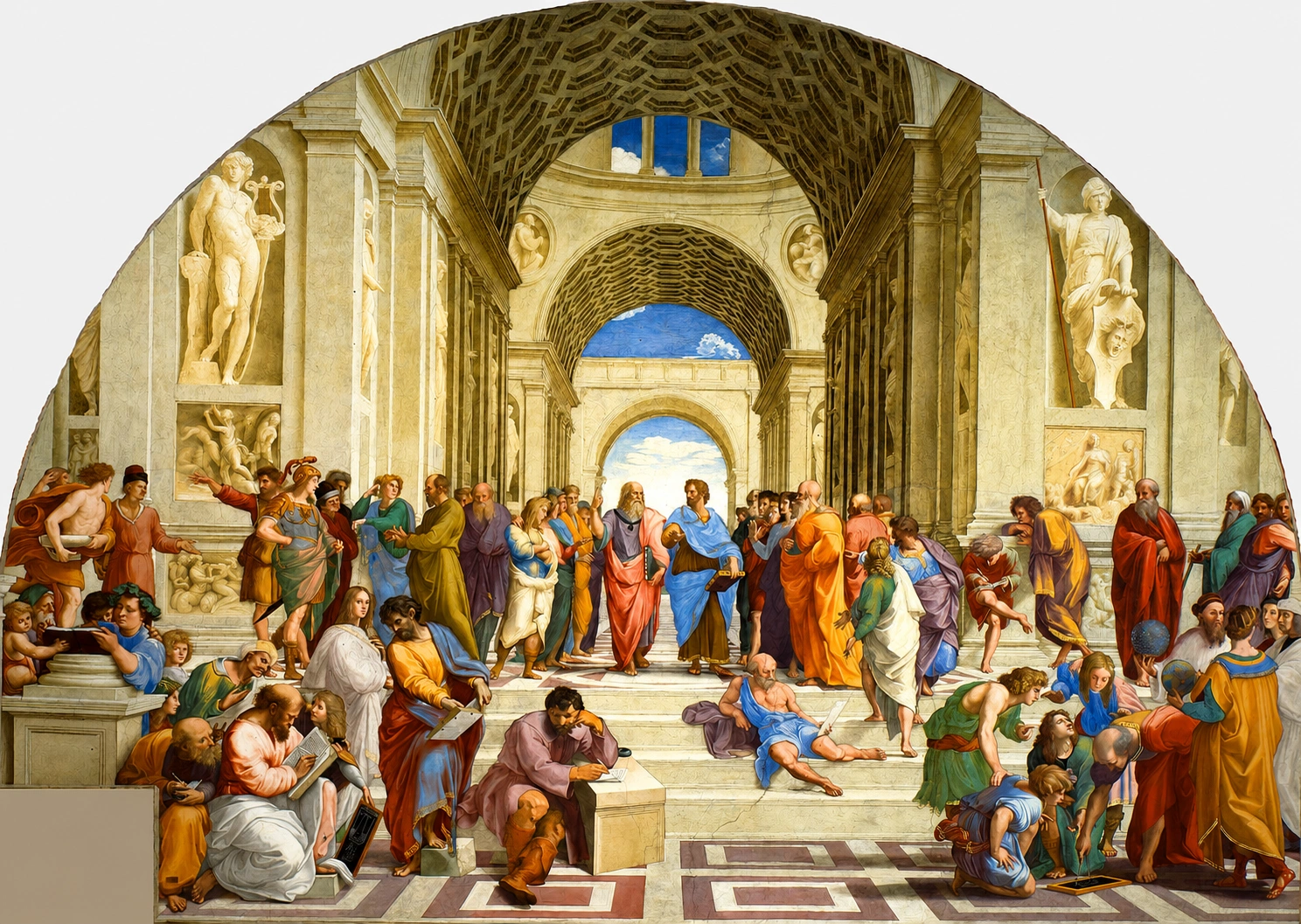
“The School of Athens” by Raphael, painted in 1511, is one of the supreme achievements of the Italian High Renaissance. Created for the Stanza della Segnatura in the Vatican, the fresco presents an imagined gathering of the greatest thinkers of the ancient world. Raphael transforms philosophy into a grand visual drama, placing Plato, Aristotle, mathematicians, astronomers, poets, and other intellectual figures inside an idealized classical building. The result is not simply a picture of famous philosophers. It is a celebration of human reason, learning, harmony, and the Renaissance belief that ancient wisdom could illuminate the modern world.
The painting immediately impresses through its scale, clarity, and architectural order. Raphael organizes a crowded scene with remarkable balance, allowing dozens of figures to occupy the same space without visual confusion. Every gesture, glance, and pose contributes to the larger rhythm of the composition. The viewer’s eye is drawn toward the center, where Plato and Aristotle walk beneath a bright archway. Around them, the other figures form groups of discussion, study, debate, and demonstration. The whole fresco feels alive with thought.
A Vision of Philosophy and Human Knowledge
Raphael’s subject is philosophy, but he makes an abstract idea visible through human interaction. Instead of showing knowledge as a book, symbol, or isolated scholar, he shows knowledge as conversation. The philosophers teach, question, listen, calculate, write, and argue. This makes “The School of Athens” a powerful image of intellectual community.
At the center stand Plato and Aristotle, the two giants of ancient Greek philosophy. Plato, older and bearded, points upward, suggesting his interest in ideal forms, eternal truths, and realities beyond the physical world. Aristotle, younger and more grounded, extends his hand outward, suggesting his concern with observation, ethics, nature, and practical experience. Raphael captures a major philosophical contrast in a single pair of gestures. The upward motion of Plato and the horizontal motion of Aristotle create a visual dialogue between idealism and realism.
This central pairing gives the fresco its meaning. Raphael does not choose one thinker over the other. Instead, he places them side by side, suggesting that wisdom requires both spiritual vision and earthly understanding. The Renaissance admired antiquity not as a dead past, but as a living source of balance, reason, and beauty.
The Architecture of Renaissance Harmony
The grand architectural setting is one of the most important features of “The School of Athens.” Raphael places his philosophers inside a vast classical structure filled with arches, columns, vaults, niches, statues, and open sky. The building recalls ancient Roman architecture, but it also reflects Renaissance ideals of mathematical proportion and spatial clarity.
The deep perspective leads the viewer’s eye toward the central arch behind Plato and Aristotle. The tiled floor, steps, walls, and barrel vaults all reinforce the sense of depth. This use of linear perspective gives the fresco intellectual order. The space itself seems rational, measurable, and harmonious, just like the philosophical world it contains.
The architecture also raises the figures to heroic status. They are not scattered in an ordinary classroom. They inhabit a temple of knowledge. The statues of Apollo and Athena, associated with reason, wisdom, art, and disciplined thought, strengthen the connection between classical culture and human achievement. Raphael turns philosophy into something monumental, almost sacred.
Figures, Identity, and Symbolic Meaning
Many figures in “The School of Athens” have traditionally been linked to ancient thinkers. In the lower left, Pythagoras writes while students gather around him, emphasizing mathematics, music, proportion, and numerical harmony. Nearby, a figure often identified as Heraclitus sits alone in a brooding pose, writing with intense concentration. This figure is famously believed to resemble Michelangelo, whose powerful style influenced Raphael during the same period.
On the steps near the center lies Diogenes, relaxed and isolated, representing a philosophical rejection of luxury and convention. His casual pose contrasts with the formal gestures around him, adding variety and personality to the scene. On the lower right, a figure often identified as Euclid or Archimedes bends over a slate, demonstrating geometry to a group of attentive students. His practical lesson balances the more abstract discussion between Plato and Aristotle.
At the far right, figures associated with astronomy and geography hold celestial and terrestrial globes. They suggest the study of the heavens and the earth, expanding the painting’s theme from philosophy to the full range of human knowledge. Raphael also includes what is often interpreted as his own self portrait near the right edge, looking outward toward the viewer. This subtle presence links the modern Renaissance artist to the ancient thinkers he depicts.
Color, Light, and Movement
Although “The School of Athens” is famous for its composition and intellectual symbolism, its color is also essential. Raphael uses soft but varied tones to distinguish the figures and guide the eye. Warm reds, oranges, golds, blues, greens, and whites create visual richness without disrupting the fresco’s harmony. Plato’s reddish garment and Aristotle’s blue mantle help identify the central figures and make them stand out within the crowded scene.
Light enters the painting with a calm, even clarity. It brightens the architecture, touches the marble steps, and gives the figures a sculptural presence. Unlike dramatic Baroque lighting, Raphael’s light does not create violent contrast. It reveals. This is appropriate for a painting about reason and understanding. The clear illumination becomes a metaphor for knowledge itself.
Movement appears throughout the fresco, but it is controlled and graceful. Some figures lean forward, others turn, point, kneel, write, or walk. Yet the whole composition remains balanced. Raphael’s genius lies in making a complex scene feel effortless. The painting suggests that intellectual life is active and dynamic, but also capable of order and beauty.
Why The School of Athens Still Matters
“The School of Athens” remains one of the most admired paintings of the Renaissance because it unites beauty, philosophy, history, and design with extraordinary confidence. Raphael presents human thought as noble and communal. He shows that ideas are not dry abstractions, but living forces shaped by people, gestures, debates, and discoveries.
The fresco also captures the High Renaissance ideal of harmony between antiquity and Christianity, reason and faith, art and knowledge. Painted in the Vatican, it celebrates pagan philosophers within a papal setting, showing the Renaissance conviction that classical wisdom could support a broader vision of truth. Raphael’s achievement is not only technical. It is cultural and intellectual.
As a work of art, “The School of Athens” demonstrates Raphael’s mastery of composition, perspective, figure grouping, and expressive gesture. As an image of civilization, it honors the pursuit of wisdom across generations. The painting continues to feel modern because it imagines learning as a shared human project. Its philosophers may belong to the ancient world, but their questions remain alive: What is truth? How should we live? What can reason teach us about the universe?
“The School of Athens” by Raphael is therefore more than a masterpiece of Renaissance painting. It is one of the great visual statements about the dignity of thought. Through architecture, color, gesture, and symbolic arrangement, Raphael created an enduring image of the mind in motion.