The Syndics by Rembrandt: Vibrant Color Edit
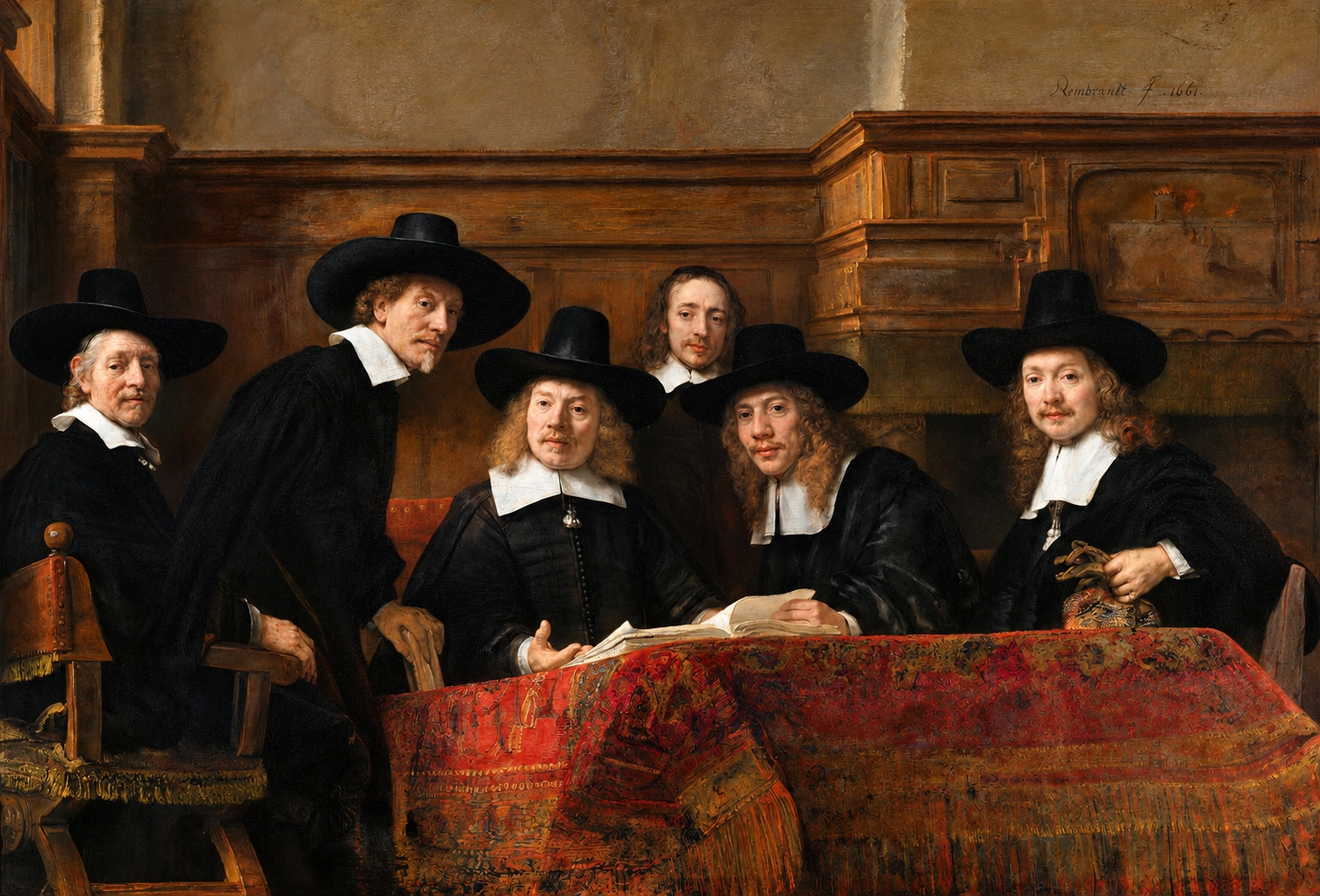
Free to Download & Reuse: You are welcome to use this image! If you republish or share it online, you must include a direct link back to this webpage for attribution.
Original Image Source: wikiart.org
Introduction
Rembrandt van Rijn’s The Syndics, painted in 1662, stands among the most compelling group portraits of the Dutch Golden Age. Also known as The Sampling Officials of the Amsterdam Drapers’ Guild, the painting transforms what could have been a formal record of professional administrators into an exceptionally vivid study of personality, authority, social responsibility, and human presence.
By the early 1660s, Rembrandt had already spent decades exploring the possibilities of portraiture, light, texture, and psychological expression. In The Syndics, these interests come together with remarkable maturity, creating a painting that seems almost to dissolve the boundary separating the viewer from the men gathered around the table.
Historical Context of The Syndics
The Syndics was commissioned by officials associated with Amsterdam’s cloth industry, one of the important commercial activities of the seventeenth-century Dutch Republic. The men represented were responsible for examining and regulating the quality of cloth, making their position one connected not only with business but also with standards, reputation, and public trust.
Group portraits of civic organizations, professional guilds, and charitable institutions were especially popular in the Netherlands during this period. Such paintings allowed individuals to commemorate their public roles while also presenting collective ideals of responsibility, prosperity, and respectable citizenship.
Rembrandt had already revolutionized the group portrait earlier in his career with works such as The Anatomy Lesson of Dr. Nicolaes Tulp and The Night Watch. In The Syndics, however, he adopts a quieter strategy, relying less on dramatic movement and more on subtle gestures, glances, spatial relationships, and psychological tension.
Composition and Arrangement
The composition of The Syndics appears simple at first. Five men sit or stand around a table covered with an elaborate reddish textile, while a servant occupies a more recessed position behind them.
Yet Rembrandt carefully organizes every figure to avoid stiffness. Instead of presenting the syndics as a symmetrical line of equally posed individuals, he gives each man a slightly different posture, expression, and relationship to the surrounding space.
The most striking compositional effect comes from the impression that the viewer has interrupted an ongoing meeting. Several of the men look directly outward, while the figure at the left appears to be rising from his chair, creating an immediate sense of movement.
This arrangement makes the spectator psychologically important to the scene. We are not simply observing the syndics from a safe distance, but seem to occupy the position of someone who has just approached their table and attracted their collective attention.
The Power of the Gaze
One of the greatest strengths of Rembrandt’s The Syndics is the extraordinary use of eye contact. The men do not all stare outward in exactly the same way, and these variations prevent the painting from feeling artificial.
Some expressions suggest curiosity, while others convey concentration, reserve, or mild scrutiny. The effect is subtle, but it gives each individual a distinct psychological identity while maintaining the unity of the group.
Their gazes also establish authority without relying on extravagant symbols of wealth or power. These men appear serious because of the way they occupy the space, study the viewer, and interact with the documents placed before them.
The painting therefore communicates status through behavior rather than spectacle. Rembrandt allows posture and expression to convey the importance of their professional responsibilities.
Light and Shadow
Rembrandt’s famous use of light is essential to the atmosphere of The Syndics. The faces, white collars, hands, and portions of the table emerge from the darker interior with controlled intensity.
The lighting is not theatrical in the manner of some of Rembrandt’s earlier works. Instead, it feels soft and concentrated, drawing attention toward the human figures while allowing the architecture behind them to remain relatively subdued.
The brilliant white collars are particularly important because they create visual rhythm across the composition. Against the predominantly black clothing, their sharp brightness leads the eye from one figure to another.
The darker clothing also allows Rembrandt to concentrate attention on faces and hands. These areas become the emotional and intellectual centers of the painting, reinforcing the idea that character and responsibility matter more than decorative display.
Color and Texture
Although The Syndics uses a restrained palette, it is far from colorless. Warm browns, deep blacks, muted golds, creamy whites, and rich reds create a sophisticated harmony that gives the scene both seriousness and warmth.
The reddish table covering is especially significant. Its rich color anchors the foreground and provides a striking contrast with the dark clothing of the men behind it.
Rembrandt also demonstrates his mastery of texture throughout the painting. The heavy fabric of the table covering, crisp linen collars, wooden furniture, dark garments, and aged interior surfaces are all suggested through varied brushwork rather than painstakingly polished detail.
In certain passages, the paint appears relatively loose and expressive. This mature technique allows forms to emerge through light, tone, and suggestion, creating a sense of visual richness without making every surface equally sharp.
Individuality Within the Group
One of the challenges of any group portrait is balancing the importance of individual sitters with the unity of the collective. Rembrandt solves this problem by giving each syndic a distinct personality while connecting them through overlapping bodies, shared gestures, repeated clothing, and coordinated attention.
The man near the center becomes an important visual focus because of his frontal position and the documents before him. His hands and the open book emphasize the administrative purpose of the gathering.
The figure leaning forward at the right introduces a different type of energy. His posture creates depth and brings his face closer to the viewer, while the man at the far right appears comparatively calm and composed.
The standing or rising figure toward the left contributes one of the painting’s most memorable gestures. His partially lifted posture introduces uncertainty about what happened immediately before the captured moment, making the scene feel spontaneous rather than carefully staged.
The Table and Documents
The table is more than a piece of furniture separating the figures from the viewer. It functions as a symbolic and compositional boundary between the officials and the space occupied by the spectator.
The documents placed upon it reinforce the syndics’ administrative responsibilities. These papers and books suggest inspection, record keeping, regulation, and decision making, connecting the men’s individual portraits with their collective professional duties.
At the same time, the tablecloth brings visual warmth into the foreground. Its complex reds, browns, and golden tones prevent the lower half of the painting from becoming too dark and create a luxurious surface against which the men’s hands and documents stand out.
The table also contributes to the illusion that the viewer has approached a real meeting. It feels like an actual working surface rather than a decorative studio prop, strengthening the painting’s convincing sense of immediacy.
Rembrandt’s Mature Style
By 1662, Rembrandt’s style had become increasingly expressive and economical. Rather than emphasizing smooth surfaces and meticulous finish everywhere, he relied on contrasts of texture, broad passages of paint, and carefully controlled highlights.
This approach is especially effective in The Syndics because it gives the painting a remarkable sense of presence. From a distance, the figures appear convincing and fully formed, while closer observation reveals brushwork that can be surprisingly free.
The mature Rembrandt was deeply interested in the expressive possibilities of imperfect surfaces. Faces are not idealized into flawless masks, and the physical presence of age, experience, and individuality contributes to the psychological power of the portrait.
This quality separates The Syndics from more conventional representations of professional prestige. Rembrandt does not merely record clothing, faces, and status, but creates the impression of intelligent individuals temporarily interrupted during serious work.
Psychological Realism
The psychological realism of The Syndics is one of the primary reasons the painting remains so compelling. Each sitter appears to be thinking rather than simply posing.
Their expressions contain subtle differences that invite interpretation without producing a simple narrative. One man seems attentive, another slightly questioning, another reserved, and another almost caught halfway through a response.
Rembrandt avoids exaggerated emotion. The tension comes from restraint, making the viewer more aware of small changes in eyebrows, mouths, posture, and direction of gaze.
This subtlety gives the scene an unusual timelessness. Although the clothing, setting, and institutional purpose belong unmistakably to seventeenth-century Amsterdam, the experience of unexpectedly entering a serious meeting feels immediately understandable.
A Masterpiece of Group Portraiture
The Syndics demonstrates Rembrandt’s ability to make a formal commission feel alive. Instead of presenting six men as static representatives of an institution, he creates a believable moment in which personality, duty, observation, and social authority intersect.
The painting’s greatness lies partly in its restraint. There is no dramatic landscape, violent action, elaborate allegory, or spectacular architectural setting, yet the arrangement of several men around a table becomes intensely engaging.
Through carefully controlled light, varied expressions, restrained color, rich texture, and a brilliantly organized composition, Rembrandt turns ordinary professional activity into a study of human presence. The viewer becomes part of the scene, confronting the syndics just as they appear to notice someone entering their space.
More than three centuries after it was painted, The Syndics continues to demonstrate why Rembrandt is regarded as one of history’s greatest portrait painters. Its combination of realism, psychological complexity, technical freedom, and compositional intelligence makes it both an important document of Dutch civic culture and an enduring exploration of how people look, think, and respond to one another.