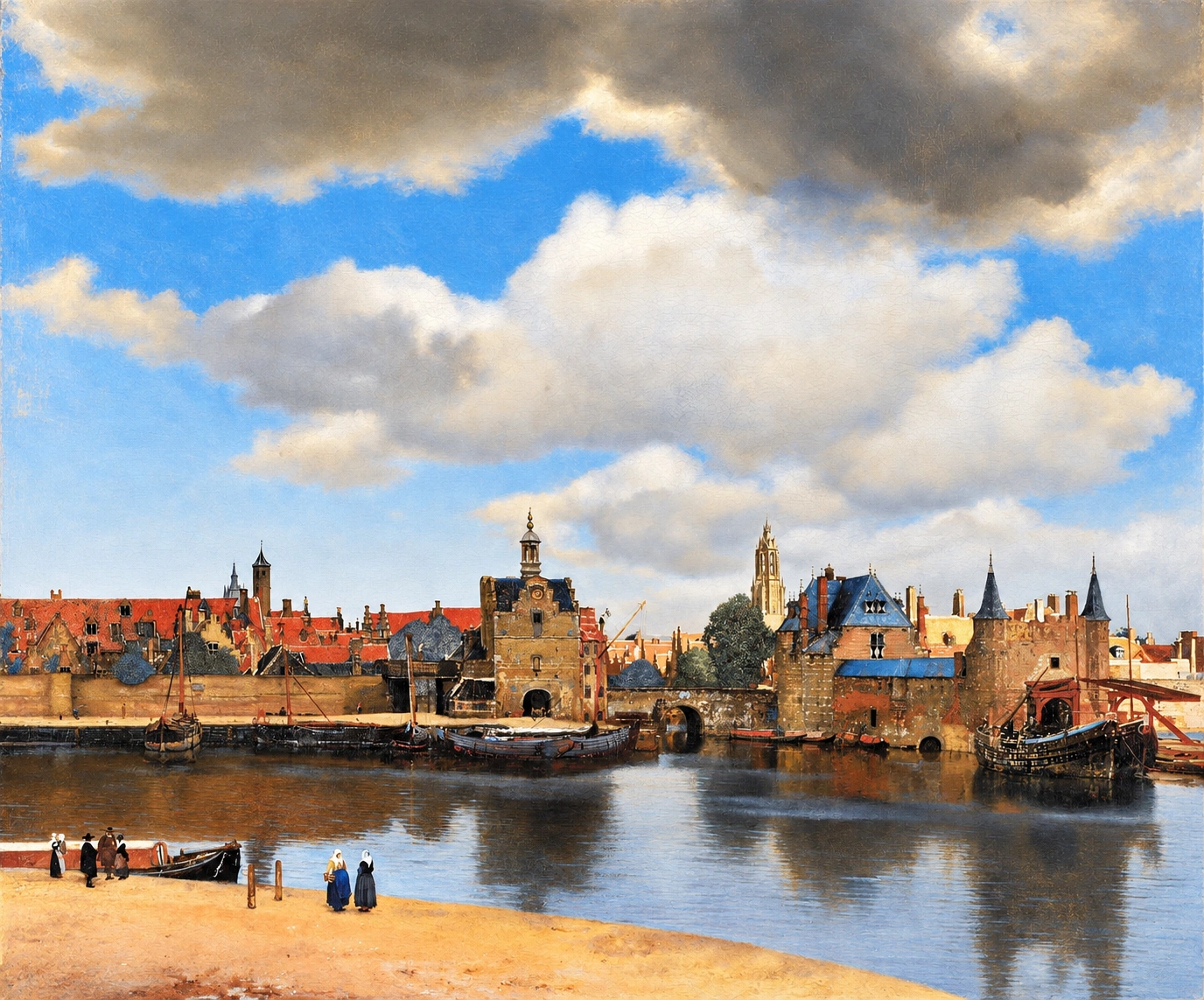
View of Delft by Johannes Vermeer: Vibrant Color Edit
Free to Download & Reuse: You are welcome to use this image! If you republish or share it online, you must include a direct link back to this webpage for attribution.
Original Image Source: wikiart.org
Introduction: The Timeless Beauty of “View of Delft”
“View of Delft,” painted by Johannes Vermeer around 1660–1661, stands among the most celebrated cityscapes of the Dutch Golden Age. Renowned for its extraordinary treatment of natural light, atmospheric perspective, and architectural detail, the painting captures the quiet beauty of Delft, the Dutch city where Vermeer spent his entire life. Rather than depicting a dramatic historical event or an elaborate religious scene, Vermeer transforms an ordinary urban panorama into a profound meditation on light, time, and the relationship between humanity and its surroundings.
At first glance, “View of Delft” appears to be a straightforward representation of a seventeenth-century Dutch city. However, its carefully balanced composition, subtle color harmonies, and luminous atmosphere reveal an artist deeply concerned with the emotional possibilities of landscape painting. Through his extraordinary sensitivity to visual perception, Vermeer creates an image that feels both remarkably realistic and almost dreamlike.
Historical Context: Delft During the Dutch Golden Age
During the seventeenth century, the Dutch Republic experienced remarkable economic prosperity, cultural development, and artistic innovation. Cities such as Amsterdam, Haarlem, Leiden, and Delft became important centers of commerce, craftsmanship, and intellectual exchange. The growing wealth of Dutch merchants and citizens encouraged a flourishing art market, creating demand for paintings depicting everyday life, landscapes, interiors, and recognizable urban environments.
Delft was particularly renowned for its distinctive architecture, picturesque canals, and internationally admired blue-and-white ceramics. The city also possessed a strong artistic tradition, although Vermeer approached painting with a degree of refinement that distinguished him from many contemporaries. His relatively small body of surviving work demonstrates an exceptional interest in light, spatial relationships, and the poetic qualities of ordinary experience.
“View of Delft” reflects the civic pride characteristic of Dutch urban culture during this period. Nevertheless, Vermeer avoids turning the city into an exaggerated symbol of prosperity or political power. Instead, he presents Delft as a harmonious environment where architecture, water, clouds, and human activity coexist within a carefully observed natural setting.
Composition: A Perfect Balance Between Land, Water, and Sky
One of the most striking characteristics of “View of Delft” is its remarkably balanced composition. Vermeer organizes the painting into three principal horizontal zones: the expansive sky occupying the upper portion, the architectural skyline stretching across the middle, and the reflective water dominating much of the foreground. This arrangement creates an immediate sense of stability while allowing the viewer’s attention to move naturally throughout the scene.
The city appears across the Schie waterway, with its buildings forming a varied silhouette of rooftops, towers, chimneys, and fortified gateways. Among the identifiable structures are the Schiedam Gate, the Rotterdam Gate, and the prominent tower of the Nieuwe Kerk. These architectural landmarks establish the painting’s geographical identity while contributing to its intricate visual rhythm.
The foreground introduces a quieter human dimension through several small figures standing near the water’s edge. Their modest scale emphasizes the breadth of the urban landscape and reinforces the impression of observing Delft from a peaceful distance. Rather than becoming the primary subjects, these individuals function as subtle reminders of the daily life unfolding within the city.
The Extraordinary Treatment of Natural Light
Light is undoubtedly the defining element of Vermeer’s “View of Delft.” The painting captures a moment when sunlight breaks through an overcast sky, illuminating selected buildings while leaving others beneath soft shadows. This contrast produces a captivating interplay between brightness and darkness that gives the entire composition its distinctive atmosphere.
The Nieuwe Kerk tower receives particularly delicate illumination, allowing its warm architectural surfaces to emerge from the darker surroundings. Elsewhere, sunlight touches rooftops and walls, creating small areas of brilliance against the subdued urban panorama. These carefully distributed highlights guide the viewer’s gaze without disrupting the natural appearance of the scene.
Vermeer demonstrates extraordinary restraint in his manipulation of illumination. Instead of presenting uniformly bright architecture, he allows clouds to determine the distribution of sunlight across the city. The resulting atmosphere feels spontaneous, as though the viewer has encountered a fleeting moment of exceptional beauty.
This sensitivity to changing light anticipates certain concerns later explored by Impressionist painters. Although Vermeer’s methods differed fundamentally from those of nineteenth-century artists, his fascination with the temporary effects of sunlight establishes a compelling connection between Dutch Golden Age painting and later developments in landscape art.
Color Palette: Subtle Harmonies of Blue, Gold, and Earth
The color palette of “View of Delft” demonstrates Vermeer’s remarkable ability to achieve visual richness through carefully controlled tonal relationships. Cool blues and muted grays dominate the sky and water, while warmer ochres, reddish browns, and golden highlights define the city’s architectural structures. These contrasting temperatures create depth and contribute to the painting’s harmonious appearance.
The expansive sky contains delicate variations of blue, white, and gray, suggesting the movement and density of passing clouds. Beneath it, the buildings display a restrained assortment of brick reds, warm yellows, and dark earthy tones. The combination produces an atmosphere that feels both realistic and gently idealized.
Particularly impressive is Vermeer’s handling of transitions between illuminated and shadowed surfaces. Rather than relying on harsh outlines, he frequently allows neighboring colors and values to establish architectural forms. This approach contributes to the painting’s softness while preserving the recognizable character of Delft’s buildings.
Water and Reflections: Creating Depth and Tranquility
The water occupying the foreground plays an essential role in establishing the painting’s peaceful atmosphere. Its relatively calm surface reflects elements of the city and sky, creating a visual connection between the architectural landscape and the surrounding natural environment. Through subtle variations in color and texture, Vermeer suggests gentle movement without introducing unnecessary drama.
The reflections are deliberately softened rather than rendered as exact mirror images. Dark architectural forms dissolve into elongated patches of color, while brighter areas of the sky create luminous passages across the water. This treatment reinforces the sensation of atmospheric depth and prevents the foreground from appearing rigid or overly detailed.
The water also establishes a psychological distance between the viewer and the city. Delft appears accessible yet separated, inviting contemplation rather than immediate participation. This quiet distance contributes significantly to the painting’s enduring emotional appeal.
The Sky: An Essential Element of the Painting's Atmosphere
The sky occupies an unusually generous portion of “View of Delft,” demonstrating Vermeer’s understanding of its importance to the entire composition. Large, billowing clouds stretch across the upper canvas, combining brilliant white passages with darker gray formations. Their irregular shapes introduce movement into an otherwise stable architectural scene.
These clouds are more than decorative elements because they determine the lighting conditions throughout the landscape. Their shifting shadows create a complex arrangement of illuminated and darkened surfaces across the buildings below. Consequently, the sky becomes an active participant in the painting’s visual structure.
The contrast between the monumental clouds and the comparatively small cityscape also establishes a subtle relationship between human achievement and the natural world. Delft’s architecture appears enduring and substantial, yet the changing atmosphere reminds viewers that the city exists within a much larger environment.
Architectural Detail and the Identity of Delft
Vermeer’s careful representation of Delft’s architecture gives the painting considerable historical importance. The recognizable city gates, church towers, rooftops, and waterfront buildings preserve the appearance of a Dutch urban landscape during the seventeenth century. Although the artist made compositional adjustments, the painting remains deeply connected to an identifiable geographical location.
The Nieuwe Kerk is especially significant because its tower rises prominently above the surrounding structures. The church possessed strong historical associations with the Dutch House of Orange, including its role as a burial place for members of the ruling dynasty. Its illuminated presence may therefore suggest civic identity and national pride, although the painting does not impose an explicit political narrative.
Vermeer’s architecture is impressive because it combines precise observation with painterly freedom. Individual bricks, roof tiles, and windows are suggested through carefully positioned marks of color rather than uniformly detailed descriptions. Viewed from a distance, these marks merge into convincing structures, demonstrating the artist’s sophisticated understanding of visual perception.
Stillness, Human Presence, and the Passage of Time
Despite depicting an inhabited city, “View of Delft” communicates an extraordinary sense of silence. The small figures along the waterfront appear engaged in ordinary activities, yet their presence does not disturb the composition’s contemplative atmosphere. Boats rest quietly near the shore, and the distant buildings suggest a city temporarily suspended between moments of activity.
This stillness gives the painting an emotional depth extending beyond its descriptive subject matter. Vermeer captures a particular instant of daylight while simultaneously suggesting the enduring character of the city. The contrast between temporary atmospheric conditions and permanent architectural structures creates a subtle meditation on time.
The painting’s serenity also distinguishes it from more animated urban scenes produced during the Dutch Golden Age. Vermeer does not emphasize crowded streets, commercial transactions, or bustling waterways. Instead, he invites viewers to appreciate the quiet poetry of a familiar place.
Artistic Technique and Vermeer's Remarkable Realism
Vermeer’s technical approach contributes significantly to the painting’s extraordinary visual effects. Through carefully layered paint, subtle tonal transitions, and selective highlights, he creates the impression of surfaces responding naturally to changing daylight. His attention to the relationship between sharp details and softened forms produces a convincing sensation of atmospheric distance.
Certain architectural highlights appear as small, concentrated touches of paint that sparkle against darker surroundings. These details demonstrate Vermeer’s interest in how light interacts with surfaces and how the human eye perceives distant objects. The resulting image achieves a remarkable balance between meticulous representation and expressive painterly technique.
Scholars have frequently discussed the possibility that Vermeer employed optical devices, including the camera obscura, in developing his compositions. Although the precise extent of such assistance remains uncertain, the painting reveals an exceptional sensitivity to optical phenomena. Its achievement ultimately rests on Vermeer’s artistic judgment, particularly his ability to transform observed reality into a unified visual experience.
Legacy and Significance in Art History
“View of Delft” occupies an exceptional position within Vermeer’s artistic legacy because it is one of his very few surviving outdoor cityscapes. While the artist is primarily associated with intimate domestic interiors, this painting demonstrates that his understanding of light and space extended equally to expansive landscapes. Its combination of geographical specificity and poetic atmosphere makes it one of the defining achievements of Dutch cityscape painting.
The French writer Marcel Proust famously admired the painting, particularly the small illuminated section of yellow wall that became associated with his novel “In Search of Lost Time.” This literary connection contributed to the work’s modern reputation as an image capable of inspiring intense aesthetic contemplation. Its influence illustrates how an apparently modest architectural detail can acquire extraordinary emotional and symbolic significance.
Today, “View of Delft” is preserved in the Mauritshuis in The Hague, where it remains among the museum’s most admired masterpieces. Visitors continue to be captivated by its luminous atmosphere, balanced composition, and extraordinary sense of tranquility. More than three centuries after its creation, the painting retains its ability to make an ordinary moment appear timeless.
Conclusion: The Enduring Magic of “View of Delft”
Johannes Vermeer’s “View of Delft” represents one of the most refined expressions of light, atmosphere, and urban beauty in seventeenth-century European painting. Through carefully balanced composition, harmonious colors, delicate reflections, and extraordinary observational sensitivity, Vermeer transforms a recognizable Dutch city into an image of profound serenity. Every element contributes to a unified experience in which architecture and nature seem inseparable.
The painting’s greatness lies in its ability to reveal extraordinary beauty within an apparently ordinary scene. Rather than relying on theatrical gestures or dramatic subject matter, Vermeer allows sunlight, clouds, buildings, and water to communicate through their subtle relationships. “View of Delft” remains a timeless masterpiece because it encourages viewers to pause, observe, and discover the quiet wonder concealed within the everyday world.