Water Lilies by Claude Monet: Vibrant Color Edit
Free to Download & Reuse: You are welcome to use this image! If you republish or share it online, you must include a direct link back to this webpage for attribution.
Original Image Source: wikiart.org
A Complete Analysis of “Water Lilies” by Claude Monet
Claude Monet’s “Water Lilies” from 1904 is a luminous example of the artist’s late devotion to the pond at Giverny, where water, flowers, reflections, and atmosphere became the entire subject of painting. Rather than presenting a traditional landscape with a clear horizon, fixed viewpoint, or central object, Monet invites the viewer to look directly into the shifting surface of a pond. The result is both natural and abstract, a painting that seems to describe a real place while also dissolving that place into color, rhythm, and light.
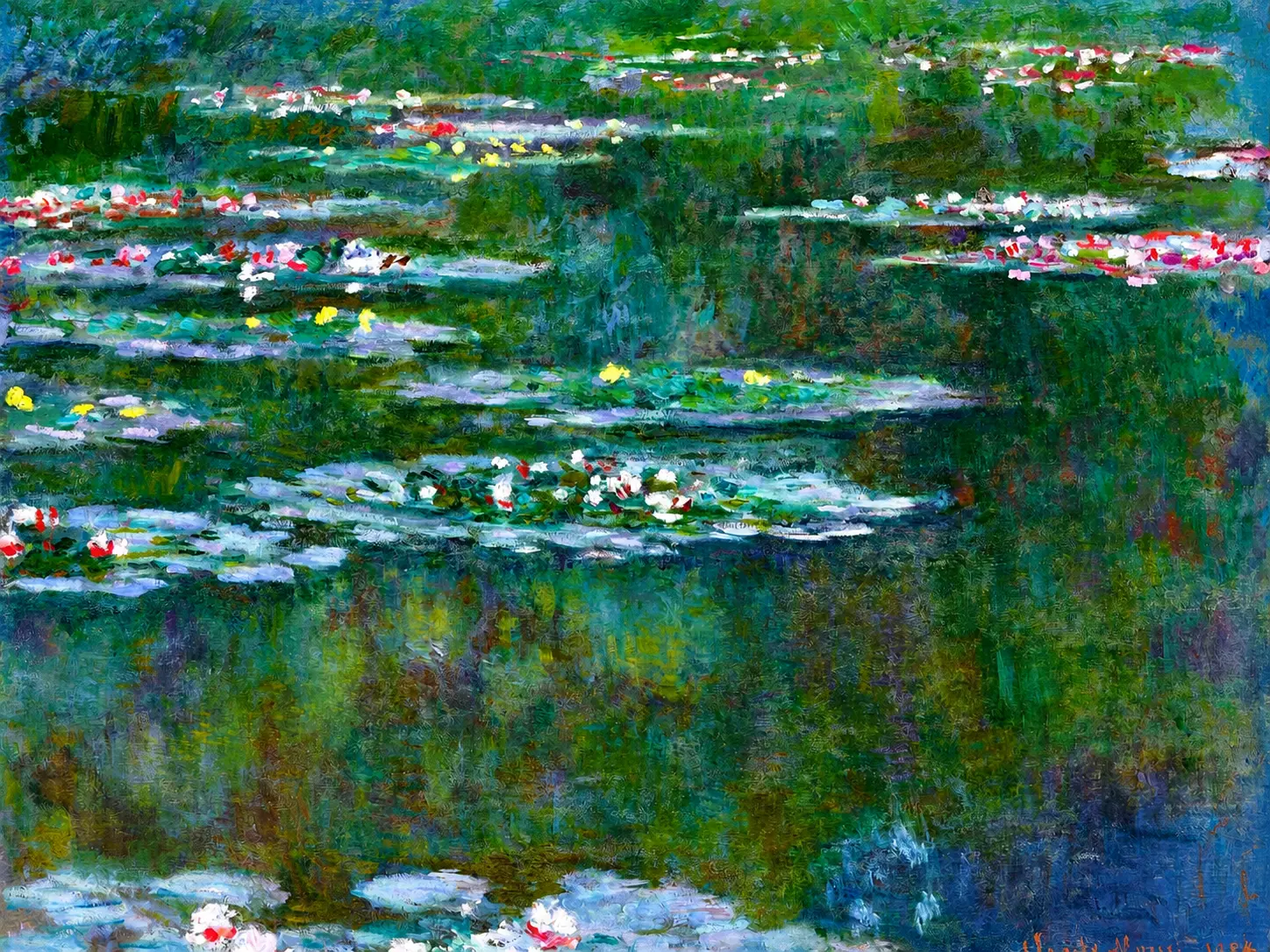
At first glance, the scene appears peaceful and simple. Lily pads float across the water in loose horizontal bands, while small blossoms of white, red, pink, and yellow punctuate the cool green and blue surface. Yet the more one looks, the more complex the image becomes. The water does not behave like a flat mirror. It gathers shadows, reflections, submerged color, and drifting vegetation into a single vibrating field. Monet paints not only the pond itself, but the experience of seeing it change from moment to moment.
The Pond as a World of Reflections
In “Water Lilies,” Monet removes the usual boundaries between sky, land, and water. There is no obvious shoreline, no architectural marker, and no human figure to stabilize the composition. Instead, the entire canvas is filled with the pond’s surface. Reflections of trees and surrounding plants appear as vertical, softened shapes in the water, especially in the darker central and lower areas. These reflected forms are not sharply defined. They waver and merge with the green surface, creating a sense of depth without conventional perspective.
This approach makes the painting feel immersive. The viewer is not standing at a distance from the landscape. Instead, the eye seems to hover just above the pond, moving across layers of floating flowers and mirrored foliage. Monet turns the surface of the water into a living visual field, where everything is connected. The lily pads belong to the surface, the reflected trees belong to the surrounding garden, and the colors beneath the brushwork suggest hidden depths below.
Color, Light, and Atmosphere
The color palette of this 1904 “Water Lilies” is dominated by cool greens, blues, violets, and muted turquoise tones. These colors create a moist, shaded atmosphere, suggesting a garden pond under filtered light. Monet avoids hard contrasts in most of the image, allowing colors to blend gently into one another. The greens are not uniform. Some are deep and mossy, others lean toward blue, teal, or yellow. This variety gives the water a living quality.
The flowers provide the brightest accents. Small touches of white, pink, red, and yellow appear across the composition like sparks of light. They are not painted with botanical precision, yet they are immediately recognizable as blossoms. Their brightness keeps the painting from becoming too dark or too heavy. Against the cool water, these small flowers act like visual notes, leading the eye from one part of the canvas to another.
Monet’s handling of light is subtle. There is no single beam of sunlight or dramatic glow. Instead, light seems to be scattered throughout the painting. It catches on petals, glides across lily pads, and shimmers faintly in the blue and violet strokes of the water. This scattered light is central to the painting’s beauty. Monet is not painting the pond as a fixed object. He is painting the way light makes the pond visible.
Brushwork and Movement
The brushwork in “Water Lilies” is loose, layered, and full of motion. Monet uses short, broken strokes to suggest flowers and lily pads, while broader, softer strokes create the reflective water. The paint appears to move in different directions, sometimes horizontally across the surface, sometimes vertically where reflections descend into the pond. This variation gives the image a gentle internal rhythm.
The water lilies are not outlined sharply. Instead, Monet builds them from clusters of color. A few strokes of pale blue, lavender, and green become a floating pad. A dab of white and red becomes a flower. This technique allows the painting to feel spontaneous and alive. The forms are clear enough to be read as nature, but open enough to remain painterly.
This balance between recognition and abstraction is one of the reasons Monet’s “Water Lilies” paintings became so influential. The viewer can enjoy the image as a garden pond, but also as an arrangement of color and texture. The painting does not need a story or symbolic drama. Its meaning comes from perception itself, from the act of looking closely at light, water, and time.
Composition and Visual Harmony
The composition of “Water Lilies” is organized through horizontal bands of floating vegetation. These bands stretch across the canvas, creating a calm structure. At the same time, the reflections and darker passages interrupt that structure, preventing the image from feeling flat or repetitive. The eye moves gently from the upper clusters of flowers to the central dark reflections, then down toward the larger blossoms near the bottom edge.
There is no single focal point. Instead, Monet creates a distributed composition, where attention moves across the whole surface. This is important because it mirrors the way one might actually look at a pond. The eye does not stop at one object. It drifts, returns, compares, and notices small changes. The painting rewards this kind of slow viewing.
The lower portion of the canvas is especially beautiful. Pale lilies and cool blue pads emerge from darker water, while the artist’s signature rests quietly in the lower right. This area gives the image a sense of closeness, as though the flowers are floating near the viewer. Farther back, the smaller blossoms and softened strokes suggest distance without needing a traditional perspective system.
Monet’s Modern Vision of Nature
By 1904, Monet had moved far beyond the early Impressionist goal of capturing modern life in quick outdoor scenes. At Giverny, he created a private world where nature could be studied repeatedly, almost endlessly. “Water Lilies” shows how deeply he was interested in change, repetition, and sensation. The pond was not just a subject. It was a laboratory for seeing.
This painting also points toward modern abstraction. Although it remains connected to the natural world, many areas of the canvas can be appreciated as pure color relationships. The dark greens, violet shadows, pale blues, and bright floral touches create a nearly musical surface. Monet’s late work helped later artists understand that a painting could be about atmosphere, movement, and visual experience rather than detailed description.
The Lasting Appeal of “Water Lilies”
“Water Lilies” by Claude Monet continues to feel fresh because it captures something both ordinary and profound. A pond with floating flowers becomes a meditation on time, light, and perception. Nothing dramatic happens in the scene, yet everything seems to be changing. The flowers drift, the reflections tremble, and the colors shift as the eye moves across the canvas.
The painting’s power lies in its quietness. Monet does not force meaning onto the viewer. He creates a space where looking becomes the main experience. In this 1904 work, the garden at Giverny is transformed into a field of color and reflection, a place where nature and painting become almost inseparable. “Water Lilies” is not simply an image of flowers on water. It is a vision of the world as light in motion.