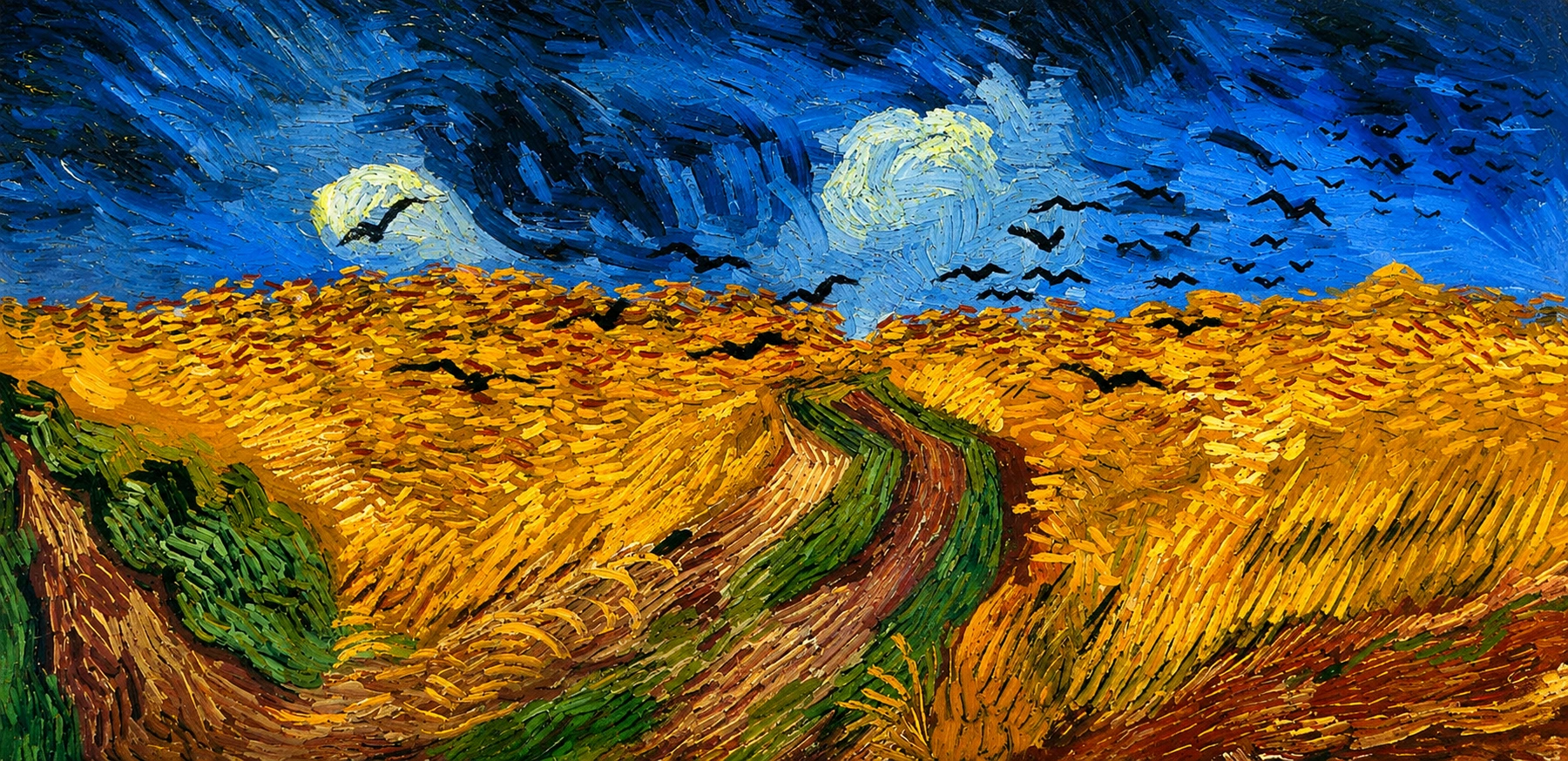
Wheatfield with Crows by Vincent van Gogh: Vibrant Color Edit
Free to Download & Reuse: You are welcome to use this image! If you republish or share it online, you must include a direct link back to this webpage for attribution.
Original Image Source: wikiart.org
Wheatfield with Crows by Vincent van Gogh: A Storm of Color, Movement, and Emotion
Vincent van Gogh’s “Wheatfield with Crows” from 1890 is one of the most powerful paintings of his final creative period. At first glance, it appears simple: a wheatfield, a dark blue sky, a rough path, and a flock of black crows. Yet the painting feels anything but calm. Every part of the image seems alive with movement. The wheat bends and flashes in thick strokes of yellow, the sky churns with deep blues and blacks, and the crows scatter across the scene like sudden marks of disturbance. Van Gogh transforms a rural landscape into an intense emotional vision, where nature becomes a language of uncertainty, energy, and inner feeling.
The painting does not present the countryside as a peaceful retreat. Instead, it shows a landscape charged with tension. The field is bright, but the sky is heavy. The paths are open, but they do not lead to a clear destination. The birds fly, but their direction feels restless and unsettled. This combination gives “Wheatfield with Crows” its lasting power. It is not merely a view of a field near Auvers-sur-Oise. It is a painting about atmosphere, feeling, and the dramatic force of color.
The Composition and the Dividing Power of the Field
The composition is built around strong horizontal bands. The golden wheatfield fills the middle and lower sections of the canvas, while the dark sky stretches across the top like a storm pressing down on the earth. This contrast immediately creates drama. The land is warm and luminous, while the sky is cold, deep, and threatening. Van Gogh places these two forces against each other so sharply that the painting feels almost like a confrontation between light and darkness.
The path in the foreground is especially important. Rather than offering a single road into the distance, the ground appears split into several directions. One path curves from the lower center into the field, while others seem to move toward the left and right edges. This creates a sense of uncertainty. The viewer is invited into the landscape, but there is no obvious way forward. The road does not promise arrival. It opens into possibility, confusion, and emotional suspense.
This unstable composition gives the painting its psychological weight. A traditional landscape often uses a path to guide the eye calmly into depth. Here, the paths feel fractured. They pull the viewer in different directions, echoing the restless brushwork and unsettled sky. The field becomes a space of choice, movement, and unresolved feeling.
Color as Emotional Force
Color is one of the main reasons “Wheatfield with Crows” feels so immediate. Van Gogh uses a striking contrast between yellow and blue, one of his most expressive color pairings. The wheat is not painted as a soft natural gold. It glows with sharp yellows, ochres, and orange tones, applied in quick, directional strokes. These marks make the field shimmer, as if it is being pushed by wind or charged with nervous energy.
The sky, by contrast, is painted in saturated blues, dark ultramarine tones, and near-black brushstrokes. It does not simply sit above the landscape. It seems to move, swirl, and press downward. Pale greenish-blue cloud forms appear within the darkness, adding a strange, almost electric quality. The sky feels alive, but not comforting. It is beautiful and turbulent at the same time.
The greens and reddish browns in the paths intensify the emotional range of the painting. The green areas feel raw and earthy, while the browns and purples create heaviness in the foreground. These colors prevent the landscape from becoming decorative. They anchor the brightness of the wheat in something rougher and more unstable. Van Gogh’s color choices are not realistic in a quiet sense. They are expressive, using nature to reveal mood.
Brushwork and the Feeling of Motion
The brushwork in “Wheatfield with Crows” is thick, urgent, and highly visible. Van Gogh does not hide the act of painting. Every stroke remains present on the surface. In the wheat, the brushmarks move in repeated curves and slashes, suggesting both the texture of the grain and the movement of wind. In the sky, broader strokes swirl and overlap, creating a feeling of agitation. In the paths, the paint forms rough channels that push the viewer’s eye through the composition.
This active surface is central to Van Gogh’s style. He does not describe the field from a distance. He seems to experience it physically. The viewer can almost feel the hand moving across the canvas. The painting becomes not just an image of a landscape, but a record of pressure, speed, and sensation.
The crows are painted with quick black marks, some appearing as simple silhouettes and others as more irregular strokes. Their simplicity makes them stronger. They do not need detail to carry meaning. Their dark shapes interrupt the bright wheat and blue sky, adding rhythm and unease. They appear scattered, as if suddenly disturbed, which increases the painting’s sense of urgency.
The Meaning of the Crows
The crows are among the most memorable features of the painting. Their black forms move across the sky and field, creating a dramatic pattern against the vivid colors. In art and literature, crows often suggest mystery, warning, or transition, but Van Gogh’s painting does not reduce them to one fixed symbol. They can be read as signs of disturbance, but also as living creatures moving through the landscape.
Their direction is ambiguous. Some seem to fly toward the viewer, while others move across the horizon. This uncertainty matters. The birds do not resolve the painting’s emotional tension. Instead, they intensify it. They add movement to an already restless scene and make the space feel less settled.
Because of the painting’s date and its connection to Van Gogh’s last phase, many viewers have treated the crows as symbols of darkness or finality. That interpretation is understandable, but the painting is more complex than a single biographical reading. The crows also give the work vitality. They animate the sky. They break the silence. They make the field feel alive, not empty.
A Landscape of Inner Experience
What makes “Wheatfield with Crows” unforgettable is the way it turns landscape into emotional experience. Van Gogh was not simply painting what he saw. He was painting how the scene felt. The wheatfield, sky, paths, and birds become parts of one expressive whole. The painting feels open and closed at the same time, full of light yet heavy with pressure.
The field stretches widely across the canvas, suggesting vastness and freedom. Yet the dark sky compresses that openness. The paths invite movement, but they do not provide clarity. The crows fly, but their motion feels unsettled. These contradictions give the work its emotional depth. It is beautiful because it is uneasy. It is luminous because it contains darkness. It is direct, but also mysterious.
Van Gogh’s genius lies in this ability to make ordinary subjects feel profound. A wheatfield becomes a stage for color, movement, and feeling. The landscape is not passive. It seems to breathe, tremble, and speak. Every stroke contributes to the sense that the natural world is charged with human emotion.
Why Wheatfield with Crows Still Matters
“Wheatfield with Crows” remains one of Van Gogh’s most discussed works because it captures the intensity of his mature style with extraordinary force. It brings together many of the qualities that define his art: bold color, visible brushwork, emotional honesty, and a deep connection to nature. The painting feels immediate even today because it does not rely on polished realism. It communicates through rhythm, contrast, and sensation.
The work also shows how modern landscape painting could move beyond description. Van Gogh does not ask the viewer merely to admire a field. He asks the viewer to feel the weather, the movement, the uncertainty, and the energy of the place. The painting becomes an encounter. Its roughness is part of its truth.
More than a century later, “Wheatfield with Crows” still feels urgent. The golden field, the stormy sky, the fractured paths, and the dark birds continue to speak with unusual force. It is a painting of nature, but also of inner life. Its power comes from the way Van Gogh makes the visible world carry invisible emotion.