Whistler’s Mother by James McNeill Whistler: Vibrant Color Edit
Free to Download & Reuse: You are welcome to use this image! If you republish or share it online, you must include a direct link back to this webpage for attribution.
Original Image Source: commons.wikimedia.org
A Complete Analysis of “Whistler’s Mother” by James McNeill Whistler
James McNeill Whistler’s “Whistler’s Mother,” painted in 1871, is one of the most recognizable portraits in nineteenth century art, yet its power comes from restraint rather than spectacle. The work is officially titled “Arrangement in Grey and Black No. 1,” a title that reveals Whistler’s deeper intention. Although the sitter is his mother, Anna McNeill Whistler, the painting is not simply a sentimental family portrait. It is a carefully balanced study of tone, form, stillness, and psychological presence. Its fame rests on the way it transforms a private domestic scene into an image of dignity, memory, and quiet endurance.
The Composition and Its Severe Balance
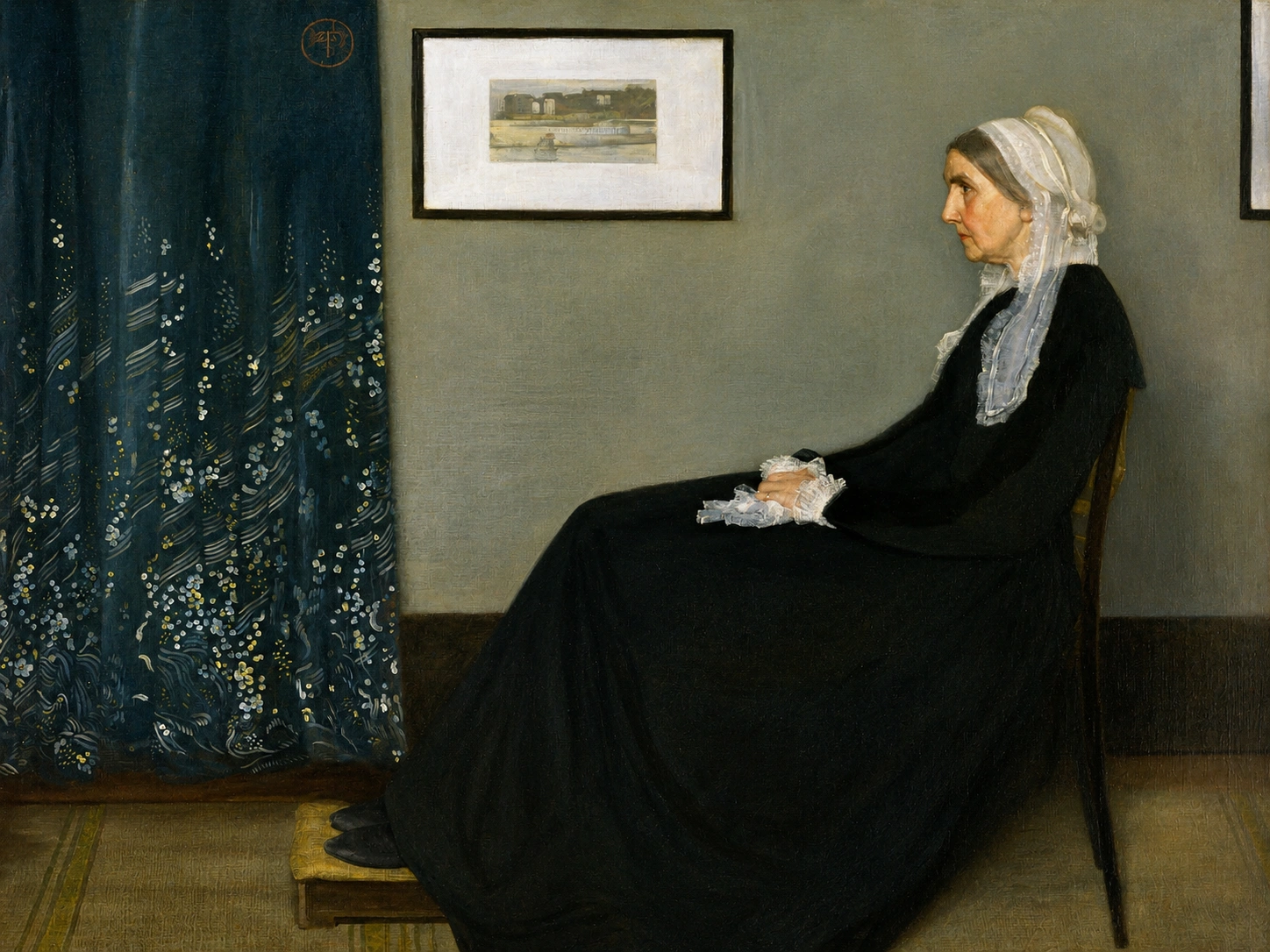
The painting presents Anna Whistler seated in strict profile, facing left, dressed in black against a subdued grey interior. The composition is strikingly simple. A curtain fills the left side, a framed picture hangs on the wall behind her, and the woman’s dark figure occupies the right half of the canvas. Nothing feels accidental. Every shape is controlled, flattened, and placed with almost musical precision.
Whistler reduces the room to a series of rectangles, verticals, and horizontal planes. The framed print on the wall echoes the rectangular canvas itself, while the dark curtain creates a heavy vertical counterweight to the sitter. Anna’s body forms a large black mass, softened by the pale lace of her cap and cuffs. Her feet rest on a small footstool, grounding the figure and emphasizing her age, stillness, and self possession.
This balance gives the painting its calm authority. The viewer does not feel invited into a dramatic moment. Instead, the image seems suspended in silence. It is less a snapshot of a person than an arrangement of presence.
Grey, Black, and Emotional Restraint
The limited color palette is central to the painting’s mood. Whistler works almost entirely with grey, black, white, and muted greenish brown tones. The lack of bright color does not make the painting empty. It makes every tonal shift more meaningful. The pale wall, the deep black dress, the patterned curtain, and the delicate whites of the cap and hands create a quiet harmony.
The black dress dominates the image, but Whistler avoids making it flat. Subtle variations of darkness suggest folds, weight, and depth. The figure seems both solid and shadowlike, physically present yet absorbed into the tonal structure of the room. The grey wall behind her is not merely background. It functions as an atmosphere, a muted field that makes the sitter’s face and hands stand out with greater sensitivity.
This restraint reflects Whistler’s belief that painting could resemble music, where tones and arrangements mattered as much as subject. The title “Arrangement in Grey and Black No. 1” supports this idea. The painting asks the viewer to look not only at Anna Whistler as a mother, but at the visual rhythm created by shape, color, and silence.
Portrait of a Mother
Despite Whistler’s formal interests, the painting’s emotional force depends on the sitter. Anna McNeill Whistler appears dignified, disciplined, and inward. Her face is calm, but not blank. The profile view gives her a meditative quality, as if she is lost in thought or patiently accepting the passage of time. Her posture is upright, yet the footstool and folded hands suggest age and physical vulnerability.
The painting has often been read as an image of motherhood, sacrifice, and moral strength. This interpretation is understandable. Anna’s dark clothing, modest cap, and composed attitude create an impression of seriousness and restraint. She does not perform affection for the viewer. Her emotional depth is contained. That containment makes the image more moving, because it suggests a life of discipline, memory, and quiet endurance.
Whistler does not idealize his mother in a decorative way. He does not surround her with sentimental symbols of domestic love. Instead, he gives her dignity through simplicity. Her individuality emerges through the clarity of her profile, the delicacy of her hands, and the stillness of her seated pose.
Interior Space and Psychological Silence
The interior in “Whistler’s Mother” is sparse, but it plays an essential role. The patterned curtain on the left introduces visual complexity, while the wall and floor remain subdued. The framed image behind Anna hints at culture, memory, and domestic refinement, but it does not distract from her presence. The room feels lived in, yet emotionally quiet.
This silence is one reason the painting remains so powerful. Whistler creates a space where nothing dramatic happens, yet everything feels meaningful. The sitter does not look at the viewer. She looks past the curtain, toward an unseen area beyond the edge of the painting. This gives the image a sense of distance. We are observing her, but we are not fully admitted into her thoughts.
The painting’s stillness can feel almost ceremonial. Anna Whistler appears like a figure of remembrance, seated within a carefully ordered world. The room becomes a stage for contemplation, where ordinary domestic life is elevated into something timeless.
Whistler’s Aesthetic Vision
Whistler was associated with the idea of art for art’s sake, a belief that painting should not be judged only by moral message, narrative, or realism. “Whistler’s Mother” reflects this philosophy. Its official title deliberately downplays personal biography and emphasizes arrangement. The painting is about visual harmony as much as family identity.
Yet the work succeeds because it does not choose between form and feeling. The formal arrangement strengthens the emotional effect. The strict geometry makes Anna’s stillness more profound. The subdued palette gives her face and hands greater importance. The quiet interior makes her inner life seem deeper. Whistler’s aesthetic control does not drain the painting of humanity. It intensifies it.
This is why the painting can be appreciated on multiple levels. It is a portrait of a specific woman, a tribute to motherhood, a study in tonal composition, and a statement of modern artistic independence. Its simplicity allows it to carry many meanings without becoming confused.
Why “Whistler’s Mother” Remains Famous
The lasting popularity of “Whistler’s Mother” comes from its rare combination of intimacy and universality. Many portraits depend on status, beauty, wealth, or dramatic expression. This painting depends on quiet recognition. The viewer senses age, memory, patience, and respect. Anna Whistler becomes both herself and a broader symbol of maternal dignity.
Its fame also comes from its visual directness. The profile, the black dress, the grey wall, and the seated pose are instantly memorable. The image is easy to recognize, but difficult to exhaust. The more one looks, the more subtle it becomes. Small tonal differences, the curve of the face, the softness of the cap, and the severe placement of objects all contribute to its emotional gravity.
“Whistler’s Mother” is not grand in scale or theatrical in subject, but it has the authority of an icon. It turns restraint into feeling and silence into presence. Through this seated figure, Whistler created one of the most enduring images of nineteenth century art, a painting that remains powerful because it says so much with so little.