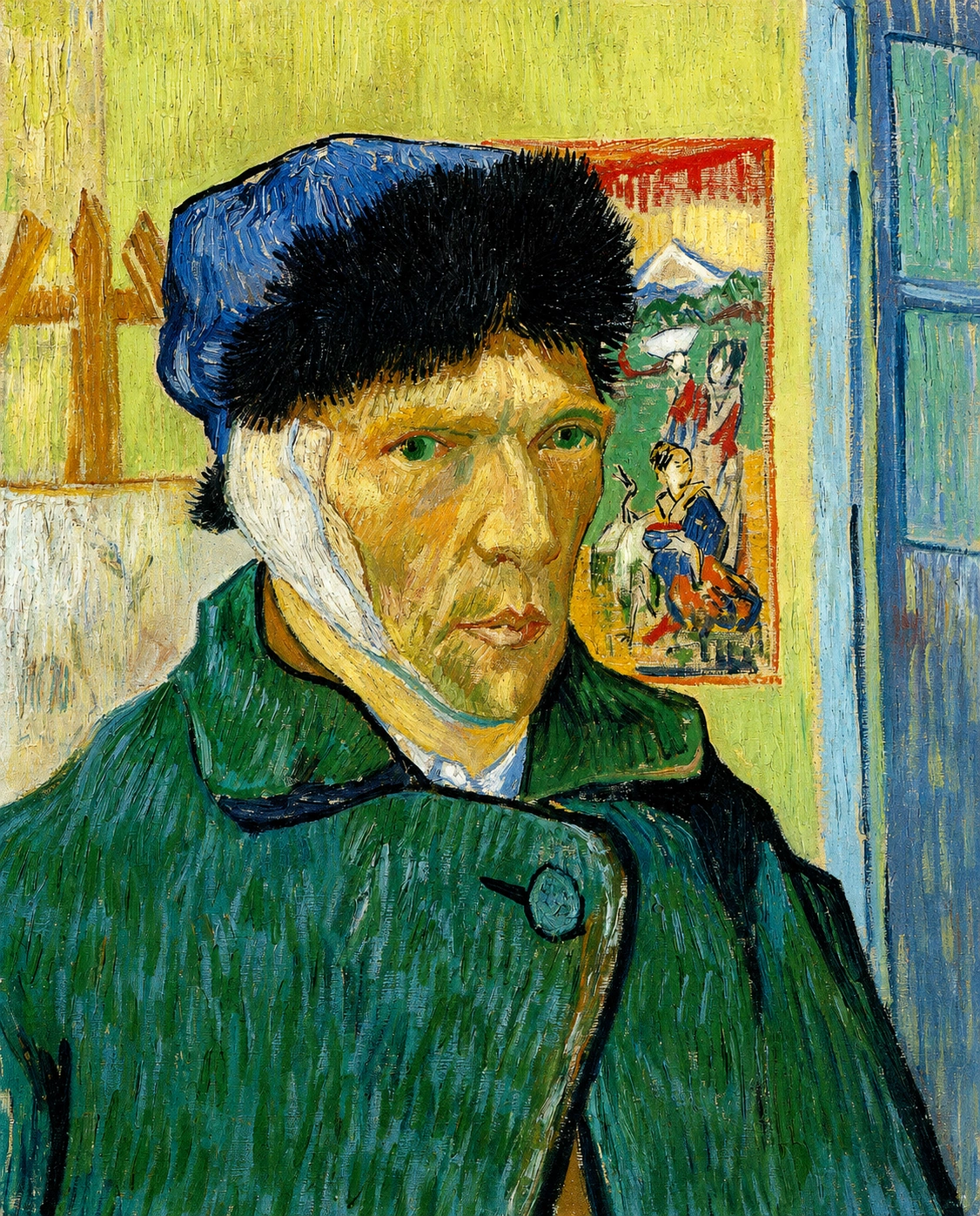
Self Portrait with Bandaged Ear by Vincent van Gogh: Vibrant Color Edit
Free to Download & Reuse: You are welcome to use this image! If you republish or share it online, you must include a direct link back to this webpage for attribution.
Original Image Source: wikiart.org
An Intimate Portrait of Recovery and Resolve
Vincent van Gogh’s “Self Portrait with Bandaged Ear” is one of the most recognizable and psychologically charged self-portraits in Western art. Painted in 1889, during his time in Arles, it presents the artist not as a mythic genius or dramatic sufferer, but as a watchful, wounded, and intensely present human being. The painting’s power comes from this restraint. Van Gogh does not exaggerate the scene. He sits upright, wrapped in a heavy green coat, wearing a dark fur cap, with a white bandage covering part of his head. His gaze meets the viewer directly, yet it does not invite easy interpretation. It is steady, guarded, tired, and strangely calm.
The painting was made after a serious personal crisis, and that knowledge inevitably shapes how viewers approach it. Yet the work should not be reduced to biography alone. Van Gogh was not merely recording an event. He was using painting as a way to reassert identity, discipline, and artistic purpose. The self-portrait becomes a declaration: despite pain, confusion, and instability, the artist is still looking, still painting, still constructing himself through color and form.
Composition and Presence
The composition is close and frontal, placing Van Gogh’s face and upper body near the surface of the picture. There is little empty space around him. The viewer is brought into immediate contact with his figure, almost as if standing across from him in a small room. This compressed arrangement gives the portrait its intensity. Van Gogh fills the canvas, but he does not dominate it with theatrical gesture. Instead, his presence is quiet and firm.
His body is turned slightly, while his face looks outward. This creates a subtle tension between withdrawal and confrontation. He seems physically enclosed by the coat, the cap, and the interior setting, yet his eyes remain open and alert. The heavy garment gives the figure a protective quality. It wraps around him like armor, but it is soft, worn, and domestic rather than heroic. The button and curved seam of the coat add structure to the lower half of the painting, while the dark outlines around the shoulders and collar reinforce the figure’s solidity.
The bandage is visually important because it interrupts the face without overwhelming it. Its pale shape contrasts with the warmer skin tones and the dark cap. It also guides the eye from the side of the head down toward the collar, creating a diagonal movement that balances the otherwise vertical structure of the portrait. Van Gogh transforms a sign of vulnerability into a compositional element, making it part of the painting’s visual rhythm rather than a sensational detail.
Color as Emotional Language
Color is one of the painting’s most expressive forces. Van Gogh uses greens, yellows, blues, blacks, and reds in a way that feels heightened but not decorative. The yellow-green wall behind him vibrates with energy, while the blue door or window frame at the right cools the scene. His green coat occupies much of the lower canvas, creating a broad field of textured color that stabilizes the image. Against this, the face becomes a zone of complex warmth, built from ochres, pale greens, pinks, and muted oranges.
The palette is unsettling because it refuses naturalism. Van Gogh does not paint flesh as smooth or conventionally healthy. His face is made from shifting, broken strokes that suggest fatigue, sensitivity, and inner pressure. Greenish shadows run across the cheeks and forehead, while reddish accents around the eyes and lips add emotional sharpness. The result is not a flattering likeness, but it is deeply alive.
The background intensifies this emotional language. The yellow wall gives the room an almost vibrating brightness. It is not a neutral interior. It presses forward, surrounding the figure with nervous light. The Japanese print in the background introduces reds, whites, and greens that enliven the space and connect Van Gogh’s private self-image to his artistic imagination. Even in a moment of recovery, he places himself among images, colors, and artistic influences.
Brushwork and Surface
The brushwork in “Self Portrait with Bandaged Ear” is direct, restless, and highly visible. Van Gogh’s strokes do not hide the act of painting. They show it. The coat is built from long vertical and diagonal marks, giving the fabric a vibrating texture. The wall is scraped and streaked with thin lines of color. The cap is dense and dark, made from short strokes that create a bristling surface. The face, by contrast, is modeled with varied touches that move across the features like traces of thought.
This active surface makes the portrait feel immediate. The viewer senses the artist’s hand moving across the canvas, making decisions quickly but deliberately. Nothing appears polished in the academic sense, yet everything is carefully placed. The looseness is not carelessness. It is a form of precision based on energy rather than smooth finish.
The outlines are especially important. Van Gogh often uses dark contour lines to strengthen forms, and here they give the portrait a graphic clarity. The cap, coat, face, and window frame are all defined by assertive edges. This helps the image hold together despite the restless color and brushwork. The painting feels both unstable and controlled, which is part of its emotional complexity.
The Japanese Print and Van Gogh’s Artistic Identity
The Japanese print behind Van Gogh is more than decoration. It reflects his deep admiration for Japanese art, which shaped his ideas about color, line, cropping, and composition. In Arles, Van Gogh imagined that southern France might become a kind of artistic Japan, a place of clarity, brightness, and renewal. By including the print in the background, he places himself within that dream.
The print also contrasts with the self-portrait’s mood. Its lively figures and decorative colors suggest another world, one of movement, elegance, and imaginative escape. Van Gogh sits in front of it, still and solemn. This contrast deepens the painting. The artist is not shown outside in the landscape he loved, but indoors, surrounded by images of the world he hoped to reach through art.
In this sense, the painting is not only about injury or recovery. It is about artistic continuity. Van Gogh presents himself as a painter who remains connected to his influences, ambitions, and visual ideals. The Japanese print becomes a quiet sign of persistence. Even when life narrows into a room, art keeps the world open.
The Face and the Gaze
The face is the emotional center of the painting. Van Gogh’s expression is difficult to name. It is not despairing, not serene, not defiant in a simple way. The eyes are steady but inward. They seem to look at the viewer while also looking through the viewer, absorbed in a private condition that cannot be fully shared.
This ambiguity is what makes the portrait so compelling. Van Gogh does not perform emotion for the audience. He allows contradiction to remain. The face suggests exhaustion and control, fragility and endurance, distance and honesty. The mouth is closed, the cheeks are hollowed by angular strokes, and the eyes are framed by shadows that heighten their intensity.
The portrait therefore becomes a study of selfhood under pressure. Van Gogh is not presenting an idealized image of the artist. He is showing the self as something constructed moment by moment, held together through attention, work, and vision. The act of painting becomes a way of staying present.
Why the Painting Still Matters
“Self Portrait with Bandaged Ear” continues to matter because it resists simplification. It is often treated as an emblem of Van Gogh’s troubled life, but its greatness lies in how much more it contains. It is a portrait of vulnerability, but also of professionalism. It is emotionally exposed, yet formally disciplined. It acknowledges crisis without turning crisis into spectacle.
The painting also challenges the idea that Van Gogh’s art was simply the product of instinct or suffering. Here, every color relationship, contour, background detail, and brushstroke shows intelligence and control. He was not passively expressing pain. He was actively transforming experience into visual order.
The result is one of the most humane self-portraits ever painted. Van Gogh looks wounded, but he also looks working. The image does not end with damage. It continues toward attention, craft, and survival. In that quiet continuation lies the painting’s enduring force.