Portrait of Doctor Gachet by Vincent van Gogh: Vibrant Color Edit
Free to Download & Reuse: You are welcome to use this image! If you republish or share it online, you must include a direct link back to this webpage for attribution.
Original Image Source: wikiart.org
Portrait of Doctor Gachet by Vincent van Gogh
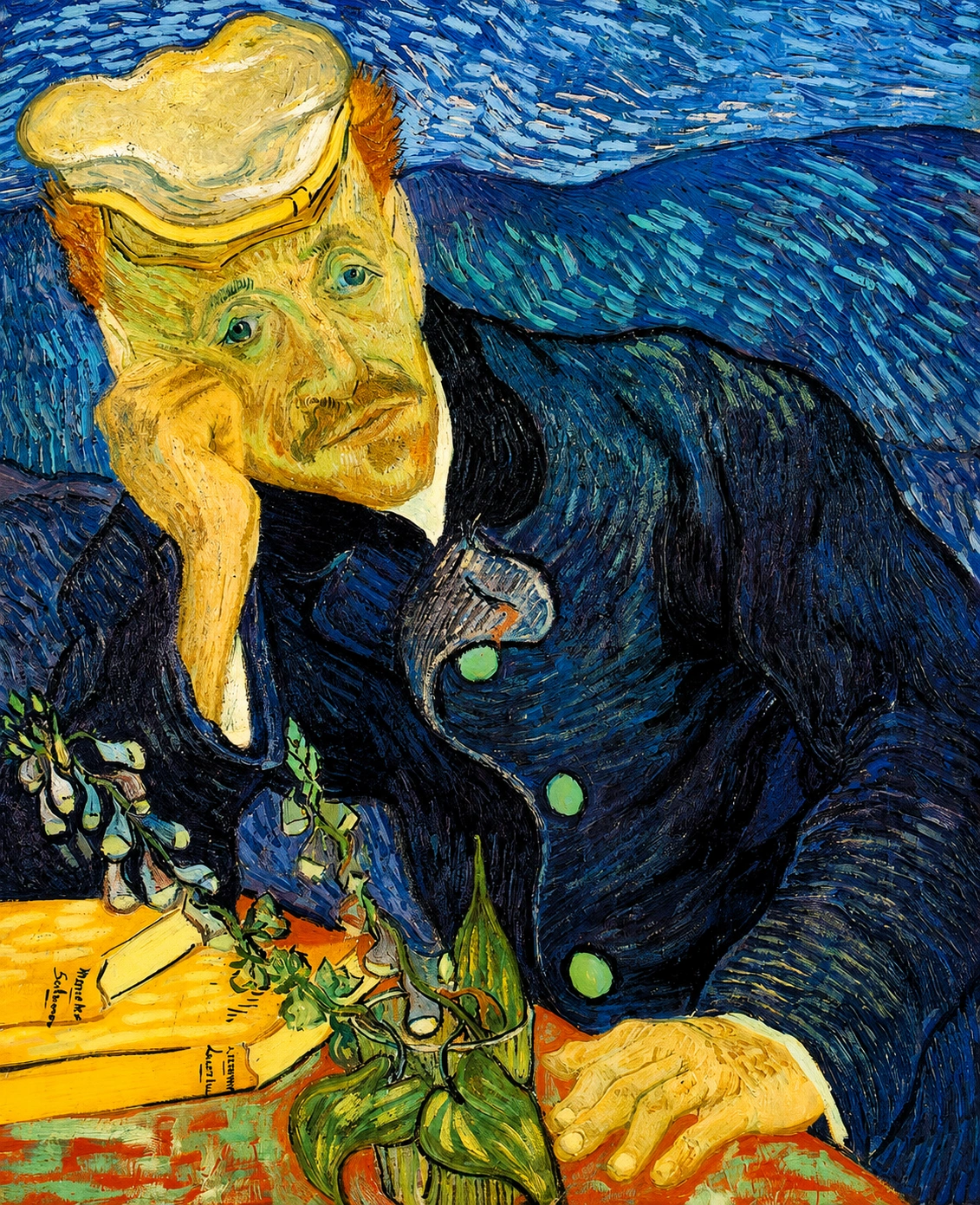
Vincent van Gogh’s “Portrait of Doctor Gachet” is one of the most moving portraits of the artist’s final year. Painted in 1890, during van Gogh’s stay in Auvers-sur-Oise, the work presents Dr. Paul Gachet, the physician who cared for him in the last months of his life. Yet this is far more than a record of a doctor’s appearance. It is a painting about melancholy, sympathy, nervous intelligence, and emotional exhaustion. Through the sitter’s tilted pose, weary expression, restless brushwork, and charged color, van Gogh turns Dr. Gachet into a mirror of human sadness.
The painting shows the doctor leaning heavily on one hand, his face angled toward the viewer with an expression that feels both attentive and withdrawn. He wears a dark blue coat and pale cap, while the background swirls with blue and green strokes that seem to move like troubled air. In the foreground are books, a vase, and a sprig of foxglove, a plant associated with digitalis, which was used medicinally for heart conditions. These details identify Gachet as a cultivated, scientific man, but they also deepen the emotional atmosphere of the portrait.
A Portrait of Shared Melancholy
Van Gogh once described Dr. Gachet as looking “sicker than I am,” and that impression is central to the painting. Gachet does not appear strong, confident, or clinically detached. Instead, he seems burdened by the same spiritual fatigue that haunted many of van Gogh’s late works. His drooping posture, softened eyes, and hand supporting the cheek suggest sadness rather than authority.
This makes the portrait unusually intimate. Van Gogh does not idealize the doctor as a savior figure. He paints him as a fellow sufferer, someone whose knowledge of illness may come from personal experience as much as medical study. The result is a psychological portrait in which doctor and patient seem emotionally linked. Gachet becomes not only a caregiver but also a double of van Gogh himself.
The sitter’s gaze is especially important. His eyes meet the viewer, but not with direct command. They appear tired, sensitive, and searching. The face is modeled with yellow, green, and ochre tones, giving the skin an unsettled intensity. Rather than creating smooth realism, van Gogh uses color to reveal inner feeling. The doctor’s face seems almost lit from within by nervous thought.
Color, Line, and Emotional Pressure
The color palette of “Portrait of Doctor Gachet” is dominated by blues, greens, yellows, and dark violets. These colors are not simply decorative. They create the emotional temperature of the painting. The deep blue coat gives the doctor a somber presence, while the yellowish face and cap introduce a fragile, almost feverish brightness. The contrast between warm flesh and cool surroundings makes the figure feel isolated inside his own mood.
Van Gogh’s brushwork is equally expressive. The background is built from short, curved strokes that ripple across the surface. These marks do not form a calm setting. They create movement, vibration, and unease. The doctor’s coat is painted with heavy, dark strokes that give weight to his body, while the face is handled with lighter, more exposed touches. This contrast makes the head and hands feel emotionally vulnerable against the dense mass of clothing.
The composition also adds to the sense of compression. Gachet’s body fills the picture, leaning diagonally across the canvas. His elbow and hand create a visual anchor, while the tilted head gives the whole image a feeling of imbalance. Nothing feels stiff or formal. The portrait seems to breathe, tremble, and sag under the pressure of feeling.
The Foxglove and the Books
The objects in the foreground help define Dr. Gachet’s identity. The foxglove plant refers to medicine and healing, but it also carries symbolic weight. Its association with the heart makes it especially meaningful in a portrait so concerned with emotional and physical vulnerability. Placed near the doctor’s hand, it connects his profession with the fragile human body.
The books suggest learning, culture, and intellectual refinement. Gachet was not only a physician but also an art lover and amateur artist. Van Gogh’s inclusion of books presents him as a man of thought, not merely a medical practitioner. Yet the books do not make the scene feel stable or scholarly. Their bright yellow color adds intensity to the foreground, while their diagonal placement contributes to the restless rhythm of the painting.
These objects create a subtle tension between knowledge and helplessness. Gachet has medicine, books, and experience, but the portrait does not suggest that knowledge can fully cure suffering. Instead, it shows a man surrounded by signs of care and intellect while still appearing deeply sad.
Van Gogh’s Late Style in Auvers
Painted shortly before van Gogh’s death, “Portrait of Doctor Gachet” belongs to the extraordinary final period of his career. In Auvers, he produced landscapes, portraits, gardens, cottages, and still lifes with remarkable speed and intensity. His late style often combines vivid color with emotional urgency. Forms become simplified, outlines grow stronger, and brushwork carries psychological force.
This portrait reflects that late urgency. It is not polished in the academic sense, but it is powerfully complete as an emotional statement. Van Gogh uses distortion not as a failure of observation but as a means of truth. The enlarged eyes, tilted head, and wavering background make the sitter feel more alive, not less. They communicate the instability of thought and feeling.
In this sense, “Portrait of Doctor Gachet” is one of van Gogh’s great achievements in portraiture. Like his self-portraits, it treats the human face as a landscape of emotion. Every color and line contributes to a sense of inner life.
Meaning and Legacy
“Portrait of Doctor Gachet” remains famous because it captures something universal: the exhaustion of a sensitive person facing suffering with limited power to heal it. The doctor’s sadness is not theatrical. It is quiet, persistent, and human. Van Gogh gives that sadness dignity by making it visible without making it sentimental.
The painting also complicates the relationship between artist and sitter. Gachet was supposed to care for van Gogh, but van Gogh’s portrait seems to care for Gachet in return. It sees him with compassion. It notices his fatigue, his intelligence, his vulnerability, and his humanity. That mutual recognition gives the work its emotional depth.
As an image of medicine, melancholy, and artistic empathy, “Portrait of Doctor Gachet” stands among van Gogh’s most unforgettable paintings. It is not only a portrait of a man. It is a portrait of shared fragility, painted with extraordinary tenderness and force.