The Laughing Cavalier by Frans Hals: Vibrant Color Edit
Free to Download & Reuse: You are welcome to use this image! If you republish or share it online, you must include a direct link back to this webpage for attribution.
Original Image Source: wikiart.org
The Laughing Cavalier by Frans Hals
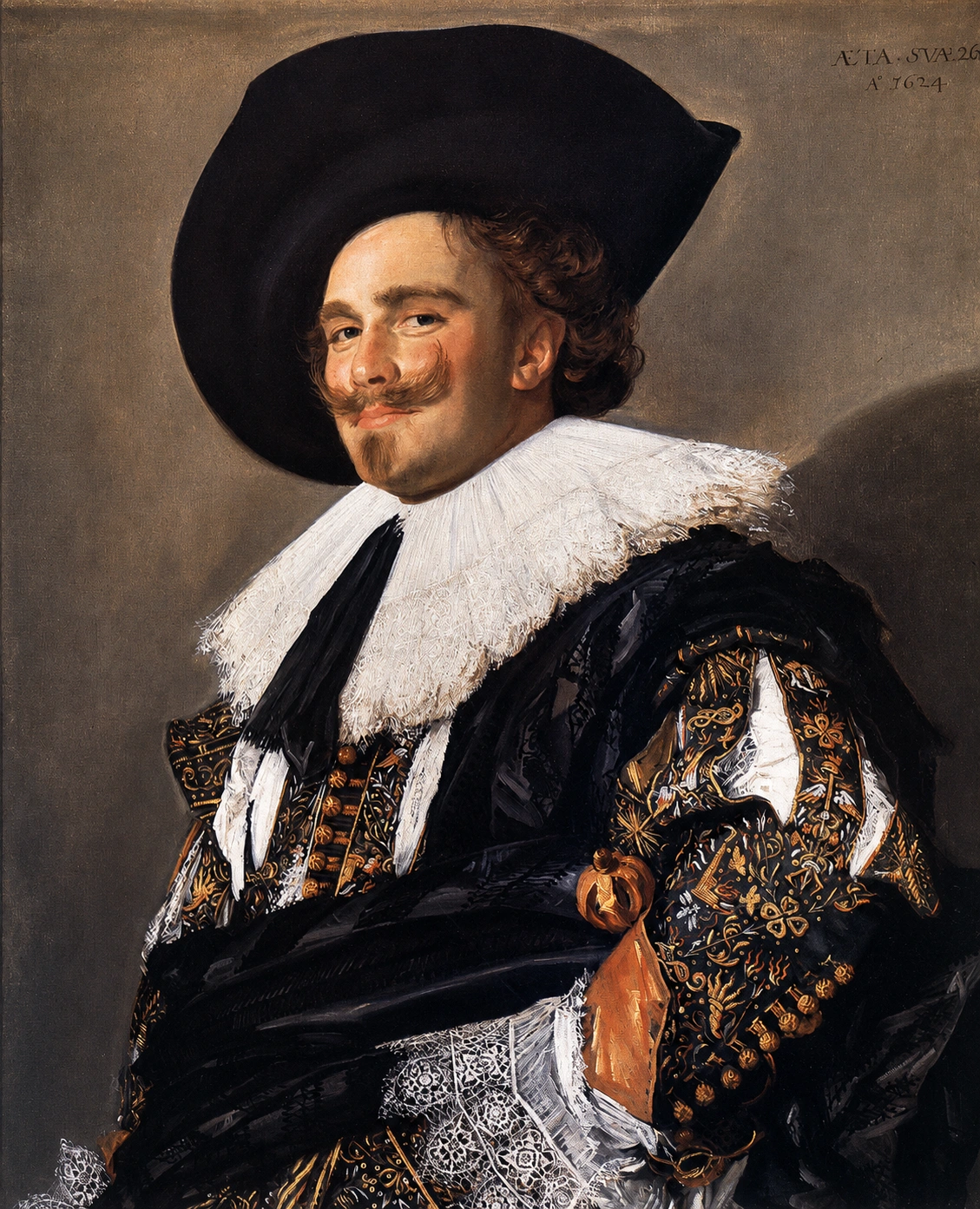
“The Laughing Cavalier” by Frans Hals, painted in 1624, is one of the most memorable portraits of the Dutch Golden Age. Although the painting’s popular title suggests laughter, the sitter is not actually laughing in an open or comic way. Instead, Hals captures something subtler and more intriguing: a confident half-smile, a raised expression, and a direct gaze that seem to turn a formal portrait into a living encounter. The man appears self-assured, stylish, and socially alert, as though he has just noticed the viewer and is choosing to meet that attention with wit rather than stiffness.
The painting shows a young man aged twenty-six, as indicated by the inscription in the upper right corner. He wears a large black hat, a broad white lace collar, and an elaborately embroidered black costume filled with decorative patterns. The image is both a portrait and a performance of status. Every part of the sitter’s clothing announces wealth, taste, and urban sophistication, yet Hals prevents the painting from becoming merely a display of luxury. The true force of the work lies in the lively presence of the sitter himself.
A Portrait Built on Confidence
The sitter’s pose is one of the first things that gives the painting its energy. He is turned slightly away from the viewer, but his head angles back with ease and confidence. This creates a strong diagonal movement through the body and face, making the portrait feel active rather than static. He does not sit passively for inspection. He seems to present himself deliberately, almost playfully, aware of his own elegance and comfortable under the viewer’s gaze.
His expression is central to the painting’s lasting appeal. The upturned moustache, the narrowed eyes, and the slight smile give him a teasing, charismatic quality. Hals was especially skilled at suggesting personality through small changes in facial expression. Here, the sitter appears proud but not cold, elegant but not lifeless. The result is a portrait that feels immediate, as if the man’s mood could shift at any second.
This sense of animation was one of Hals’s great achievements. Many formal portraits of the period aimed to preserve social rank through stillness and dignity. Hals gives dignity to his sitter, but he also adds movement, attitude, and psychological sparkle. “The Laughing Cavalier” therefore feels less like a frozen record and more like a brief social encounter across time.
Costume, Status, and Symbolic Display
The sitter’s clothing is one of the most spectacular features of the painting. The black doublet is richly decorated with gold, red, white, and orange embroidery. These patterns cover the sleeves and bodice with intricate motifs, turning the clothing into a field of visual luxury. The costume would have marked the sitter as a man of means, someone who could afford fashionable dress and wanted to be seen as refined.
The white lace collar creates a dramatic contrast against the dark costume and hat. Hals uses this contrast to frame the face, drawing the eye upward toward the sitter’s expression. The collar is not merely decorative. It acts almost like a stage light, illuminating the face and separating the sitter from the muted gray background. Its crisp, feathery edges also show Hals’s ability to suggest texture with quick, confident brushwork.
The embroidery has often been read as more than ornament. Some of its motifs suggest themes of love, fortune, pleasure, and social identity. Whether every detail was intended to carry a fixed meaning or not, the overall impression is clear. This is a man dressed for admiration. His clothing communicates ambition, charm, and worldly success.
Frans Hals’s Brushwork and Technique
Frans Hals’s handling of paint is one of the reasons “The Laughing Cavalier” remains so admired. His brushwork looks loose and spontaneous, but it is carefully controlled. In the lace, he uses quick strokes to create the illusion of fine threads and delicate edges. In the embroidered costume, he suggests complex decoration without making every detail feel heavy or overworked. The painting balances precision and freedom.
The face is modeled with warmth and subtlety. Hals gives the skin a lively glow, especially around the cheeks, nose, and eyes. The moustache is painted with curling energy, reinforcing the sitter’s lively personality. The eyes are especially important. They are not wide or theatrical, but they carry alertness and intelligence. Hals makes the gaze feel direct without making it harsh.
The background is simple and restrained, which allows the figure to dominate the composition. Its gray-brown tone creates depth without distraction. Against this subdued setting, the black hat, white collar, and embroidered costume stand out with greater force. Hals understands that visual drama does not require a crowded scene. A single figure, handled with confidence, can command the entire canvas.
Why the Painting Feels So Modern
One reason “The Laughing Cavalier” still feels fresh is its sense of personality. The sitter does not appear like a distant historical figure trapped in seventeenth-century formality. He seems vivid, socially aware, and almost contemporary in his confidence. His expression feels familiar because it suggests humor, self-possession, and a touch of vanity, qualities that remain instantly recognizable.
The painting also feels modern because it resists a single interpretation. Is the sitter charming or arrogant? Friendly or mocking? Relaxed or carefully performing? Hals leaves these possibilities open. The viewer is invited to respond to the sitter as one might respond to a real person, reading the face and posture for clues. This ambiguity gives the portrait its continuing life.
The popular title adds another layer to the painting’s fame. The man is not a cavalier in the strict military sense, and he is not truly laughing. Yet the title captures the public’s emotional response to the work. He looks dashing, confident, and amused. The name may be inaccurate as description, but it has helped turn the portrait into an icon.
The Lasting Power of The Laughing Cavalier
“The Laughing Cavalier” is a masterpiece because it combines technical brilliance, social display, and psychological vitality. Frans Hals presents a young man at the height of confidence, dressed in dazzling fashion and painted with extraordinary freedom. The portrait celebrates surface beauty, but it does not stop there. Beneath the costume is a personality that feels alert, teasing, and alive.
The painting is also an important example of Dutch Golden Age portraiture at its most engaging. It reflects a culture in which successful individuals wanted portraits that expressed identity, prosperity, and personal presence. Hals understood that a portrait could do more than record appearance. It could create an impression of character.
More than four centuries after it was painted, “The Laughing Cavalier” continues to attract viewers because it feels like a meeting rather than a monument. The sitter looks out with a knowing smile, while Hals’s lively brushwork keeps every surface active. The result is one of the most charismatic portraits in European art, a painting where elegance, confidence, and mystery come together in a single unforgettable image.