The Ambassadors by Hans Holbein the Younger: Vibrant Color Edit
Free to Download & Reuse: You are welcome to use this image! If you republish or share it online, you must include a direct link back to this webpage for attribution.
Original Image Source: commons.wikimedia.org
A Complete Analysis of “The Ambassadors” by Hans Holbein the Younger
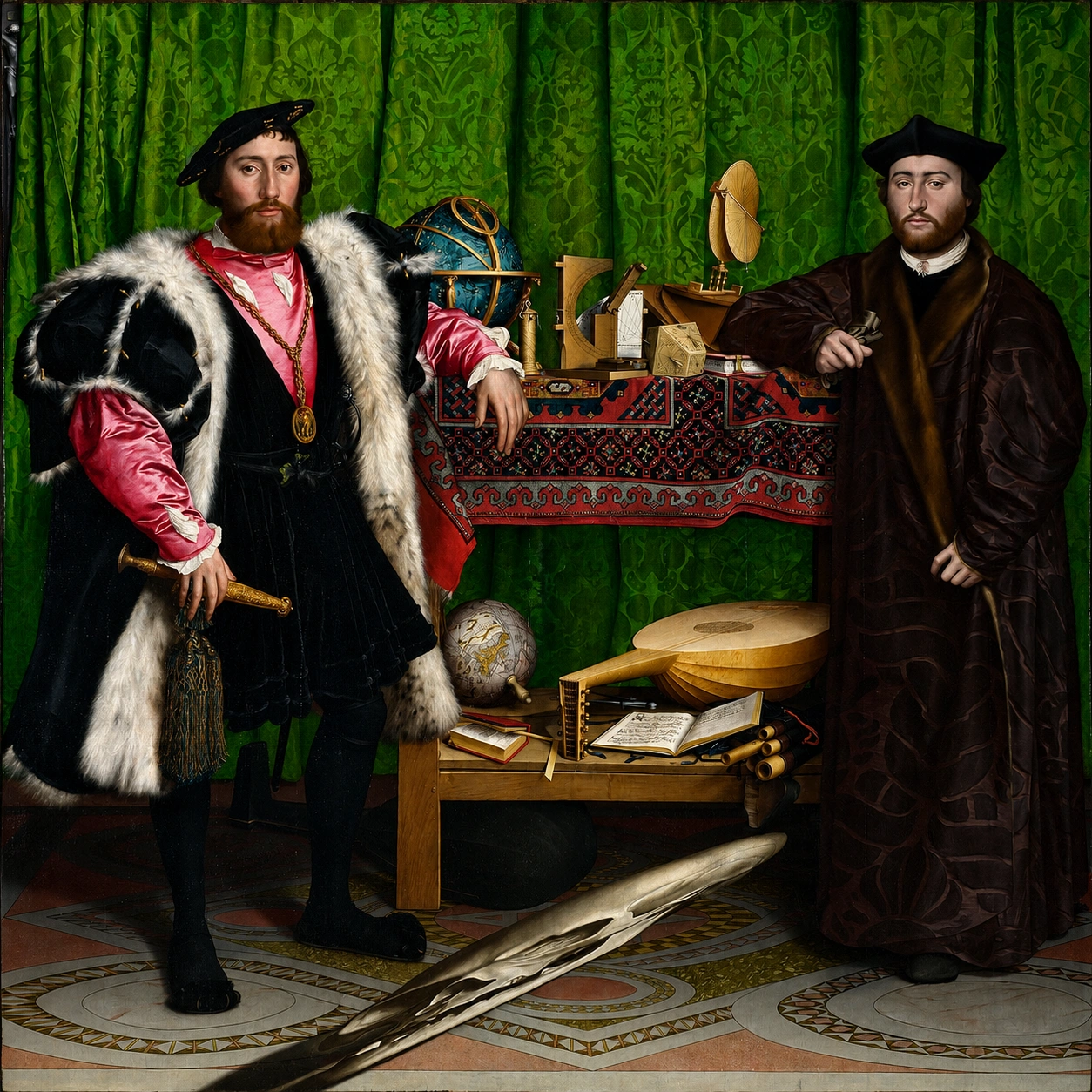
Hans Holbein the Younger’s “The Ambassadors,” painted in 1533, is one of the most intellectually ambitious portraits of the Northern Renaissance. At first glance, it presents two richly dressed men standing beside a table crowded with objects of learning, travel, music, mathematics, and astronomy. Yet the painting is far more than a display of status. It is a meditation on knowledge, power, faith, mortality, and the fragile confidence of Renaissance humanism. Holbein turns portraiture into a visual puzzle, combining astonishing realism with symbolic complexity. Every surface, fabric, tool, and shadow seems carefully chosen, making “The Ambassadors” one of the most fascinating paintings of the 16th century.
The Power of Presence
The two figures dominate the composition with calm authority. The man on the left stands in luxurious clothing, wearing a fur-lined robe over a vivid pink satin garment. His pose is confident and worldly. His hand rests on a dagger, a sign of rank, identity, and social position. The man on the right is more restrained, dressed in darker clerical clothing. His posture is quieter, but no less significant. Together, they represent two forms of influence: political power and intellectual or religious authority.
Holbein’s genius lies in how he gives each sitter a distinct psychological presence. The left figure appears outward-facing, proud, and assertive. The right figure seems more inward, contemplative, and reserved. They do not interact directly with each other, yet they are united by the objects between them. The painting becomes a staged encounter between action and reflection, public life and private thought, material splendor and spiritual seriousness.
A World of Learning and Measurement
The table at the center of “The Ambassadors” is filled with scientific and artistic instruments. Globes, sundials, measuring tools, books, and musical objects create a dense field of meaning. These items reflect the Renaissance fascination with mapping, navigation, astronomy, geometry, and the ordering of the world through reason. The terrestrial globe suggests exploration and political reach, while the celestial instruments point toward humanity’s attempt to understand the heavens.
Holbein paints these objects with extraordinary precision. They are not decorative filler. They are signs of education, curiosity, and human achievement. The ambassadors are shown as men connected to the latest intellectual culture of their age. Their world is one in which knowledge can be collected, measured, displayed, and possessed.
Yet the painting also questions this confidence. The objects are impressive, but they are not perfectly harmonious. Some instruments suggest disorder, disagreement, or uncertainty. The world of knowledge shown here is brilliant, but also unstable. Holbein presents Renaissance learning as magnificent and fragile at the same time.
The Green Curtain and the Stage of the World
The rich green curtain behind the figures gives the painting a theatrical quality. It creates a shallow stage on which the two men and their possessions appear before the viewer. The curtain’s pattern adds visual luxury, but it also has symbolic force. It separates the sitters from the ordinary world, making them appear elevated, almost like actors in a carefully arranged drama of status and meaning.
Green also intensifies the colors around it. The pink satin, white fur, red patterned textile, golden instruments, and dark robes all stand out against the backdrop. Holbein’s color choices are controlled but powerful. The painting is not loud, yet it is visually unforgettable. Its richness comes from the balance between brilliant detail and solemn stillness.
The curtain may also suggest concealment. Something is hidden behind the surface of the image, and the viewer is invited to look more carefully. This idea becomes especially important when considering the painting’s most famous visual secret.
The Anamorphic Skull
The strange distorted shape at the bottom of the painting is one of the most famous uses of anamorphosis in art history. Seen from the front, it looks like a stretched, pale form cutting diagonally across the floor. From the correct angle, it becomes a skull. This visual trick transforms the entire meaning of the painting.
The skull is a reminder of death. In a work filled with wealth, science, diplomacy, and worldly intelligence, Holbein places mortality directly before us, but in a form that cannot be understood from the normal viewing position. The viewer must move, change perspective, and look differently. This is not just a technical display. It is a philosophical statement.
From the ordinary viewpoint, human achievement appears solid and impressive. From another angle, death becomes clear. Holbein suggests that worldly glory depends on perspective. Power, beauty, knowledge, and status are real, but they are temporary. The skull does not cancel the rest of the painting. Instead, it deepens it, making the portrait a profound reflection on the limits of earthly ambition.
Religious Tension and Hidden Meaning
“The Ambassadors” was painted during a period of intense religious conflict in Europe. The Reformation had shaken the unity of Western Christianity, and debates over faith, authority, and worship shaped political life. Holbein includes signs that may allude to this divided world. The broken string on the lute has often been read as a symbol of discord, suggesting broken harmony in religion, politics, or society.
There is also a small crucifix partly hidden in the upper left corner, almost concealed behind the curtain. Its subtle placement is important. Christianity is present in the painting, but not immediately dominant. It is partly obscured by the grand display of human knowledge and worldly prestige. This hidden crucifix complicates the scene. It suggests that beyond science, diplomacy, and material splendor, there remains a spiritual truth that is easy to overlook.
Holbein does not offer a simple moral lesson. Instead, he creates a painting where faith, reason, death, and ambition coexist uneasily. The viewer must navigate these meanings just as carefully as the viewer must navigate the distorted skull.
Holbein’s Mastery of Realism
Holbein’s technical skill is breathtaking. The fur, satin, metal, wood, paper, carpet, and flesh are all rendered with meticulous attention. Each material has its own texture and weight. The white fur looks soft and dense. The pink fabric reflects light with a smooth sheen. The patterned textile across the table is painted with jewel-like precision. The instruments are so carefully described that they seem almost usable.
This realism gives the painting authority. Holbein makes the visible world convincing, then uses that convincing world to carry symbolic meaning. The viewer is drawn in by the beauty of surfaces, but those surfaces lead to deeper questions. This is one reason “The Ambassadors” remains so powerful. It satisfies the eye while challenging the mind.
Why “The Ambassadors” Still Matters
“The Ambassadors” endures because it captures a turning point in European culture. It shows a world fascinated by discovery, measurement, luxury, and intellectual achievement, but also haunted by division and death. Holbein’s painting is not only a portrait of two men. It is a portrait of an age.
The work invites slow looking. Its meaning does not reveal itself all at once. The viewer first notices the figures, then the objects, then the distorted skull, then the hidden crucifix, then the uneasy relationship between everything in the scene. This layered structure makes the painting feel alive. It rewards curiosity and changes as the viewer changes position.
Hans Holbein the Younger’s “The Ambassadors” is a masterpiece because it brings together portraiture, symbolism, science, illusion, and spiritual reflection in one unforgettable image. It celebrates human intelligence while reminding us that knowledge and power cannot escape mortality. In that tension, the painting becomes one of the great visual statements of the Renaissance.