Judith Beheading Holofernes by Artemisia Gentileschi: Vibrant Color Edit
Free to Download & Reuse: You are welcome to use this image! If you republish or share it online, you must include a direct link back to this webpage for attribution.
Original Image Source: wikiart.org
A Powerful Vision of Judith’s Courage
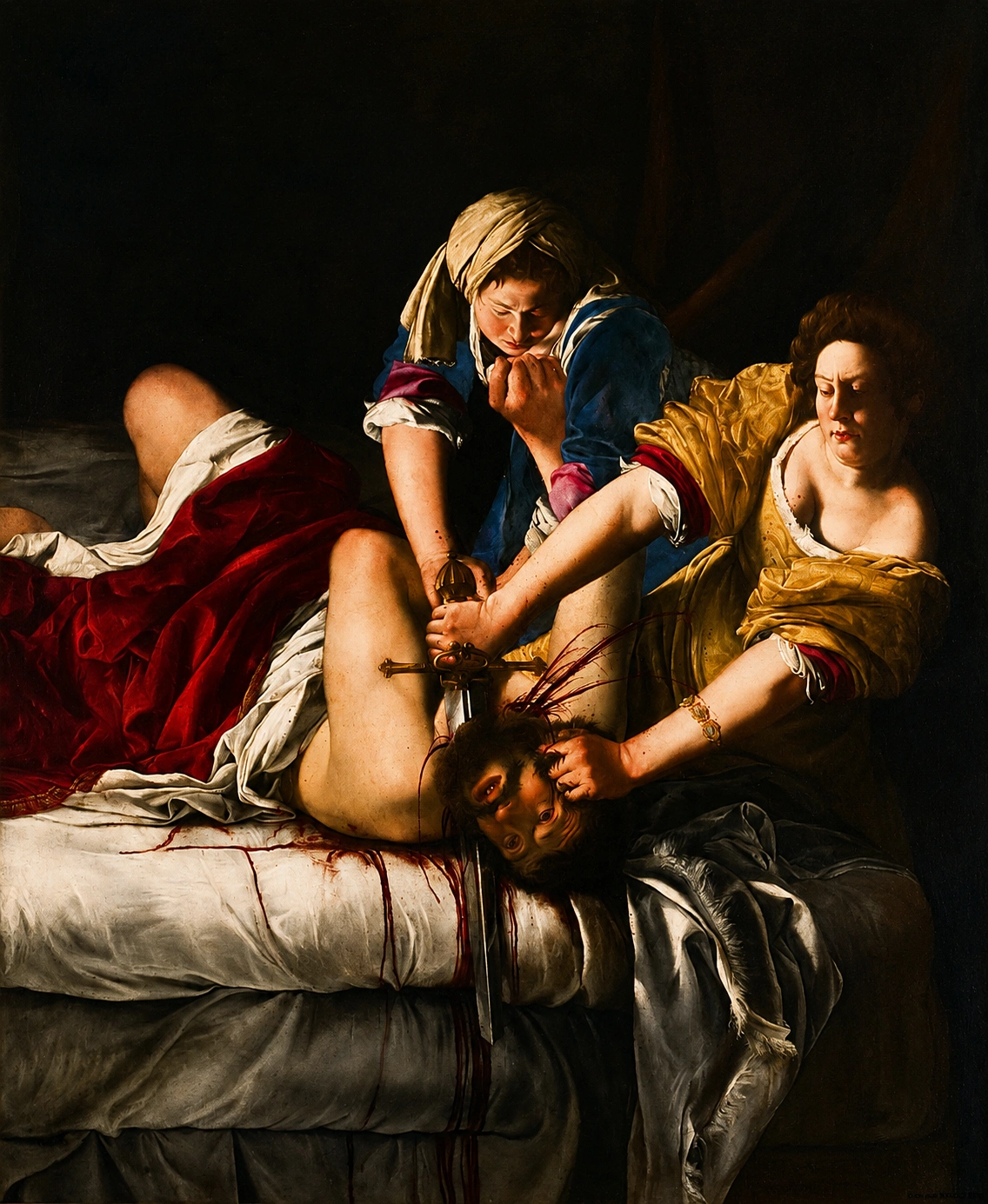
Artemisia Gentileschi’s “Judith Beheading Holofernes” from 1620 is one of the most forceful and unforgettable paintings of the Baroque period. The scene comes from the biblical story of Judith, a widow who saves her people by entering the enemy camp, charming the Assyrian general Holofernes, and killing him while he is vulnerable. Many artists painted this subject, but Gentileschi gives it a startling physical and emotional intensity. Her version is not distant, decorative, or symbolic in a soft way. It is immediate, concentrated, and almost theatrical, placing the viewer close to the action and making Judith’s strength impossible to ignore.
The painting shows Judith and her maidservant working together with determination. Holofernes lies across the bed, his body caught in a dramatic diagonal, while Judith leans forward with controlled force. The maidservant does not stand aside passively. She helps hold him down, becoming an active participant in the event. This is one of the most important aspects of Gentileschi’s interpretation. The women are not presented as fragile figures overwhelmed by violence. They are focused, practical, and united by purpose.
Baroque Drama and Caravaggist Light
Gentileschi was deeply shaped by the dramatic lighting associated with Caravaggio, and this painting shows how powerfully she adapted that influence. The dark background presses the figures forward, while strong light strikes the bodies, faces, fabrics, and hands. This contrast between darkness and illumination gives the scene its emotional urgency. The viewer’s eye moves from Judith’s face to her arms, then to the maidservant’s concentration, and finally to Holofernes’s struggling body.
The light does more than create realism. It gives moral clarity to the composition. Judith’s face is not wild or hysterical. She looks serious, tense, and focused. Her expression suggests resolve rather than cruelty. The maidservant’s face is also crucial. She watches closely, assisting with grim concentration. Together, the two women form a compact unit of action, while Holofernes appears isolated despite his physical size. Gentileschi’s use of light turns the scene into a visual contest between domination and resistance.
Composition and Physical Force
The composition is built around pressure. Arms cross, fabrics twist, bodies overlap, and every major line pushes the viewer toward the center of the action. Holofernes’s body stretches across the bed, but he does not control the space. Judith and her maidservant occupy the upper half of the image with commanding weight. Their arms create a powerful structure, almost like a human mechanism, showing that the act depends on strength, coordination, and courage.
Judith’s posture is especially revealing. She does not shrink from the task, yet she also does not seem theatrically triumphant. Gentileschi avoids turning her into a decorative heroine. Judith’s sleeves are rolled, her arms are firm, and her body leans forward with effort. This makes the painting feel unusually real. The viewer senses the physical labor of the scene, not simply its symbolic meaning.
The maidservant’s role gives the painting another layer of meaning. In many earlier versions of the subject, the maid is shown waiting with a bag or standing at a distance. Here, she is essential. Gentileschi presents female cooperation as the center of victory. Judith is heroic, but she is not alone. The shared action makes the painting feel less like a single dramatic pose and more like a decisive moment of survival.
Color, Fabric, and Emotional Contrast
Although the painting is dominated by darkness, its color is rich and carefully controlled. Judith’s golden dress glows against the shadowed background, making her the visual and moral center of the work. The deep red fabric on the bed adds warmth and danger, while the white sheets intensify the drama of the scene. The maidservant’s blue garment creates a cooler contrast, helping to separate the two women while still linking them visually.
Gentileschi’s handling of fabric is luxurious, but never merely decorative. The folds of Judith’s dress, the white bedding, and the dark drapery all contribute to the painting’s sense of movement. The cloth seems pulled and compressed by the force of the bodies. This is Baroque painting at its most dynamic, where texture, color, and composition all serve the drama.
The contrast between beauty and violence is central to the painting’s power. Judith is elegantly dressed, yet she is engaged in an act of necessity. The rich fabrics remind us that this is not a simple scene of brutality. It is a moral and political drama, a story about danger, courage, and liberation.
Artemisia Gentileschi’s Judith
Gentileschi’s treatment of Judith has often been discussed in relation to her own life and career. As a woman artist in seventeenth-century Italy, she worked in a world dominated by men and had to fight for recognition with unusual determination. Her paintings frequently show women from history, mythology, and scripture as intelligent, resilient, and emotionally complex figures. “Judith Beheading Holofernes” belongs to this larger pattern.
What makes her Judith so compelling is the absence of hesitation. She is not painted as an ornament, a seductress, or a passive instrument of divine will. She is an agent. Her body, expression, and gesture all communicate decision. Gentileschi gives Judith the seriousness usually reserved for male heroes in history painting. The result is one of the strongest images of female action in European art.
This does not mean the painting can be reduced to biography. Its greatness lies in how many levels it holds at once. It is a biblical scene, a Baroque drama, a study of physical action, and a powerful image of resistance. Gentileschi transforms the story into something immediate and human, while still preserving its larger spiritual and political meaning.
Why the Painting Still Matters
“Judith Beheading Holofernes” remains famous because it refuses to soften its subject. Gentileschi does not present courage as graceful or effortless. She shows it as difficult, intense, and demanding. The painting captures the moment when fear has been overcome by action. That is why the image still feels modern. Its emotional force does not depend only on the biblical story. It comes from the way Gentileschi understands power, vulnerability, and determination.
The painting also stands as a masterpiece of Baroque realism. Its lighting, composition, color, and psychological tension all work together with extraordinary precision. Every part of the image contributes to the central drama. Nothing feels accidental. The scene is shocking, but it is also disciplined. Gentileschi’s control as a painter is as impressive as Judith’s control within the story.
In this 1620 version, Artemisia Gentileschi created more than an illustration of a biblical episode. She created an image of focused resistance, female strength, and moral resolve. “Judith Beheading Holofernes” is powerful because it does not look away from conflict, but it also does not treat violence as spectacle. Instead, it presents a decisive act within a world of danger and oppression. Through Judith and her maidservant, Gentileschi gives courage a body, a face, and a terrible clarity.