Calling of Saint Matthew by Caravaggio: Vibrant Color Edit
Free to Download & Reuse: You are welcome to use this image! If you republish or share it online, you must include a direct link back to this webpage for attribution.
Original Image Source: wikiart.org
The Calling of Saint Matthew by Caravaggio
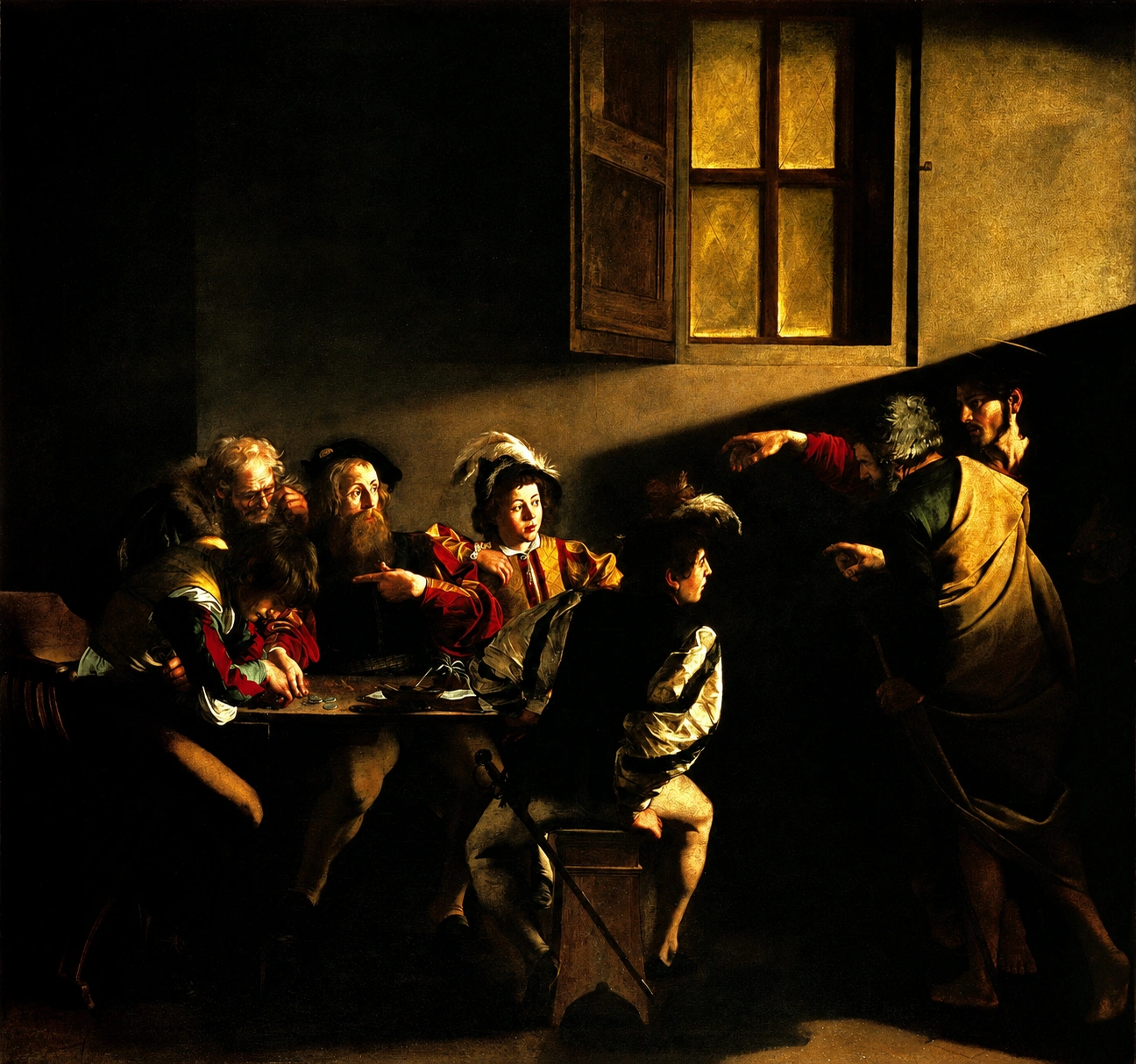
Caravaggio’s “Calling of Saint Matthew,” painted around 1600, is one of the defining images of early Baroque art. Created for the Contarelli Chapel in the church of San Luigi dei Francesi in Rome, the painting captures the moment when Christ enters an ordinary room and calls Matthew to follow him. Rather than showing the scene in a grand biblical setting, Caravaggio places the event in a shadowy interior filled with men dressed like people from his own time. This choice makes the miracle feel immediate, physical, and unexpectedly close to everyday life.
The painting represents the instant of recognition, but Caravaggio makes that recognition uncertain and dramatic. A group of men sits around a table, absorbed in money, conversation, and private attention. From the right, Christ enters with Saint Peter, his arm extended toward the figures at the table. The gesture is quiet but powerful. It does not depend on theatrical movement or divine spectacle. Instead, the force of the scene comes from light, shadow, expression, and the psychological tension between spiritual summons and human hesitation.
Light as Divine Presence
The most striking feature of “Calling of Saint Matthew” is its use of light. A strong beam enters from the upper right and cuts across the dark room, illuminating faces, hands, and fragments of clothing. This light does not behave merely as natural sunlight. It becomes the visual symbol of grace, revelation, and divine intervention. Caravaggio’s mastery lies in making the light feel both believable and supernatural at once.
The room itself is almost swallowed by darkness. The left side of the painting is heavy and dim, while the right side contains the source of spiritual action. Christ is partly hidden in shadow, yet his gesture directs the entire composition. The light seems to travel from his presence toward the seated men, touching them selectively. Some respond, some remain distracted, and some appear unaware. This creates a powerful contrast between those open to transformation and those still enclosed in worldly concerns.
Caravaggio’s technique is often described through chiaroscuro and tenebrism. Chiaroscuro refers to the contrast of light and dark, while tenebrism pushes that contrast into a deeper, more dramatic darkness. In this painting, darkness is not simply background. It is emotional and moral space. It surrounds the figures, isolates them, and makes the arrival of light feel like an event.
The Mystery of Matthew’s Identity
One of the most fascinating aspects of the painting is the question of which figure is Matthew. Traditionally, many viewers identify him as the bearded man near the center who points toward himself in surprise, as though asking, “Who, me?” His face is lit, his expression alert, and his hand gesture echoes the uncertainty of a soul suddenly chosen. This interpretation gives the painting a vivid human drama. Matthew is caught in the moment between his former life and his new calling.
Yet another interpretation suggests that Matthew may be the younger man bent over the coins at the far left of the table. In this reading, the bearded man is not pointing to himself but toward the younger tax collector, who has not yet lifted his head. This possibility deepens the painting’s ambiguity. It suggests that divine calling may occur before the person fully recognizes it. Grace may already be present, even when the chosen person remains absorbed in earthly matters.
Caravaggio leaves the scene open enough to sustain both readings. That ambiguity is part of the painting’s genius. The viewer becomes involved in the act of interpretation, searching the gestures and faces for the exact moment of conversion. Instead of presenting a simple narrative, Caravaggio shows a spiritual crisis unfolding in real time.
A Sacred Event in an Ordinary Room
Caravaggio’s decision to set the scene in a plain, contemporary interior was radical. The room looks more like a Roman tavern or counting house than a biblical setting. The men wear fashionable clothing from around 1600, with feathered hats, rich fabrics, and theatrical sleeves. The table is not an altar but a place of business. Coins lie before the figures, reminding the viewer that Matthew was a tax collector before becoming an apostle.
This ordinary setting makes the sacred event more powerful. Caravaggio removes the distance between biblical history and the viewer’s world. The calling of Matthew is not presented as something safely locked in the past. It appears as something that could happen in a dim room, during a routine moment, among people concerned with money and status. The divine enters not through ceremony but through interruption.
This approach reflects the spiritual intensity of Counter Reformation art, which sought to make religious subjects emotionally direct and accessible. Caravaggio does not idealize the figures into perfect saints. He shows them as flawed, distracted, and human. That realism gives the painting its emotional force. Matthew’s calling matters because he is not already transformed. He is called from the middle of ordinary life.
Gesture, Composition, and Theatrical Drama
The composition of “Calling of Saint Matthew” is carefully structured around hands and lines of sight. Christ’s extended hand is the key gesture. It recalls the hand of God reaching toward Adam in Michelangelo’s Sistine Chapel ceiling, but Caravaggio makes the gesture quieter and more restrained. Christ does not dominate the room physically. His authority is spiritual, expressed through a simple movement.
Saint Peter stands before Christ, partially blocking him from view. This inclusion gives the scene a layered meaning. Peter, the foundation of the Church, becomes a mediator between Christ and Matthew. His presence also makes the divine call feel institutional as well as personal. Matthew is not only called by Christ; he is drawn into the community of apostles and into the future Church.
The figures at the table form a horizontal cluster, while the beam of light cuts diagonally across the composition. This diagonal movement gives the scene energy and direction. The viewer’s eye follows the light from Christ’s side of the painting toward the illuminated faces. The drama is not chaotic. It is controlled, concentrated, and intense.
Realism and Spiritual Psychology
Caravaggio’s realism is not limited to clothing, setting, or physical detail. It is psychological realism. Each figure reacts differently to the arrival of Christ. Some turn in surprise. Others remain focused on the coins. The young figures appear absorbed in immediate concerns, while the older men seem more aware of the disruption. This variety of response makes the scene feel authentic.
The painting does not show conversion as a simple, instant emotional display. Instead, it shows the first shock of being addressed. Matthew’s possible gesture of self-questioning is especially important. He does not leap up in certainty. He hesitates. That hesitation makes the moment believable. A life is about to change, but the old life has not yet disappeared.
Caravaggio’s genius lies in making faith visible through ordinary human reactions. He does not paint halos around the central figures in a decorative way. He lets light, posture, and expression carry the meaning. The sacred is present, but it must be recognized.
Why the Painting Still Feels Modern
“Calling of Saint Matthew” still feels modern because it refuses distance. The scene is dark, intimate, and psychologically unresolved. The viewer is placed inside the room, close to the table, close to the money, close to the uncertainty. Caravaggio does not ask us merely to admire a holy event. He asks us to witness the moment when a person is interrupted by meaning.
The painting’s lasting power comes from this combination of realism and mystery. It is a religious painting, but it is also a study of choice, attention, and transformation. The beam of light becomes more than a formal device. It represents the possibility that grace can arrive suddenly, in the least expected place, and call a person out of habit into a new identity.
Conclusion
Caravaggio’s “Calling of Saint Matthew” is one of the great masterpieces of Baroque painting because it turns a biblical episode into an immediate human drama. Through dramatic light, deep shadow, contemporary clothing, and subtle gesture, Caravaggio makes the viewer feel the shock of divine calling. The painting is not only about Matthew’s conversion. It is about the moment when the ordinary world is pierced by something greater.
Caravaggio’s “Calling of Saint Matthew” is one of the great masterpieces of Baroque painting because it turns a biblical episode into an immediate human drama. Through dramatic light, deep shadow, contemporary clothing, and subtle gesture, Caravaggio makes the viewer feel the shock of divine calling. The painting is not only about Matthew’s conversion. It is about the moment when the ordinary world is pierced by something greater.