Supper at Emmaus by Caravaggio: Vibrant Color Edit
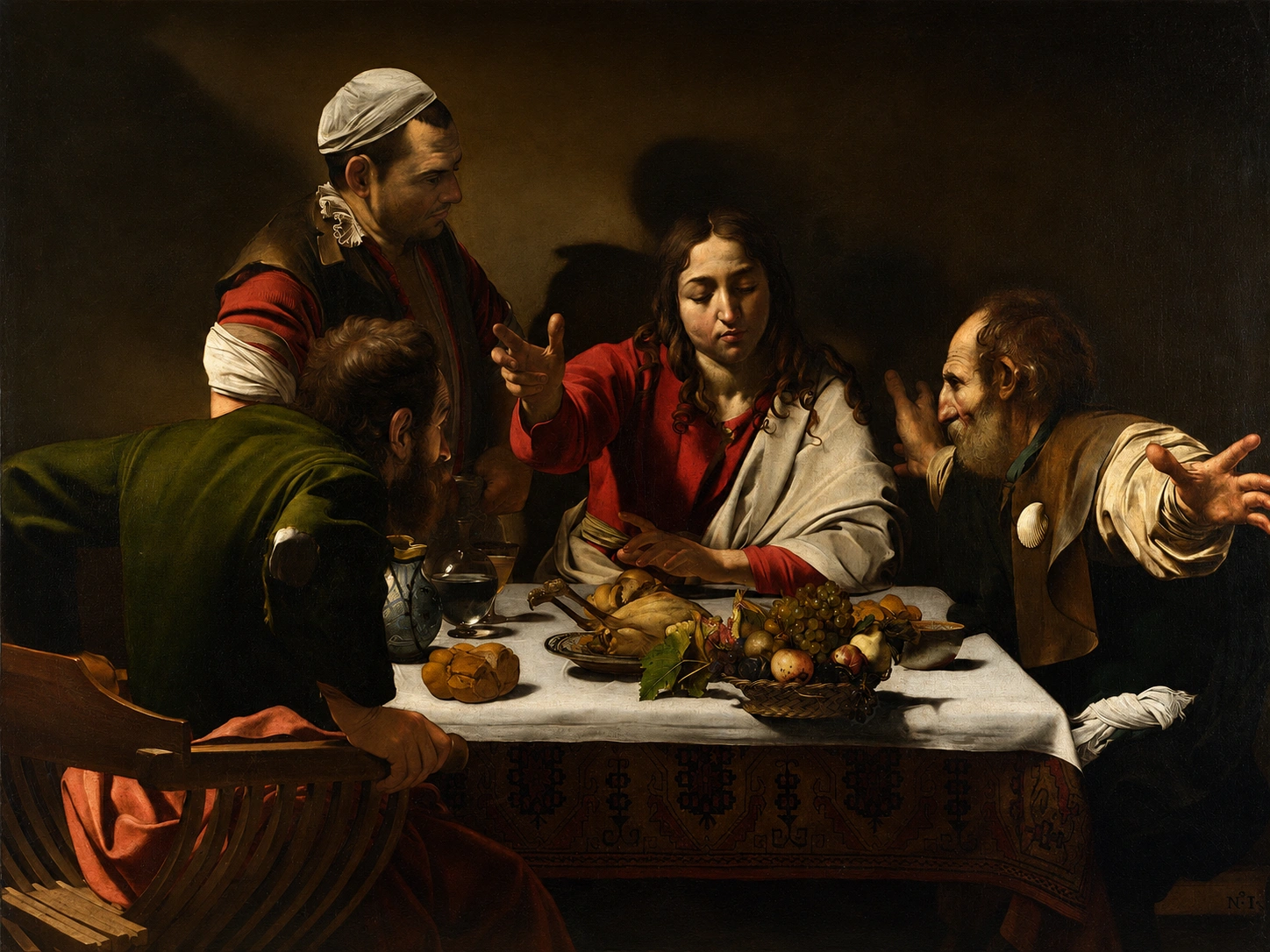
Free to Download & Reuse: You are welcome to use this image! If you republish or share it online, you must include a direct link back to this webpage for attribution.
Original Image Source: wikiart.org
A Complete Analysis of “Supper at Emmaus” by Caravaggio
Caravaggio’s “Supper at Emmaus,” painted in 1601, is one of the most dramatic and spiritually charged interpretations of the biblical scene from the Gospel of Luke. The painting captures the exact moment when the resurrected Christ reveals himself to two disciples who had failed to recognize him during their journey to Emmaus. Rather than presenting the scene as distant, idealized, or ceremonially sacred, Caravaggio brings it into the viewer’s immediate world. The figures sit close to the edge of the canvas, the table projects forward, and the gestures seem to burst into real space. This gives the painting an astonishing sense of presence, as though the revelation is happening not in the past, but directly before us.
The composition is built around a powerful contrast between stillness and shock. Christ sits at the center, calm and composed, raising his hand in blessing. Around him, the disciples react with sudden recognition. The man on the right throws his arms wide in disbelief, while the man on the left pushes himself up from his chair, his elbow jutting toward the viewer. These gestures turn a quiet supper into a moment of revelation. Caravaggio does not show a slow process of understanding. He shows the instant when ordinary sight becomes spiritual vision.
The Central Figure of Christ
Caravaggio’s Christ is unusual because he appears youthful and beardless. This choice gives him a mysterious and almost unexpected presence. He does not resemble the older, suffering Christ familiar from many Crucifixion and Passion images. Instead, he appears renewed, serene, and otherworldly, yet still physically present. His face is soft, his gaze lowered, and his gesture restrained. While the disciples move with surprise and emotion, Christ remains the still center of the painting.
The red garment beneath his pale drapery gives him visual prominence. Red suggests sacrifice, life, and divine love, while the white fabric evokes purity and resurrection. His hand gesture recalls traditional images of blessing, but Caravaggio avoids making the moment feel remote or formal. Christ is seated at an ordinary table, surrounded by food, shadows, and imperfect human beings. This makes the miracle feel deeply human. The sacred enters the everyday without losing its mystery.
Light, Shadow, and Spiritual Recognition
The painting is a masterful example of Caravaggio’s use of chiaroscuro, the dramatic contrast between light and dark. The background is almost entirely shadowed, allowing the figures and objects on the table to emerge with powerful clarity. Light falls across Christ’s face, the white tablecloth, the food, and the expressive hands of the disciples. This light is not merely natural illumination. It also carries symbolic meaning. It represents recognition, grace, and the sudden unveiling of truth.
The darkness around the figures creates a sense of confinement and intensity. There is no distracting landscape, architecture, or decorative setting. The viewer is forced to focus on the human reaction to divine presence. Caravaggio turns light into a theological language. The disciples have been walking in confusion, but at this table, their eyes are opened. The light dramatizes that inner awakening.
The Disciples’ Gestures and Emotional Realism
The two disciples are painted with striking naturalism. Their faces, clothes, and movements feel drawn from real life rather than from idealized religious convention. The disciple on the left is seen from behind, his worn green garment catching the light across his shoulder. He grips the chair as if he is about to leap to his feet. His body twists toward Christ, showing that recognition is not only mental, but physical. His entire body responds.
The disciple on the right is even more theatrical. His arms stretch outward in a gesture of astonishment, forming one of the most memorable passages in the painting. His open hands seem to reach beyond the frame, making the viewer feel included in the revelation. The shell pinned to his clothing identifies him as a pilgrim, which connects the Emmaus story to the broader idea of spiritual journey. Like the disciples, the believer travels without fully understanding, then suddenly encounters truth in an unexpected place.
The Innkeeper and the World of Ordinary Sight
The standing man behind Christ is often understood as the innkeeper. Unlike the disciples, he does not appear to understand what is happening. He looks at Christ, but without the same emotional shock or spiritual recognition. His presence deepens the meaning of the scene. He sees the same person, the same gesture, and the same meal, but he does not perceive the miracle.
This contrast between seeing and understanding is central to the painting. Caravaggio suggests that revelation is not only a matter of physical sight. It requires spiritual awakening. The innkeeper represents the ordinary world, attentive but unaware. His practical presence makes the miracle more believable because it unfolds in a common setting. At the same time, his lack of recognition reminds the viewer that divine truth can be present and still remain unseen.
The Still Life on the Table
The table is one of the most remarkable parts of “Supper at Emmaus.” Caravaggio paints the bread, fruit, fowl, glass, and basket with extraordinary realism. The basket of fruit appears precariously balanced at the edge of the table, almost projecting into the viewer’s space. This illusionistic detail heightens the immediacy of the scene. It also reminds us of the fragility of earthly things.
The fruit may carry symbolic meanings. Some pieces appear ripe, while others show signs of blemish or decay. This mixture suggests the tension between life and mortality, abundance and corruption. The bread at the center is especially important because it connects directly to the biblical moment of recognition. In Luke’s Gospel, the disciples recognize Christ when he breaks bread. Caravaggio therefore makes the meal itself a sign of revelation. The ordinary objects on the table become instruments of sacred meaning.
Caravaggio’s Radical Naturalism
What makes this painting so powerful is Caravaggio’s refusal to separate holiness from the physical world. The disciples have rough faces, worn clothing, and expressive bodies. The table is crowded with tangible objects. The lighting is sharp, theatrical, and immediate. Nothing feels distant or decorative. Caravaggio’s religious art speaks through flesh, gesture, food, fabric, and shadow.
This naturalism was revolutionary because it made sacred history feel present and accessible. The viewer is not invited to admire a distant ideal. The viewer is placed at the table. The outstretched arm, the leaning chair, and the projecting basket all break down the barrier between painted space and real space. Caravaggio turns spectators into witnesses.
The Meaning of the Painting
“Supper at Emmaus” is ultimately a painting about recognition. It shows the moment when the familiar becomes miraculous and when a simple meal reveals the presence of the divine. Caravaggio gives this moment emotional force by grounding it in human surprise. The disciples do not respond with calm ritual dignity. They react as real people might react if the impossible suddenly became visible before them.
The painting remains one of Caravaggio’s greatest achievements because it combines theological depth with dramatic immediacy. Its power comes from the tension between the humble and the divine, the ordinary and the miraculous, the visible and the hidden. In “Supper at Emmaus,” revelation does not arrive in a palace or a temple. It comes at a table, in a dark room, through bread, light, and the sudden recognition of Christ.