Entombment of Christ by Caravaggio: Vibrant Color Edit
Free to Download & Reuse: You are welcome to use this image! If you republish or share it online, you must include a direct link back to this webpage for attribution.
Original Image Source: wikiart.org
Entombment of Christ by Caravaggio: A Dramatic Vision of Sacred Grief
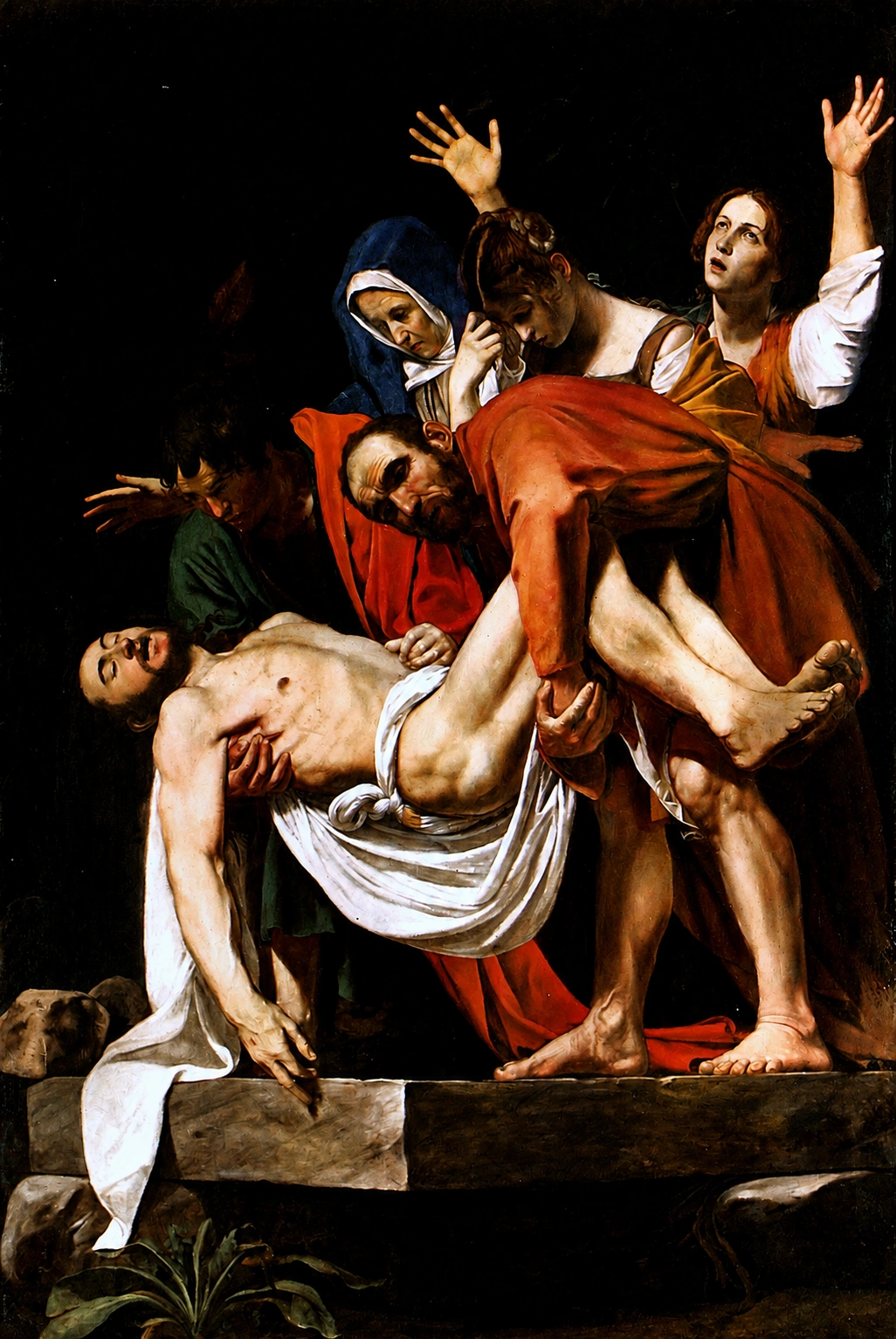
Caravaggio’s “Entombment of Christ,” painted in 1603, is one of the most powerful religious paintings of the Italian Baroque. The work presents the moment when Christ’s body is being lowered toward the tomb after the Crucifixion. Instead of treating the scene as distant, idealized, or heavenly, Caravaggio brings it close to the viewer. The figures press forward into our space, their bodies heavy with sorrow, their gestures urgent and human. The result is a painting that feels immediate, physical, and emotionally overwhelming.
The composition is built around the weight of Christ’s body. His pale torso forms the central visual focus, illuminated against a dark background. Caravaggio uses his famous chiaroscuro, the dramatic contrast between light and shadow, to make the figures emerge from darkness with almost sculptural force. The light does not simply reveal the scene. It gives the painting spiritual intensity. Christ appears both lifeless and sacred, vulnerable in his humanity yet still commanding the center of the image.
A Composition That Pulls the Viewer Into the Scene
One of the most striking features of “Entombment of Christ” is the way Caravaggio arranges the figures in a descending diagonal. The movement begins with the raised hands of the grieving woman at the upper right, passes through the bowed heads of the mourners, then follows Christ’s body down toward the stone slab in the foreground. This downward motion reflects the physical act of burial, but it also creates a spiritual descent from life into death.
The stone slab at the bottom of the painting is especially important. It projects outward toward the viewer, almost as if it extends into our own space. This makes the scene feel less like an image we observe from a distance and more like an event happening directly before us. Caravaggio breaks the barrier between painting and viewer. We are not simply looking at Christ being entombed. We are placed at the edge of the tomb itself.
This closeness is central to the painting’s emotional power. The viewer is invited to witness grief at a human scale. The figures are not elegant abstractions. They strain, bend, hold, support, and mourn. Caravaggio makes sacred history feel present, bodily, and real.
The Human Weight of Christ’s Body
Christ’s body is shown with remarkable naturalism. His head falls back, his arm hangs downward, and his body is supported by those around him. Caravaggio avoids decorative idealization. The body has mass, gravity, and stillness. This physical realism makes the painting deeply moving because it emphasizes the cost of sacrifice.
The pale flesh of Christ contrasts strongly with the surrounding reds, browns, whites, and dark shadows. His body becomes the visual and spiritual center of the work. The white burial cloth underneath him catches the light and echoes the shape of his body, reinforcing the connection between death, purity, and sacrifice.
Caravaggio’s treatment of Christ is not sentimental. It is solemn and direct. The viewer is made to confront the reality of loss, but also the dignity of the moment. Christ’s body is handled with care, and the gestures of the surrounding figures suggest devotion rather than despair alone.
The Figures of Mourning and Devotion
The people around Christ express grief in different ways. The man in red, often identified as Saint John, bends close to Christ and supports him with visible effort. His face is near Christ’s, creating a powerful emotional connection. Another man, usually understood as Nicodemus, bears much of the body’s weight. His solid, grounded form gives the scene a sense of physical truth. He looks outward, bringing the viewer into the sacred drama.
The women behind Christ create a rising rhythm of sorrow. The Virgin Mary, dressed in deep blue and white, appears quietly devastated. Her grief is inward and restrained. Beside her, another woman lowers her head, absorbed in mourning. At the upper right, Mary of Cleophas raises her arms in a gesture of anguish and prayer. This range of emotional responses gives the painting psychological richness. Caravaggio does not show grief as a single expression. He shows it as silence, collapse, prayer, tenderness, and shock.
The gestures are theatrical, but they are not artificial. They feel rooted in bodily experience. Hands reach upward, heads bow downward, and arms strain beneath the burden of Christ’s body. The painting turns mourning into a visual language.
Light, Darkness, and Baroque Spirituality
Caravaggio’s dark background removes nearly all sense of setting. There is no elaborate landscape, no architectural decoration, and no distant crowd. The darkness isolates the figures and concentrates attention on the essential drama. This makes the painting feel both intimate and monumental.
The light falls selectively across faces, hands, fabric, and flesh. It creates a rhythm of revelation. We see what matters most: Christ’s body, the mourners’ expressions, the burden of carrying him, and the stone slab of the tomb. The surrounding darkness suggests mystery, death, and sacred silence.
This use of light is one of the reasons Caravaggio became so influential. He made religious painting feel immediate, dramatic, and emotionally direct. Instead of presenting holiness through gold, ornament, or ideal beauty, he found it in the real human body, in grief, and in the stark meeting of light and shadow.
The Meaning of the Stone Slab
The stone slab in the foreground is more than a physical object. It has symbolic force. It marks the place of burial, but it also resembles an altar. This connection would have been especially meaningful in a church setting. The body of Christ being lowered toward the stone visually echoes the Eucharistic idea of Christ’s sacrifice being made present to believers.
Caravaggio’s composition therefore links the biblical event with devotional experience. The viewer stands before the painting as if standing before an altar. The tomb becomes a sacred threshold. The burial of Christ points toward the promise of resurrection, even though the painting itself remains focused on sorrow and physical loss.
The plant near the lower edge of the image also introduces a quiet note of renewal. In a painting dominated by death and mourning, this small natural detail can suggest hope, rebirth, and the life that will follow the tomb.
Why Entombment of Christ Remains So Powerful
“Entombment of Christ” remains one of Caravaggio’s greatest achievements because it combines realism, drama, and theology with extraordinary clarity. Every figure has a purpose. Every gesture contributes to the emotional force of the scene. Every contrast of light and shadow deepens the painting’s meaning.
The work is also powerful because it refuses distance. Caravaggio does not allow the viewer to treat the event as remote history. The figures are close, the body is heavy, and the tomb seems to open before us. This immediacy is what makes the painting feel modern as well as Baroque. It speaks through physical presence and emotional truth.
Caravaggio’s “Entombment of Christ” is not only a depiction of burial. It is a meditation on sacrifice, grief, devotion, and sacred presence. Through the dramatic arrangement of bodies, the sharp light against darkness, and the profound humanity of the mourners, Caravaggio transforms a biblical scene into an unforgettable encounter with faith and loss.