Conversion of Saint Paul by Caravaggio: Vibrant Color Edit
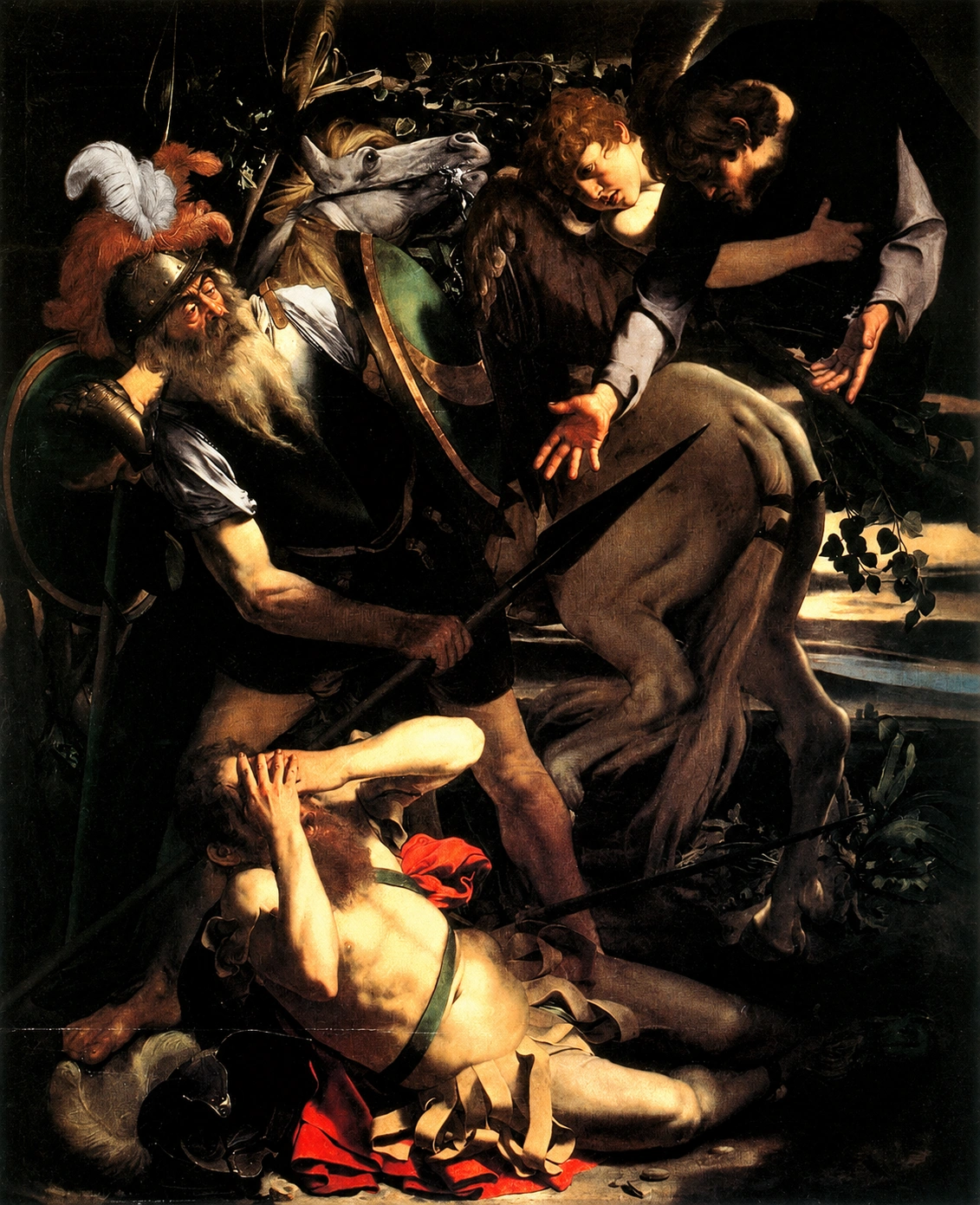
Free to Download & Reuse: You are welcome to use this image! If you republish or share it online, you must include a direct link back to this webpage for attribution.
Original Image Source: wikiart.org
Conversion of Saint Paul by Caravaggio: An Analysis
Caravaggio’s “Conversion of Saint Paul,” painted in 1600, is one of the artist’s most intense early religious dramas. The painting shows the moment when Saul, the future Saint Paul, is thrown into spiritual crisis on the road to Damascus. According to Christian tradition, Saul had been a persecutor of Christians before he was struck by a divine vision and transformed into one of Christianity’s most important apostles. Caravaggio does not present this event as a distant miracle or a calm religious revelation. Instead, he turns it into a scene of physical shock, darkness, fear, and sudden illumination.
The composition is crowded, unstable, and theatrical. Bodies, armor, fabric, limbs, weapons, and the horse all press toward the viewer. Saul lies at the bottom of the painting, exposed and vulnerable, while the horse and surrounding figures dominate the upper space. This arrangement makes the viewer feel as though the conversion is happening in a confined and dangerous place. The scene is not peaceful. It is a violent interruption of ordinary reality, a moment when divine power breaks into human life with overwhelming force.
The Fallen Saul
Saul’s body is the emotional center of the painting. He is shown lying on the ground, partly undressed, with his arms raised in confusion and surrender. His pale body catches the strongest light, making him stand out against the surrounding darkness. Caravaggio presents him not as a noble hero but as a helpless man who has lost control. His armor, sword, and military identity no longer protect him. The proud persecutor has been reduced to human weakness.
This physical collapse is essential to the meaning of the work. Saul’s fall is not only literal but spiritual. Caravaggio uses the body to express inner transformation. The exposed torso, the twisted pose, and the raised hands all suggest a man caught between resistance and acceptance. Saul is not yet the confident Saint Paul of later Christian history. He is still in the middle of conversion, blinded by revelation and forced to confront the limits of his former life.
The red cloth near Saul’s body adds a striking accent of color. It draws the eye toward him and gives the lower part of the painting a dramatic intensity. Red can suggest passion, danger, sacrifice, and spiritual awakening. In this painting, it helps mark Saul as the site of transformation. The color is not decorative. It intensifies the emotional force of the scene.
Light as Divine Presence
Caravaggio is famous for his dramatic use of light and shadow, and “Conversion of Saint Paul” is a powerful example of that style. The painting is dominated by darkness, but the light falls sharply on selected forms. Saul’s body, the horse’s head, the soldier’s face, and parts of the surrounding figures emerge from the gloom. This lighting does not simply make the scene visible. It gives the painting its spiritual meaning.
The divine presence is not shown as a visible figure of Christ in the center of the composition. Instead, it is suggested through light, movement, and the reaction of the figures. This makes the miracle feel mysterious and invisible. The viewer sees the effect of revelation rather than a clear image of its source. Caravaggio’s choice makes the scene psychologically powerful because it places us inside the confusion of the moment.
The contrast between light and darkness also reflects Saul’s spiritual condition. Darkness surrounds him, yet light strikes his body. This suggests the beginning of illumination, even while he remains overwhelmed and uncertain. The painting captures the instant before understanding becomes complete. Saul has not yet risen as Paul. He is still between blindness and faith.
The Horse and the Human Drama
The horse occupies a large and important place in the composition. Its head, body, and tack create a powerful visual mass above Saul. The animal seems restless and difficult to control, adding to the sense of chaos. Caravaggio makes the horse more than a background detail. It becomes part of the force that presses down on Saul and emphasizes his vulnerability.
The horse also contrasts with Saul’s exposed body. While Saul is helpless on the ground, the horse remains physically powerful. Its presence makes the scene feel real and immediate rather than symbolic in a distant or decorative way. Caravaggio brings sacred history into the world of weight, muscle, fear, and accident. The miracle takes place among animals, soldiers, dirt, armor, and confused gestures.
This realism is one of Caravaggio’s great innovations. He does not idealize the event. He makes it bodily and dramatic. The conversion becomes believable because it feels dangerous, sudden, and human.
A Crowded and Unstable Composition
The painting’s composition is deliberately tense. There is little open space. Figures overlap, diagonals cut across the scene, and the viewer’s eye moves rapidly from Saul’s body to the soldier, the horse, the older man, and the bright hand reaching through darkness. Caravaggio avoids calm balance. The painting feels as if it could spill forward into the viewer’s space.
This instability reflects the subject. Conversion is not presented as a gentle change of opinion. It is a rupture. Saul’s old identity is being broken apart. The crowded scene mirrors the pressure of that inner crisis. Everything seems too close, too dark, and too intense.
The diagonal movement of the composition is especially important. Saul’s body lies across the lower part of the canvas, while the horse and surrounding figures create strong opposing directions above him. These diagonals produce energy and confusion. They also guide the viewer toward the spiritual drama at the center of the painting, where human weakness meets divine intervention.
Caravaggio’s Human Vision of Faith
Caravaggio’s religious art often focuses on ordinary human bodies caught in extraordinary spiritual moments. In “Conversion of Saint Paul,” holiness is not shown through calm beauty or heavenly distance. It appears through fear, collapse, darkness, and sudden light. This makes the painting deeply human. Saul’s conversion is not abstract theology. It is an experience that shakes the body and mind.
The figures around Saul do not fully understand what is happening. Their gestures suggest alarm, confusion, or urgent response. This makes Saul’s experience feel intensely personal. The miracle happens in the middle of a public scene, yet its deepest meaning belongs to the fallen man on the ground. Caravaggio shows that conversion can be invisible to others even when it changes everything inside the person who receives it.
This psychological realism gives the painting lasting power. The viewer is not simply asked to admire a biblical story. The viewer is invited to feel the terror and wonder of transformation.
The Meaning of the Painting
“Conversion of Saint Paul” is a painting about the destruction of certainty. Saul begins as a man of force, authority, and conviction. In Caravaggio’s vision, he is thrown down, stripped of confidence, and opened to a new life. The moment is uncomfortable because true transformation is uncomfortable. It requires loss before renewal.
The painting’s darkness is not only a visual setting. It represents the spiritual ignorance from which Saul is emerging. The light does not erase that darkness all at once. Instead, it strikes through it, revealing the body and beginning the process of change. This makes the painting feel suspended in time. We know Saul will become Paul, but Caravaggio chooses the most uncertain instant, when everything is still unsettled.
Caravaggio’s “Conversion of Saint Paul” remains powerful because it treats faith as a dramatic encounter rather than a calm symbol. Through sharp light, deep shadow, crowded bodies, and intense realism, Caravaggio creates a vision of conversion that is physical, emotional, and spiritual at once. The painting shows a man brought low before he can be remade. It is not merely an image of defeat. It is an image of transformation beginning in darkness.