Beheading of Saint John the Baptist by Caravaggio: Vibrant Color Edit
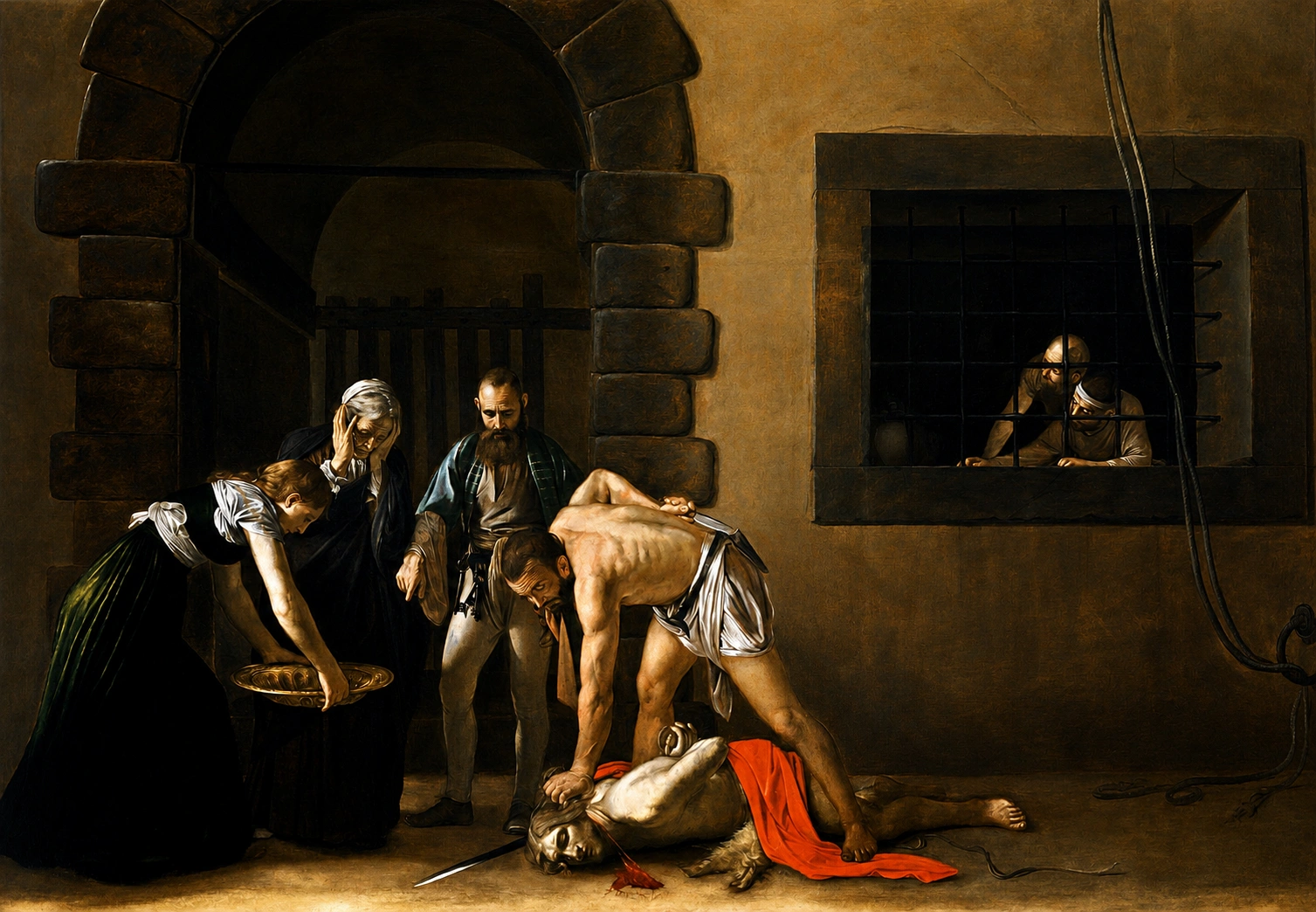
Free to Download & Reuse: You are welcome to use this image! If you republish or share it online, you must include a direct link back to this webpage for attribution.
Original Image Source: wikiart.org
Caravaggio’s “Beheading of Saint John the Baptist”
Caravaggio’s “Beheading of Saint John the Baptist,” painted in 1608, is one of the most powerful religious paintings of the Baroque period. Created during the artist’s stay in Malta, the work presents a sacred subject with startling realism, emotional restraint, and dramatic control of light. Instead of turning the martyrdom of Saint John into a scene of theatrical spectacle, Caravaggio makes it feel immediate, quiet, and deeply human. The result is a painting that does not merely illustrate a biblical event. It confronts the viewer with the weight of violence, guilt, authority, and spiritual sacrifice.
The painting shows the final moment in the life of Saint John the Baptist, the prophet who prepared the way for Christ. According to the Gospel story, John was imprisoned after condemning the marriage of Herod Antipas to Herodias. At the request of Herodias’s daughter, his execution was ordered. Caravaggio chooses the moment after the order has been carried out, when the executioner bends over John’s body and prepares to complete the grim task. Around them stand several witnesses: an old woman in anguish, a young servant holding a basin, a jailer directing the action, and two prisoners watching from behind bars.
Composition and Space
The composition is striking because of its emptiness. Most of the figures are gathered toward the lower left and center, while a large wall dominates the right half of the canvas. This wide, bare space creates a feeling of silence and oppression. Caravaggio avoids decorative richness and instead places the event inside a severe prison courtyard, where rough stone, darkness, and shadow define the atmosphere.
The archway on the left frames part of the action, while the barred window on the right introduces another layer of observation. The two figures behind the bars are not active participants, but their presence intensifies the moral pressure of the scene. They watch helplessly, just as the viewer watches. This device makes the audience feel implicated, as if witnessing something real rather than contemplating a distant religious legend.
The figures form a low, horizontal arrangement across the foreground. Saint John lies on the ground, his body stretched across the floor, while the executioner bends over him. The young servant leans forward with the basin, and the old woman raises her hand to her face in sorrow. These gestures create a rhythm of looking, bending, recoiling, and waiting. Nothing feels accidental. Each body contributes to the emotional structure of the painting.
Light, Shadow, and Caravaggio’s Realism
Caravaggio’s use of light is central to the painting’s force. A controlled beam illuminates the main figures, especially Saint John’s body, the executioner’s back, the servant’s white sleeves, and the faces of the witnesses. The surrounding darkness does not simply create drama. It suggests the moral and spiritual darkness of the prison itself.
The light also gives the scene a sacred dimension without relying on halos, angels, or supernatural signs. Caravaggio’s spirituality is grounded in physical reality. Holiness appears through suffering, silence, and human presence. Saint John’s body is painted with a naturalism that makes him vulnerable rather than idealized. He is not presented as an untouchable icon, but as a man who has endured the consequences of truth.
This realism was one of Caravaggio’s great innovations. He brought biblical subjects into the world of ordinary bodies, worn faces, dirty rooms, and harsh light. In “Beheading of Saint John the Baptist,” that realism becomes especially intense. The viewer is not invited to admire beauty in a detached way. The viewer is asked to confront a sacred event as if it has just happened before their eyes.
The Emotional Power of Restraint
One of the most remarkable qualities of the painting is its restraint. Caravaggio does not fill the scene with exaggerated grief or chaotic movement. The old woman’s gesture expresses horror and sorrow, but even this is contained. The young servant appears focused and solemn. The jailer stands firmly, pointing downward, as if reducing a spiritual tragedy to a practical command. The executioner is physically active, but his face is turned away and his emotion remains unreadable.
This emotional control makes the painting more disturbing and more profound. The scene feels official, almost routine. Saint John’s death is not shown as a dramatic battle between good and evil, but as an act carried out by human institutions. The prison setting, the jailer’s authority, and the silent witnesses all suggest a world where injustice can become procedure.
The old woman is especially important because she gives the viewer an emotional point of entry. Her raised hand and lined face express the human response that the other figures suppress. She seems to understand the spiritual gravity of what has occurred. Her grief contrasts with the cool authority of the jailer and the mechanical role of the executioner.
Saint John as Martyr
Saint John occupies the lowest position in the composition, but he remains the spiritual center of the painting. His body receives the strongest visual attention, and the space around him seems to gather meaning from his presence. Caravaggio emphasizes not triumph, but surrender. John’s martyrdom is shown through stillness.
The painting captures the paradox of Christian martyrdom: physical defeat becomes spiritual witness. Saint John appears powerless in worldly terms, yet the composition gives him a solemn dignity. His body anchors the entire scene. The other figures move around him, react to him, or look toward him, but he is the reason the painting exists.
Caravaggio’s personal circumstances may deepen the painting’s emotional charge. By 1608, he was living a troubled life marked by exile, conflict, and the need for protection from powerful patrons. In Malta, he was connected with the Knights of Saint John, and this painting was made for their oratory. The subject of punishment, judgment, and spiritual reckoning would have carried both religious and personal meaning.
The Signature in the Painting
One of the most famous details of “Beheading of Saint John the Baptist” is Caravaggio’s signature. It is often noted as the only painting he signed. The placement of the signature within the scene gives it unusual significance. Rather than appearing as a proud artistic declaration, it feels absorbed into the tragedy itself.
This detail has encouraged many interpretations. Some see it as a sign of penitence, others as a dramatic identification with the violence and guilt surrounding the scene. Whatever the intention, the signature strengthens the sense that Caravaggio was not treating this subject from a distance. He entered the painting emotionally and spiritually, binding his name to a scene of judgment and sacrifice.
Why the Painting Still Matters
“Beheading of Saint John the Baptist” remains one of Caravaggio’s greatest achievements because it combines monumental scale with psychological intimacy. It is grand without being decorative. It is dramatic without being theatrical. It is religious without depending on obvious supernatural imagery. Its power comes from the terrifying closeness of the event and the moral seriousness with which it is presented.
The painting also shows Caravaggio at the height of his mature style. His command of darkness, naturalistic anatomy, controlled gesture, and compressed emotion is extraordinary. Every part of the canvas serves the meaning of the subject. The empty wall, the barred window, the low arrangement of figures, and the stark lighting all create a world where spiritual truth appears in the middle of human cruelty.
In the end, Caravaggio’s “Beheading of Saint John the Baptist” is not only a painting about a biblical martyr. It is a painting about power, silence, conscience, and the cost of truth. Its greatness lies in the way it refuses comfort. The viewer is left in the prison courtyard, facing the aftermath of an irreversible act, while the light continues to fall on the body of a saint.