David with the Head of Goliath by Caravaggio: Vibrant Color Edit
Free to Download & Reuse: You are welcome to use this image! If you republish or share it online, you must include a direct link back to this webpage for attribution.
Original Image Source: wikiart.org
Introduction
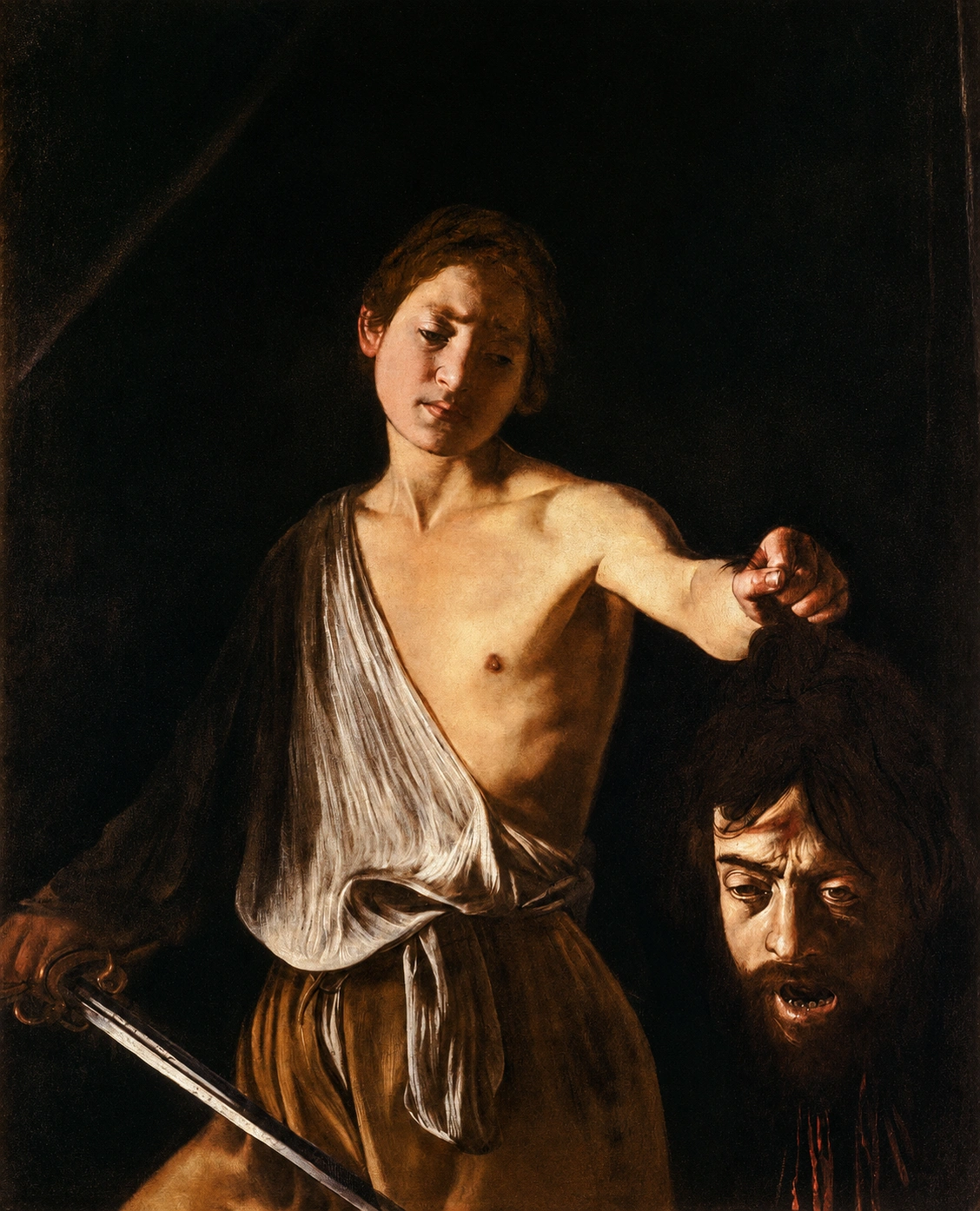
Caravaggio’s “David with the Head of Goliath,” painted in 1610, is one of the most haunting works of the artist’s final period. Unlike many heroic depictions of David, this painting does not celebrate victory with triumph, spectacle, or youthful pride. Instead, Caravaggio presents a quiet, psychologically complex image of aftermath. David stands in darkness, holding the head of Goliath with one hand and a sword with the other. The scene is dramatic, but the emotion is restrained. The painting feels less like a public victory and more like a private moral reckoning.
Created near the end of Caravaggio’s troubled life, “David with the Head of Goliath” carries an unusually personal intensity. The young David appears calm, almost sorrowful, while Goliath’s face has often been understood as a possible self-portrait of Caravaggio. Whether or not this interpretation is accepted literally, the painting clearly reflects themes of guilt, mercy, judgment, and spiritual confrontation. It is not simply a biblical scene. It is a meditation on violence, redemption, and the human soul.
The Biblical Subject
The story of David and Goliath comes from the First Book of Samuel. David, a young shepherd, defeats the giant warrior Goliath with a sling before taking his enemy’s sword. In art, this subject often becomes a symbol of courage, divine favor, and the victory of the humble over the powerful. Renaissance and Baroque artists frequently used David to represent youthful bravery and the triumph of faith.
Caravaggio’s version is different. His David is not shown at the height of action. There is no battlefield, no cheering crowd, and no visible sign of divine glory. The victory has already happened, but the emotional result is unsettled. David does not look proud. His expression is thoughtful and subdued, as though he understands the seriousness of what has occurred. By choosing this moment, Caravaggio transforms the biblical hero into a figure of moral awareness.
This makes “David with the Head of Goliath” one of the most introspective interpretations of the story. The painting asks the viewer to look beyond victory and consider its cost.
Composition and Dramatic Focus
The composition is simple but powerful. David occupies the left and central areas of the painting, while Goliath’s head appears on the lower right. The surrounding darkness isolates the figures and removes almost all narrative detail. There is no landscape, architecture, or crowd to distract the eye. The viewer is brought directly into contact with the two central forms: the living youth and the defeated giant.
David’s body forms a gentle diagonal, from his lowered sword to his extended arm. This creates movement without chaos. His arm reaches outward, holding Goliath’s head away from his own body, yet his expression suggests emotional connection rather than disgust or celebration. Caravaggio uses this pose to create tension. David has won, but he does not seem detached from the defeated man.
The sword is also important. It stretches across the lower left of the painting, reminding the viewer of the violence that has taken place. Yet Caravaggio avoids turning the weapon into a symbol of glory. It is heavy, physical, and subdued. Like the rest of the painting, it belongs to a world of consequences rather than spectacle.
Light, Shadow, and Caravaggio’s Tenebrism
Caravaggio’s use of light and shadow is central to the painting’s emotional power. The background is almost entirely dark, while light falls across David’s chest, face, arm, and drapery. This dramatic contrast, known as tenebrism, was one of Caravaggio’s defining techniques. In “David with the Head of Goliath,” it does more than create visual drama. It gives the scene a spiritual and psychological atmosphere.
The light does not simply illuminate the bodies. It reveals character. David’s youthful skin, soft face, and pale garment stand out against the darkness, making him appear vulnerable as well as victorious. Goliath’s head emerges from shadow with a heavier, more tragic presence. The contrast between the two figures is not only physical. It is emotional and symbolic.
The darkness surrounding them can be read as moral uncertainty, spiritual crisis, or the hidden space of the conscience. Caravaggio often used darkness not as an empty background, but as an active force. Here, it presses around the figures, making the painting feel intimate, silent, and severe.
David’s Expression and Emotional Ambiguity
One of the most striking aspects of the painting is David’s expression. He does not look like a conventional conqueror. His face is calm, but also troubled. His eyes appear lowered, his mouth relaxed, and his posture controlled. Instead of arrogance, he shows reflection. Instead of joy, he shows a kind of reluctant acceptance.
This emotional ambiguity gives the painting much of its depth. David may represent justice, but he does not appear free from compassion. He has defeated evil, yet he seems aware that victory through violence is not simple. Caravaggio presents him as both innocent and burdened.
David’s youth is also important. His smooth face and slender body contrast sharply with Goliath’s heavier features. This contrast emphasizes the biblical theme of the weak overcoming the strong, but Caravaggio complicates it. David’s softness is not merely heroic purity. It also makes him seem emotionally exposed. He is not untouched by the event. He is changed by it.
Goliath as a Possible Self-Portrait
One of the most famous interpretations of “David with the Head of Goliath” is that Caravaggio used his own features for Goliath. This idea has given the painting a powerful autobiographical reading. Caravaggio painted the work during the final year of his life, after years of conflict, exile, and attempts to secure pardon. In this context, Goliath’s head can be understood as an image of self-judgment.
If Goliath reflects Caravaggio himself, the painting becomes more than a biblical illustration. It becomes a confession. David may represent divine justice, youthful innocence, or mercy, while Goliath becomes the image of the fallen sinner. The relationship between the two figures then becomes deeply personal. Caravaggio may be presenting himself as both condemned and seeking forgiveness.
Even without accepting this interpretation literally, the painting has a confessional atmosphere. Goliath is not treated as a simple villain. His face has human weight and emotional presence. He is defeated, but not mocked. This gives the image a tragic dignity and makes the viewer feel the seriousness of judgment.
Clothing, Color, and Physical Realism
Caravaggio’s realism is visible in every part of the painting. David’s garment is loosely wrapped around his body, exposing his shoulder and chest. The folds of the fabric catch the light with subtle variations of white, gray, and violet. His brown trousers and natural skin tones keep the figure grounded in physical reality.
The colors are restrained but expressive. The palette is dominated by deep blacks, warm browns, flesh tones, and muted whites. This limited range intensifies the drama. Nothing feels decorative or unnecessary. Every color serves the emotional atmosphere of the painting.
Caravaggio’s figures are not idealized in the polished classical manner. They feel present, physical, and human. David is not a distant symbol. He is a young person standing in a dark space, carrying the weight of a terrible victory. This directness is one reason Caravaggio’s art felt so revolutionary. He brought sacred stories into the realm of immediate human experience.
Meaning and Legacy
“David with the Head of Goliath” is one of Caravaggio’s most powerful late paintings because it combines biblical drama with psychological confession. It shows the victory of David, but it refuses easy triumph. The painting is about justice, but also mercy. It is about evil defeated, but also about the sadness of human violence. It is about the biblical past, but also about Caravaggio’s own spiritual crisis.
The work remains unforgettable because of its emotional restraint. Caravaggio does not need a crowded scene or theatrical gesture to create intensity. The dark background, the lowered eyes of David, the extended arm, and the silent presence of Goliath are enough. The viewer is left with a profound sense of judgment and compassion existing at the same time.
In “David with the Head of Goliath,” Caravaggio turns a familiar story into a deeply personal image of conscience. It is not simply a painting of victory. It is a painting about what victory means when the soul must answer for it.