The Tempest by Giorgione: Vibrant Color Edit
Free to Download & Reuse: You are welcome to use this image! If you republish or share it online, you must include a direct link back to this webpage for attribution.
Original Image Source: wikiart.org
A Mysterious Masterpiece of the Venetian Renaissance
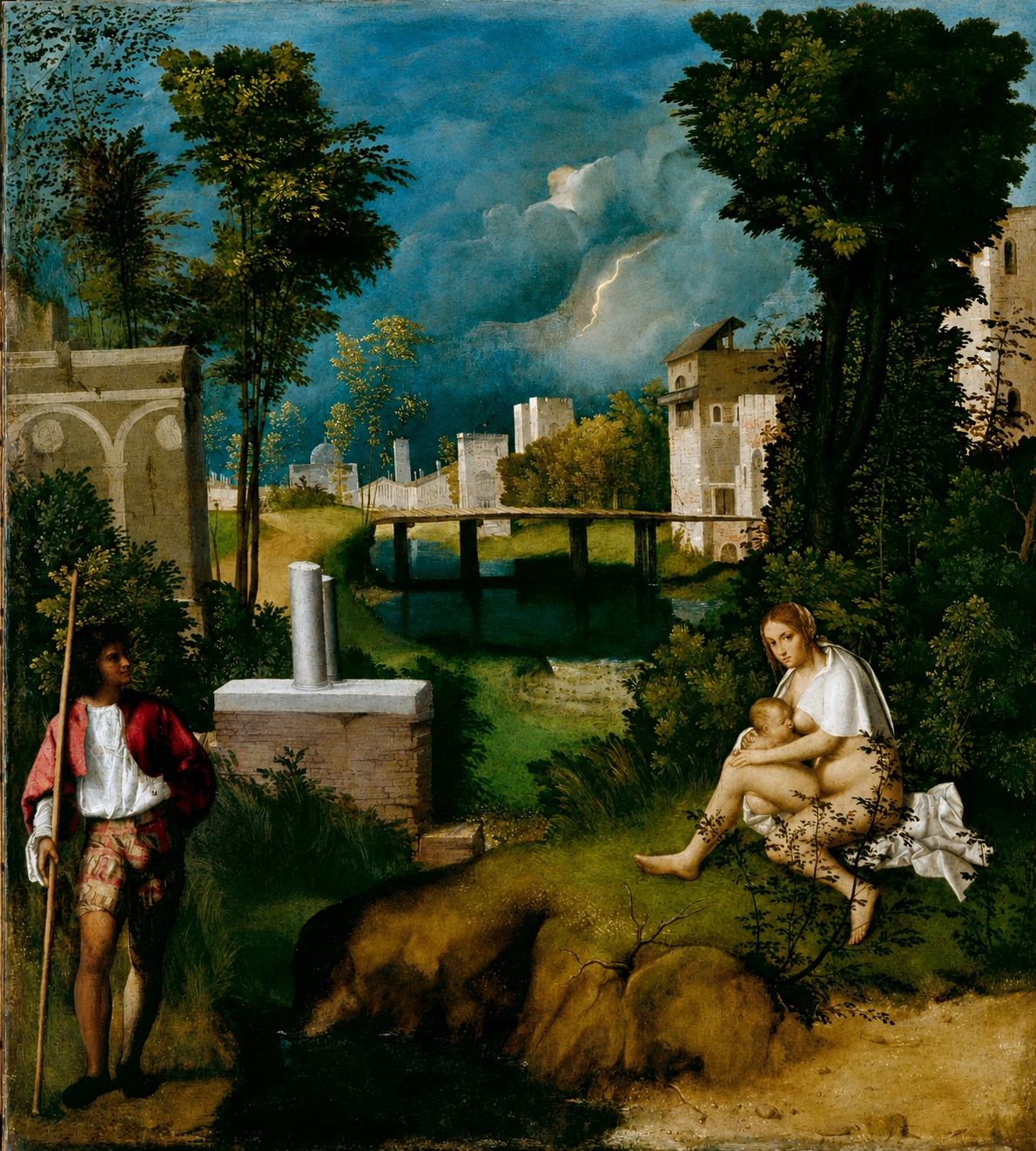
“The Tempest” by Giorgione, painted in 1508, is one of the most enigmatic works of the Italian Renaissance. Unlike many paintings of its time, it does not present an obvious biblical, mythological, or historical scene. Instead, it offers a strange and poetic landscape filled with atmosphere, silence, and uncertainty. A young man stands at the left, holding a staff. On the right, a seated woman nurses a child while looking outward toward the viewer. Between them stretches a lush, dreamlike landscape of trees, water, ruins, bridges, towers, and a darkening sky split by a flash of lightning.
The painting’s mystery is not a weakness. It is the source of its power. Giorgione creates a world that feels meaningful without explaining itself. “The Tempest” seems to invite interpretation, but it resists being reduced to a single story. Its beauty lies in that tension between recognition and uncertainty, between the visible and the unknowable.
Composition and Visual Structure
At first glance, the composition appears calm and balanced, yet everything in the painting is charged with unease. The young man on the left and the woman with the child on the right frame the foreground, but they do not seem to interact directly. Their separation creates a psychological distance. They belong to the same space, yet they appear absorbed in separate realities.
The landscape between them becomes more than a background. It is the true center of the painting. The stream, bridge, buildings, ruins, and stormy sky draw the viewer’s eye inward. Giorgione uses the figures almost as gateways into the landscape rather than as the clear subjects of a narrative. This was highly innovative. In much earlier Renaissance art, the setting usually served the story. In “The Tempest,” the landscape seems to hold the story itself.
The dark trees at the right form a heavy vertical mass, while the buildings and bridge in the distance create depth and architectural rhythm. The sky opens dramatically above the scene, giving the painting a sense of vastness beyond its modest scale. Every part of the image feels connected by mood rather than by clear action.
The Storm as Emotional Force
The lightning in the sky gives the painting its title and its emotional charge. It is small in size, yet it transforms the entire scene. The storm is not shown as a violent catastrophe. Instead, it appears as a sudden sign of instability, a flash of energy in an otherwise quiet world.
This storm can be read in many ways. It may suggest nature’s power, human vulnerability, divine presence, or emotional unrest. The figures do not react dramatically to it, which makes the scene even stranger. The young man remains still. The woman continues nursing the child. The world seems suspended in the moment before change.
Giorgione’s handling of weather is deeply poetic. The sky is not merely blue or gray. It is filled with shifting tones, misty clouds, and atmospheric depth. The storm feels both physical and symbolic. It belongs to the landscape, but it also seems to express the hidden mood of the painting.
The Figures and Their Uncertain Meaning
The standing young man has often been interpreted as a soldier, shepherd, traveler, or guardian. His clothing is elegant, and his staff gives him a pastoral quality. Yet his identity remains uncertain. He looks across the scene, but his relationship to the woman and child is unclear. Is he protecting them, observing them, ignoring them, or simply sharing the same symbolic space?
The seated woman is even more mysterious. Her act of nursing gives the painting a strong sense of motherhood, fertility, and human tenderness. At the same time, her placement in the wild landscape is unusual. She appears exposed yet calm, natural yet monumental. Her gaze toward the viewer creates a direct connection that the young man does not offer. She seems aware of being seen, but her expression remains quiet and unreadable.
The contrast between the clothed man and the partly uncovered woman has encouraged many interpretations. Some have seen the painting as an allegory of nature and civilization. Others have connected it to themes of family, exile, charity, fertility, or the beginning of human life. Giorgione does not confirm any of these readings. Instead, he allows the figures to remain suggestive, like characters from a poem whose full story has been lost.
Landscape, Ruins, and the Passage of Time
The landscape of “The Tempest” is filled with signs of human presence, but it does not feel fully controlled by humanity. Ruins, walls, columns, and buildings appear throughout the scene. These architectural fragments suggest history, memory, and decay. Nature grows around them, softening and absorbing them into the green world.
The broken column near the foreground is especially important. A column often represents order, permanence, and classical civilization. Here it is incomplete and displaced. It becomes a symbol of a world that has changed or fallen into silence. The distant city or village adds another layer of meaning. Human life exists nearby, yet the figures remain outside it, placed at the edge of society and nature.
This blending of architecture and landscape is central to the painting’s mood. Giorgione does not present nature as empty wilderness. He presents it as a place where human history, natural growth, and emotional mystery overlap.
Color, Light, and Atmosphere
Giorgione was one of the great masters of Venetian color. In “The Tempest,” color is not used only to describe objects. It creates atmosphere. The deep greens, muted blues, earthy browns, and pale flesh tones produce a world that feels humid, shadowed, and alive. The red of the young man’s clothing adds warmth and visual contrast, while the woman’s pale skin and white drapery stand out against the surrounding foliage.
The painting’s light is soft and uncertain. It does not fall in a simple, logical pattern. Instead, it seems to emerge from the air itself. This gives the scene a dreamlike quality. The figures, trees, water, and architecture are unified by the same moist, glowing atmosphere. Giorgione’s brushwork helps create this effect, making forms appear gently blended rather than sharply outlined.
This atmospheric unity is one of the painting’s great achievements. The viewer does not simply look at a landscape. The viewer feels immersed in a world of weather, silence, and expectation.
Why “The Tempest” Still Fascinates Viewers
“The Tempest” remains famous because it refuses to behave like a conventional Renaissance painting. It does not clearly explain who its figures are, what moment is being shown, or what lesson the viewer should learn. Instead, it offers ambiguity as beauty. The painting feels like a fragment of a larger mystery, one that can be approached but never completely solved.
This is what makes Giorgione so modern. He understands that a painting can move the viewer without providing a fixed narrative. The emotional truth of “The Tempest” lies in its atmosphere, not in a single meaning. The storm, the mother and child, the solitary young man, the ruins, and the green landscape all contribute to a sense of fragile human life within a powerful natural world.
In 1508, Giorgione created a work that expanded what painting could be. “The Tempest” is not only a scene. It is a mood, a question, and a visual poem. Its mystery has lasted for centuries because Giorgione painted not an answer, but an experience.