The Sleeping Venus by Giorgione: Vibrant Color Edit
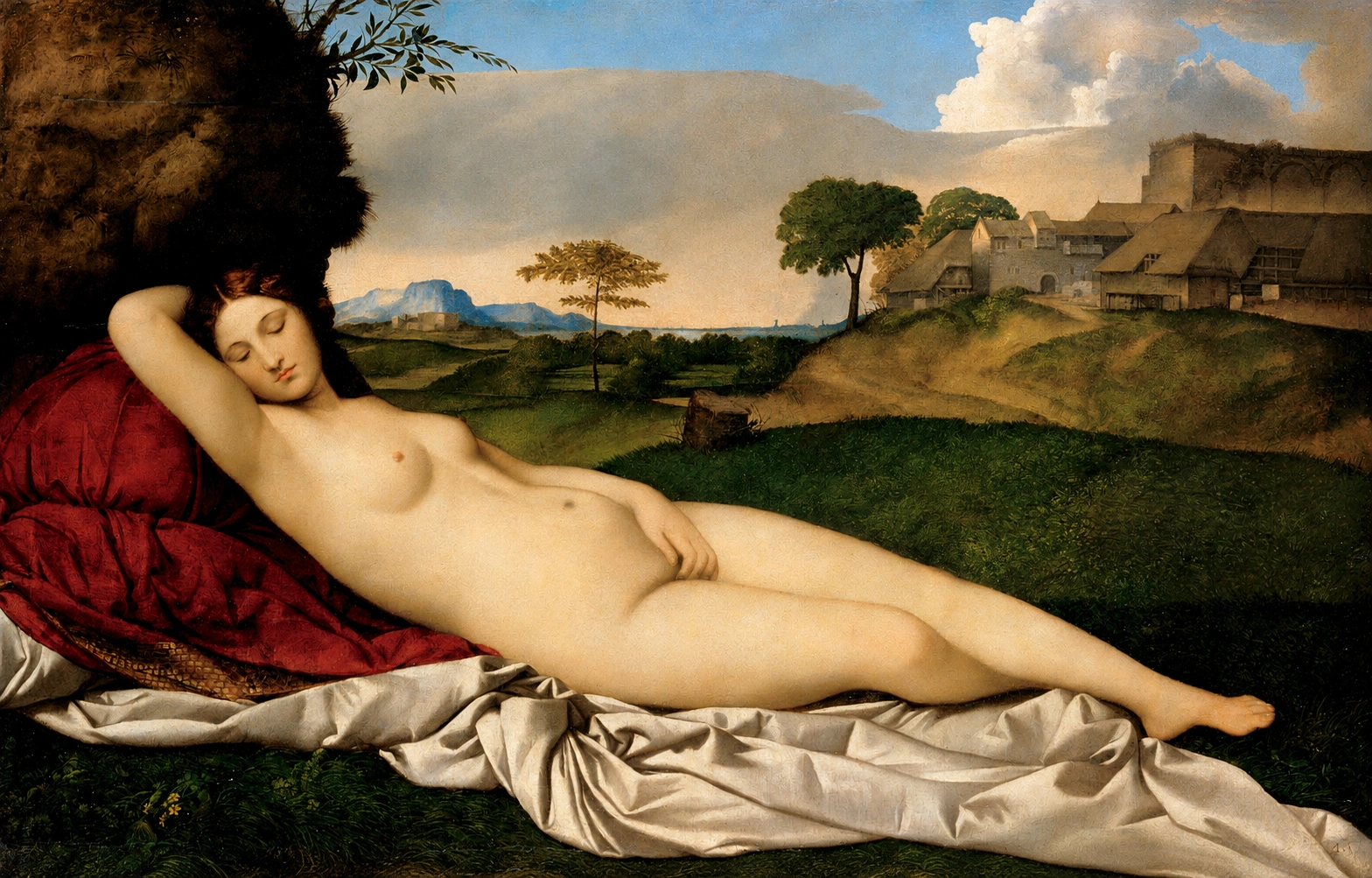
Free to Download & Reuse: You are welcome to use this image! If you republish or share it online, you must include a direct link back to this webpage for attribution.
Original Image Source: wikiart.org
The Calm Power of “The Sleeping Venus”
Giorgione’s “The Sleeping Venus”, painted around 1510, is one of the most influential images of the reclining nude in Western art. At first glance, the painting seems quiet and simple: a sleeping goddess rests in an open landscape, her body arranged across a pale sheet and a deep red cushion while the countryside stretches behind her. Yet this stillness is exactly what gives the work its power. Giorgione transforms the mythological figure of Venus into an image of harmony, beauty, distance, and dreamlike calm.
The painting does not present Venus in an active mythological episode. There is no dramatic story, no gathering of gods, no visible lover, no moment of conflict. Instead, Giorgione focuses on presence. Venus is shown asleep, removed from ordinary time, as if she belongs both to the natural world and to an ideal realm beyond it. Her closed eyes protect her from the viewer’s gaze, making the image feel less like a scene being witnessed and more like a vision being contemplated.
Composition and the Reclining Figure
The composition is built around the long diagonal of Venus’s body. She stretches from the shaded left side of the painting toward the open right edge, creating a graceful visual rhythm that guides the eye across the canvas. Her pose is relaxed, balanced, and carefully arranged. The curve of her body echoes the rolling hills in the background, linking the human figure to the landscape around her.
This connection between body and landscape is one of the painting’s most important achievements. Venus does not seem placed in nature as a separate object. Instead, she appears to belong to the same poetic order as the grass, trees, hills, clouds, and distant buildings. Her form repeats the soft rises of the earth behind her, while the gentle light on her skin mirrors the atmospheric glow of the sky. Giorgione turns the goddess into a symbol of natural beauty itself.
The painting’s horizontal format strengthens this sense of calm expansion. Nothing feels cramped or forced. The figure has space to breathe, and the landscape unfolds slowly behind her. The dark mass of trees and rock on the left creates a protective shadow, while the brighter countryside on the right opens the scene outward. This movement from shade to light gives the painting a subtle emotional progression, from intimacy to distance, from sleep to dream.
Color, Light, and Atmosphere
The color palette of “The Sleeping Venus” is restrained but deeply expressive. Giorgione uses warm flesh tones, dark greens, smoky browns, pale blues, and muted golds to create a world that feels soft and atmospheric. The red fabric behind Venus provides the strongest color accent. Its richness contrasts with the pale sheet and the luminous body, making the sleeping figure stand out without disturbing the quiet mood.
Light plays a central role in the painting. Venus’s body is gently illuminated, not with harsh theatrical brightness, but with a soft radiance that makes her seem idealized and distant. The light does not flatten her form. It moves gradually across the body, creating volume through delicate transitions rather than sharp contrast. This softness is essential to the painting’s mood. Venus appears peaceful, almost weightless, as though she belongs to the atmosphere as much as to the earth.
The landscape is painted with a similar sense of tonal subtlety. The distant hills fade into blue, the sky is softened by clouds, and the buildings on the right appear quiet and slightly remote. These elements create depth, but they also create silence. The world behind Venus is inhabited, yet no figures disturb it. Human presence is suggested through architecture, but the main feeling remains one of solitude.
Venus as Myth and Ideal
By naming the figure Venus, Giorgione places the painting within classical mythology. Venus is the goddess of love and beauty, but here she is not shown as a dramatic or seductive character. She is idealized, serene, and self-contained. Her sleep makes her inaccessible, and this distance changes how the viewer encounters the image. The painting invites admiration, but it also creates a sense of reverence.
This is not a portrait of an individual woman. It is an ideal image, shaped by Renaissance interest in classical antiquity, proportion, poetry, and natural harmony. Venus’s body is presented as a perfect form within a perfect landscape. The mythological subject allowed Giorgione to explore the nude figure in a way that connected physical beauty to philosophy and art rather than ordinary daily life.
The closed eyes are especially important. Because Venus is asleep, she does not return the viewer’s gaze. She is present but unaware, visible but psychologically distant. This gives the painting a dreamlike quality. The viewer is not interacting with Venus as a person in a narrative scene. Instead, the viewer is looking at an image of beauty suspended outside ordinary action.
The Role of the Landscape
The landscape in “The Sleeping Venus” is not a decorative background. It is part of the painting’s meaning. The countryside stretches behind Venus in calm layers, with trees, hills, clouds, buildings, and a distant horizon. This setting expands the painting from a study of the body into a meditation on nature and harmony.
The curve of the hills mirrors the curve of Venus’s figure, creating a visual unity between goddess and earth. This relationship suggests that Venus represents more than personal beauty. She becomes an image of fertility, nature, peace, and the ordered beauty of the world. The landscape does not compete with her. It completes her.
The architecture on the right adds another layer of meaning. The buildings introduce civilization into the scene, but they remain secondary and quiet. Nature dominates, while human structures appear absorbed into the same calm atmosphere. This balance between figure, nature, and architecture reflects the Renaissance desire to create harmony between the human body, the natural world, and the ideal order of art.
Giorgione’s Innovation and Influence
“The Sleeping Venus” became a model for later paintings of reclining female figures, especially Titian’s “Venus of Urbino”. Giorgione’s innovation was not simply placing a nude figure in a landscape, but giving that figure a new kind of poetic stillness. The painting feels less like a mythological illustration and more like a visual poem.
Giorgione was known for atmosphere, mystery, and mood. In this painting, those qualities are central. The meaning is not explained through action or symbols. Instead, it emerges through tone, composition, color, and silence. The viewer senses that the painting is important before fully understanding why. Its beauty lies partly in what it withholds.
There is also a historical poignancy to the work. Giorgione died young in 1510, and the painting has often been associated with the end of his brief career. Some scholars have believed that parts of the landscape may have been completed by Titian, who was deeply influenced by Giorgione. Whether or not every passage is entirely by Giorgione’s hand, the painting remains closely tied to his artistic vision: lyrical, quiet, mysterious, and emotionally restrained.
Conclusion
“The Sleeping Venus” by Giorgione is a landmark of Renaissance painting because it turns the reclining nude into an image of poetic harmony. Venus is not shown in movement, conflict, or narrative drama. She sleeps peacefully in a landscape that reflects and amplifies her beauty. Her body, the hills, the fabric, the sky, and the distant buildings all belong to one unified visual rhythm.
The painting’s greatness comes from its balance of simplicity and depth. It appears calm, but every part of the composition has been carefully shaped. It appears natural, yet it is highly idealized. It shows a mythological goddess, yet its emotional force comes from silence rather than story. Giorgione created an image that feels timeless because it joins human beauty, nature, and dream into a single serene vision.