Primavera by Sandro Botticelli: Vibrant Color Edit
Free to Download & Reuse: You are welcome to use this image! If you republish or share it online, you must include a direct link back to this webpage for attribution.
Original Image Source: wikiart.org
Introduction
Sandro Botticelli’s “Primavera,” painted in 1482, is one of the most celebrated masterpieces of the Italian Renaissance. At first glance, it appears to be a graceful mythological scene set in a dark orange grove, filled with elegant figures, delicate flowers, and flowing drapery. Yet the painting is much more than a beautiful image of spring. It is a complex visual poem about love, fertility, beauty, transformation, and the harmony between nature and human desire.
The word “Primavera” means “spring,” and the painting captures the season as both a natural event and a spiritual idea. Botticelli does not simply show flowers blooming or fruit ripening. He transforms spring into a world of myth, where gods and allegorical figures move through a dreamlike garden. The scene feels still and theatrical, yet it is filled with subtle motion. Every hand gesture, glance, garment, and flower contributes to the painting’s mysterious meaning.
The Mythological Garden
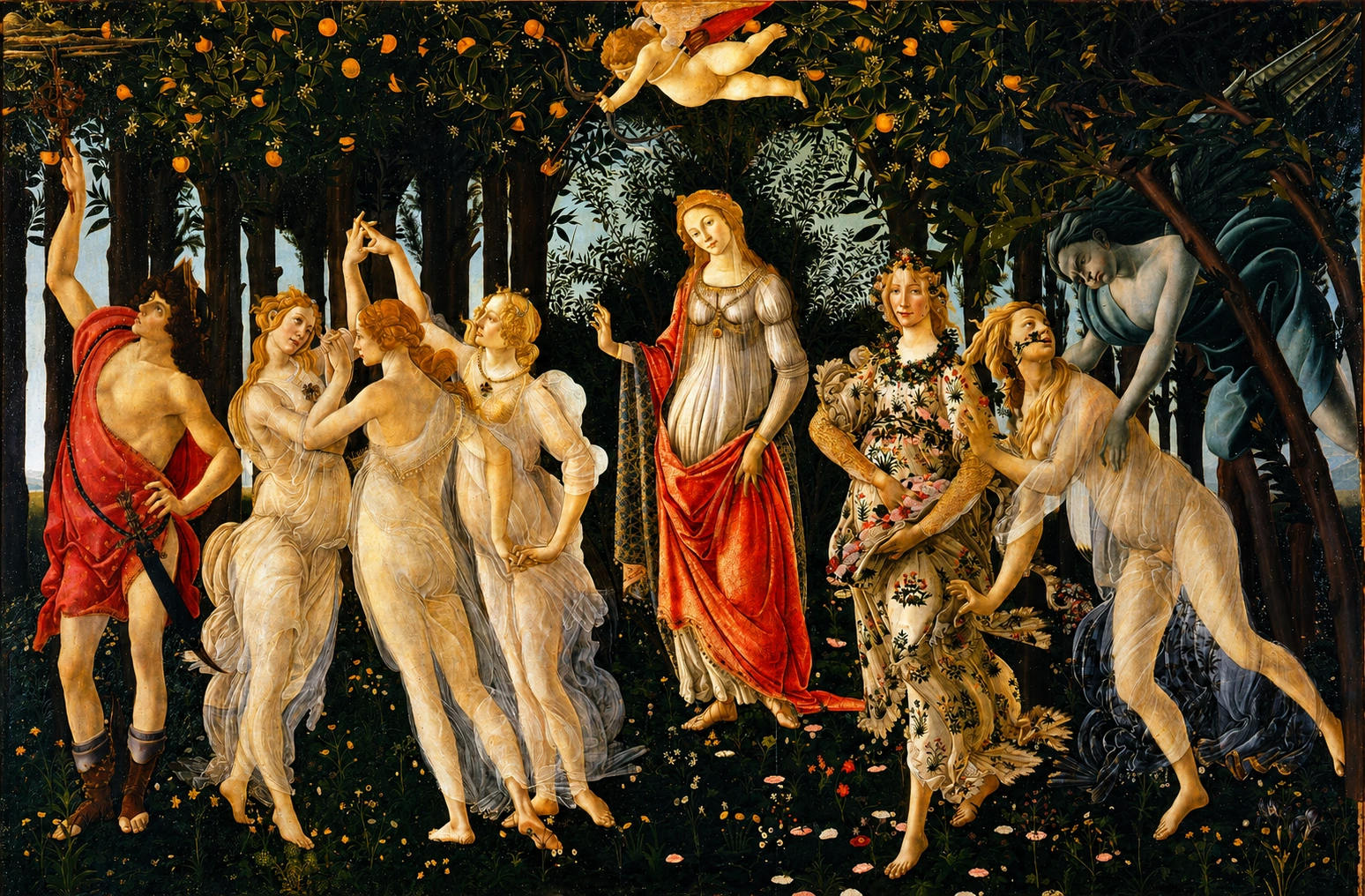
The setting of “Primavera” is a dense, shadowed grove filled with orange trees, dark leaves, and scattered flowers. This garden has often been connected with the idea of an idealized paradise, a place where nature is fertile, ordered, and enchanted. Unlike a realistic landscape, Botticelli’s grove feels almost like a stage. The figures stand across the foreground in a shallow space, arranged with the clarity of a classical frieze.
At the center stands Venus, the goddess of love. She is slightly set back from the other figures, framed by a natural arch of trees. Her calm presence gives structure to the entire composition. Above her, Cupid flies blindfolded, aiming his arrow toward the group of dancing women on the left. Venus does not dominate the painting through dramatic movement. Instead, she rules through balance, restraint, and quiet authority.
The garden is filled with flowers, many painted with careful botanical detail. These blossoms are not merely decorative. They reinforce the painting’s celebration of spring, fertility, and renewal. The richness of the floral ground makes the scene feel alive, as though the figures themselves are part of nature’s seasonal awakening.
The Figures and Their Symbolic Roles
On the far right, the blue gray figure of Zephyrus, the west wind, reaches toward Chloris, a nymph associated with springtime growth. Chloris appears startled as flowers emerge from her mouth, suggesting transformation. Beside her stands Flora, the fully transformed goddess of flowers. Her richly patterned dress is covered with blossoms, and she scatters flowers from the folds of her garment. This sequence from Zephyrus to Chloris to Flora represents one of the painting’s most important ideas: the passage from desire to transformation, and from transformation to abundance.
Flora is one of the most memorable figures in the painting because she seems to move directly toward the viewer. Her expression is serene but slightly distant, as though she exists between human presence and symbolic meaning. She embodies spring as a living force, generous and beautiful, yet also mysterious.
At the center, Venus offers a different form of love. While the right side suggests physical desire and natural fertility, Venus introduces order, refinement, and moral harmony. Her raised hand has a gentle, almost blessing like quality. She appears to moderate the energies around her, turning passion into grace.
On the left, the Three Graces dance in a circle. Their translucent garments, interlaced hands, and graceful poses create one of the most elegant passages in Renaissance painting. They represent beauty, charm, and generosity. Their movement is delicate rather than energetic, creating a rhythm of suspended motion. Cupid’s arrow points toward them, suggesting that even ideal beauty remains touched by love’s unpredictable power.
At the far left stands Mercury, identifiable by his winged sandals and staff. He turns away from the central figures and reaches upward, appearing to disperse clouds from the garden. His role seems protective. He guards the enchanted space and preserves its clarity. His red garment also balances the red drapery of Venus, giving the composition a sense of visual symmetry.
Botticelli’s Style and Line
One of the defining features of “Primavera” is Botticelli’s use of line. Unlike some Renaissance painters who focused heavily on weight, volume, and realistic depth, Botticelli creates beauty through contour, rhythm, and elegant design. The figures seem almost weightless. Their bodies are elongated, their gestures refined, and their garments ripple in decorative patterns.
The painting’s beauty depends less on physical realism than on poetic stylization. The faces are idealized, the movements are choreographed, and the space feels intentionally shallow. This gives the work a dreamlike quality. Botticelli is not trying to make the viewer believe this scene exists in ordinary life. He is inviting the viewer into an imagined world where myth and nature are arranged according to beauty and meaning.
The translucent dresses of the Three Graces show Botticelli’s extraordinary sensitivity to surface and movement. Their fabric appears light, almost like mist, revealing the elegance of the forms beneath without turning the scene into simple sensual display. Everything is controlled by line. Hair, fabric, fingers, flowers, and leaves all become part of the painting’s flowing visual music.
Color, Contrast, and Atmosphere
The color palette of “Primavera” is both rich and restrained. The dark grove creates a dramatic backdrop for the pale figures in the foreground. This contrast allows the bodies, garments, and flowers to glow against the shadowed trees. Botticelli uses warm reds, soft creams, pale golds, floral whites, and deep greens to create a mood of refined luxury.
Venus’s red drapery draws the eye toward the center, while Flora’s flower covered dress creates a dazzling ornamental focus on the right. Mercury’s red garment on the left helps balance the composition, preventing the scene from feeling too heavily weighted in one direction. The painting is carefully organized, even though it appears at first to be a natural gathering of figures.
The atmosphere is not bright in the way one might expect from a painting about spring. Instead, the grove is dark, enclosed, and almost secretive. This darkness makes the painting more mysterious. Spring is not presented only as sunshine and freshness. It is shown as a powerful, hidden force, unfolding within a sacred and symbolic space.
Meaning and Interpretation
“Primavera” has inspired many interpretations because Botticelli leaves much of its meaning open. The painting can be read as a celebration of spring, a meditation on love, a mythological allegory, or a philosophical image shaped by Renaissance humanism. Its power comes from the way it holds all these meanings together without reducing itself to a single explanation.
The movement across the painting may suggest a journey from instinctive desire to civilized love and spiritual beauty. On the right, Zephyrus pursues Chloris, and the scene becomes one of transformation into Flora. In the center, Venus offers harmony and control. On the left, the Graces dance in ideal unity while Mercury protects the garden from disturbance. The painting moves from force to fertility, from fertility to beauty, and from beauty to order.
This progression reflects a Renaissance interest in connecting classical mythology with moral and philosophical ideas. Ancient gods are not treated as simple pagan characters. They become symbols through which Botticelli explores human experience. Love can be physical, creative, social, intellectual, and spiritual. Spring becomes the perfect metaphor for this layered vision because it is the season of birth, attraction, growth, and renewal.
Why “Primavera” Still Matters
“Primavera” remains one of Botticelli’s most beloved works because it combines visual beauty with lasting mystery. It is immediately attractive, yet never fully explained. The viewer can admire its graceful figures, intricate flowers, and elegant composition, but the painting also invites deeper reflection. Its meaning seems to shift depending on where one looks.
The painting also shows Botticelli at the height of his poetic imagination. His art does not depend on dramatic action or strict realism. Instead, he creates a world of suspended beauty, where every figure seems to belong to a symbolic dance. “Primavera” is not just a painting of spring. It is a painting about the idea of spring as a force that awakens nature, transforms desire, and brings beauty into form.
In this sense, Botticelli’s masterpiece continues to feel alive. Its figures remain caught in an eternal spring, forever moving, pausing, blossoming, and turning toward love. The painting’s magic lies in this balance between stillness and change. It is both a scene and a vision, both a garden and an allegory, both a Renaissance masterpiece and one of the most enduring images of beauty in Western art.