Annunciation by Leonardo da Vinci: Vibrant Color Edit
Free to Download & Reuse: You are welcome to use this image! If you republish or share it online, you must include a direct link back to this webpage for attribution.
Original Image Source: wikiart.org
Introduction to Leonardo da Vinci’s “Annunciation”
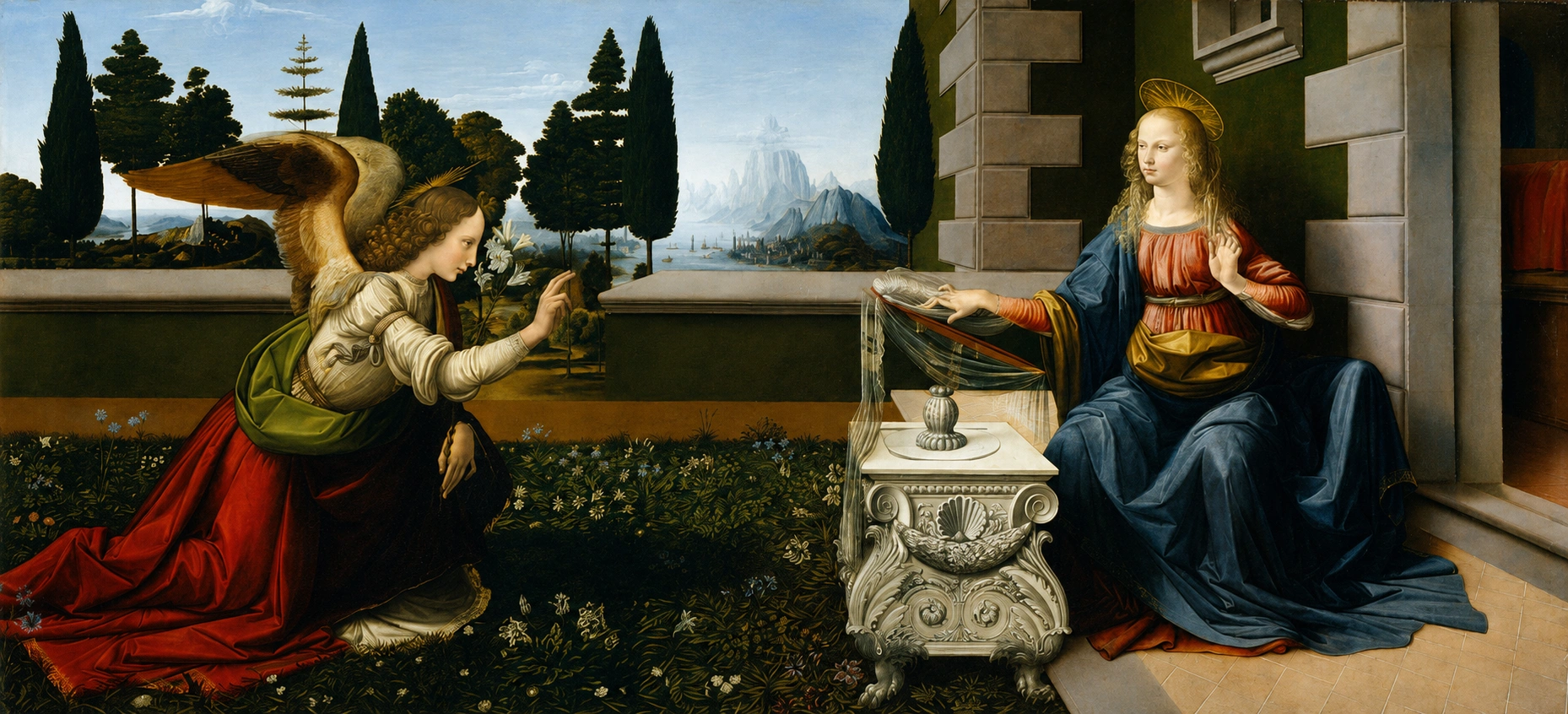
Leonardo da Vinci’s “Annunciation,” painted around 1472, presents the moment when the Archangel Gabriel tells the Virgin Mary that she will become the mother of Christ. Created during Leonardo’s early career in Florence, the painting already reveals his remarkable interest in nature, perspective, anatomy, light, and psychological expression. Although the subject had been represented many times by earlier Italian artists, Leonardo transformed the traditional religious scene into a carefully observed encounter unfolding within a believable natural world.
The painting is organized horizontally, with Gabriel kneeling in a garden on the left and Mary seated beside a Renaissance palace on the right. Between them stands an elaborately carved lectern that helps connect the two figures while also emphasizing their physical separation. The quiet distance creates a sense of anticipation. Gabriel has just arrived, while Mary appears to pause in the middle of reading as she receives his extraordinary message.
The Archangel Gabriel’s Arrival
Gabriel enters the scene from the left, kneeling respectfully upon a flowering lawn. His large wings extend behind him, suggesting that he has only recently descended into the garden. Leonardo studied the structure of birds’ wings closely, and Gabriel’s wings possess a convincing combination of strength, weight, and layered feathers. Rather than appearing purely decorative, they seem connected to Leonardo’s fascination with natural movement and flight.
The angel raises his right hand in a traditional gesture of blessing. In his left hand, he holds a white lily, one of the most familiar symbols of the Virgin Mary’s purity. The flower is presented with the precision of a botanical study. Its delicate petals and slender stem contrast with the heavy folds of Gabriel’s garments.
Gabriel’s posture combines humility with authority. His bowed position acknowledges Mary’s sacred importance, while his raised hand communicates the divine origin of his message. His face remains calm and composed, without dramatic excitement. This restraint gives the scene a solemn and meditative character.
The angel’s clothing introduces some of the painting’s richest colors. Deep red fabric spreads across the grass, while darker green and gold garments wrap around his upper body. Leonardo uses the folds of the clothing to describe the position of the figure beneath them. Even at this early stage of his career, he was interested in how fabric responds to gravity, movement, and the shape of the human body.
The Virgin Mary’s Response
Mary is seated at the right side of the composition behind a stone lectern. She has been reading a book, traditionally understood as a sacred text, when Gabriel interrupts her. One hand rests near the open pages, while the other rises in a gentle gesture of acknowledgment.
Her expression is quiet rather than frightened. She does not recoil dramatically or display exaggerated surprise. Instead, Leonardo presents her as thoughtful, dignified, and emotionally controlled. Her calm response suggests spiritual understanding and acceptance.
Mary’s clothing reinforces her importance. She wears a red dress beneath a large blue mantle. Red can suggest love, sacrifice, and human life, while blue has long been associated with heavenly grace and the Virgin’s sacred role. The broad folds of the mantle spread around her body and create a stable, monumental silhouette.
Leonardo carefully positions Mary between the world of architecture and the world of nature. She sits beside the palace, yet the garden and distant landscape remain visible behind her. This placement may suggest her role as a bridge between the earthly and the divine. She is a human woman living within a physical environment, but she is also participating in a sacred event that will transform Christian history.
The Garden and Its Symbolism
The enclosed garden is an essential part of the painting’s meaning. In Christian art, a walled garden often symbolizes Mary’s purity and spiritual separation from sin. Leonardo fills the foreground with small plants, flowers, and grasses, making the symbolic setting appear naturally alive.
The plants are not arranged as a simple decorative carpet. They vary in size, shape, and density, reflecting Leonardo’s close observation of the natural world. Some grow upright, while others spread across the earth. Small flowers appear between darker leaves, rewarding careful viewing.
This botanical attention gives the garden a physical presence, but it also contributes to the sacred atmosphere. Nature appears orderly, fertile, and harmonious at the moment of the Annunciation. The arrival of Gabriel does not disturb the garden. Instead, the angel seems to belong within it, as though the natural world quietly recognizes the divine event.
The white lily held by Gabriel connects directly with the plants beneath him. It is both a symbolic object and a believable flower. This balance between spiritual meaning and scientific observation became one of the defining characteristics of Leonardo’s art.
Architecture and Linear Perspective
The palace behind Mary introduces a contrasting world of geometry and human construction. Its heavy stone blocks, sharp corners, and dark openings differ from the irregular forms of the trees and flowers. The architecture establishes Mary’s position while giving the scene greater depth.
Leonardo uses linear perspective to guide the viewer’s attention toward the distant landscape. The edges of the building, the garden wall, and the paved terrace contribute to the illusion of space. The foreground appears solid and immediate, while the landscape gradually recedes into atmospheric haze.
The carved lectern is among the most elaborate objects in the painting. Decorated with scrolls, shells, leaves, and floral forms, it resembles the luxurious stonework associated with Renaissance Florence. Its weight and detail contrast with the lightness of Gabriel’s wings and the softness of the distant mountains.
The lectern also serves a compositional purpose. It occupies the space between Gabriel and Mary, creating a visual bridge through Mary’s extended hand and the open book. Its rectangular shape reinforces the painting’s controlled structure.
The Distant Landscape
Beyond the garden wall, Leonardo opens the composition toward an expansive landscape. A river or inlet leads toward distant mountains, settlements, and ships. Tall trees frame the view, but the central opening allows the viewer’s eye to travel far beyond the immediate scene.
The mountains are painted in pale blue and gray tones, making them appear softened by distance and atmosphere. This effect anticipates Leonardo’s later mastery of atmospheric perspective. Objects in the distance lose contrast, sharpness, and warmth because of the air between them and the viewer.
The landscape expands the meaning of the Annunciation beyond the enclosed garden. Gabriel’s message is delivered privately to Mary, yet its consequences will reach the wider world represented in the distance. The ships, buildings, mountains, and water suggest an inhabited earth that remains unaware of the event taking place in the foreground.
This contrast between intimacy and vastness gives the painting much of its emotional power. A quiet exchange between two figures becomes the beginning of a universal transformation.
Light, Color, and Surface
The light in “Annunciation” is soft and even, allowing Leonardo to describe a wide range of materials. Stone, fabric, feathers, skin, flowers, and distant water are each treated differently. The carved lectern appears hard and cool, while Gabriel’s wings seem layered and flexible. Mary’s mantle has a heavy, weighty quality, and the small plants possess crisp, delicate edges.
The color palette is balanced between warm and cool tones. Gabriel’s red garment attracts attention on the left, while Mary’s blue mantle anchors the right. The green garden connects the figures, and the pale sky creates a calm background.
Leonardo avoids harsh theatrical lighting. Instead, illumination spreads gently across the scene, supporting its contemplative atmosphere. Light does not merely reveal the figures. It unifies architecture, nature, and sacred presence within a single visual world.
An Early Expression of Leonardo’s Genius
“Annunciation” contains certain spatial and anatomical uncertainties associated with Leonardo’s youth. Mary’s extended arm appears unusually long, and the lectern’s placement can seem awkward from some viewpoints. Yet these details also reveal an ambitious young artist experimenting with perspective and the relationship between figures and space.
More importantly, the painting already demonstrates the qualities that would define Leonardo’s mature work. He treats nature as something worthy of intense study. He replaces exaggerated emotion with subtle psychological expression. He explores the behavior of light across different surfaces and uses landscape to deepen the meaning of a human event.
The sacred subject is not separated from physical reality. Gabriel’s wings have structure, the flowers belong to recognizable plants, the stone possesses weight, and the distant mountains appear surrounded by air. Leonardo’s achievement lies in making the miraculous seem both mysterious and believable.
Conclusion
Leonardo da Vinci’s “Annunciation” is a major work of the early Renaissance and an important beginning in the artist’s career. Through its balanced composition, symbolic garden, refined architecture, atmospheric landscape, and restrained expressions, the painting transforms a familiar biblical episode into a scene of quiet revelation.
Gabriel and Mary do not communicate through dramatic movement. Their gestures are measured, their expressions are thoughtful, and the space between them is filled with silence. This stillness encourages the viewer to contemplate the spiritual significance of the message.
At the same time, the extraordinary attention given to flowers, feathers, fabric, stone, water, and mountains reflects Leonardo’s belief that careful observation of nature could reveal deeper truths. “Annunciation” therefore unites religious devotion with scientific curiosity, presenting the sacred within a world that feels tangible, harmonious, and alive.