The Descent from the Cross by Rogier van der Weyden: Vibrant Color Edit
Free to Download & Reuse: You are welcome to use this image! If you republish or share it online, you must include a direct link back to this webpage for attribution.
Original Image Source: commons.wikimedia.org
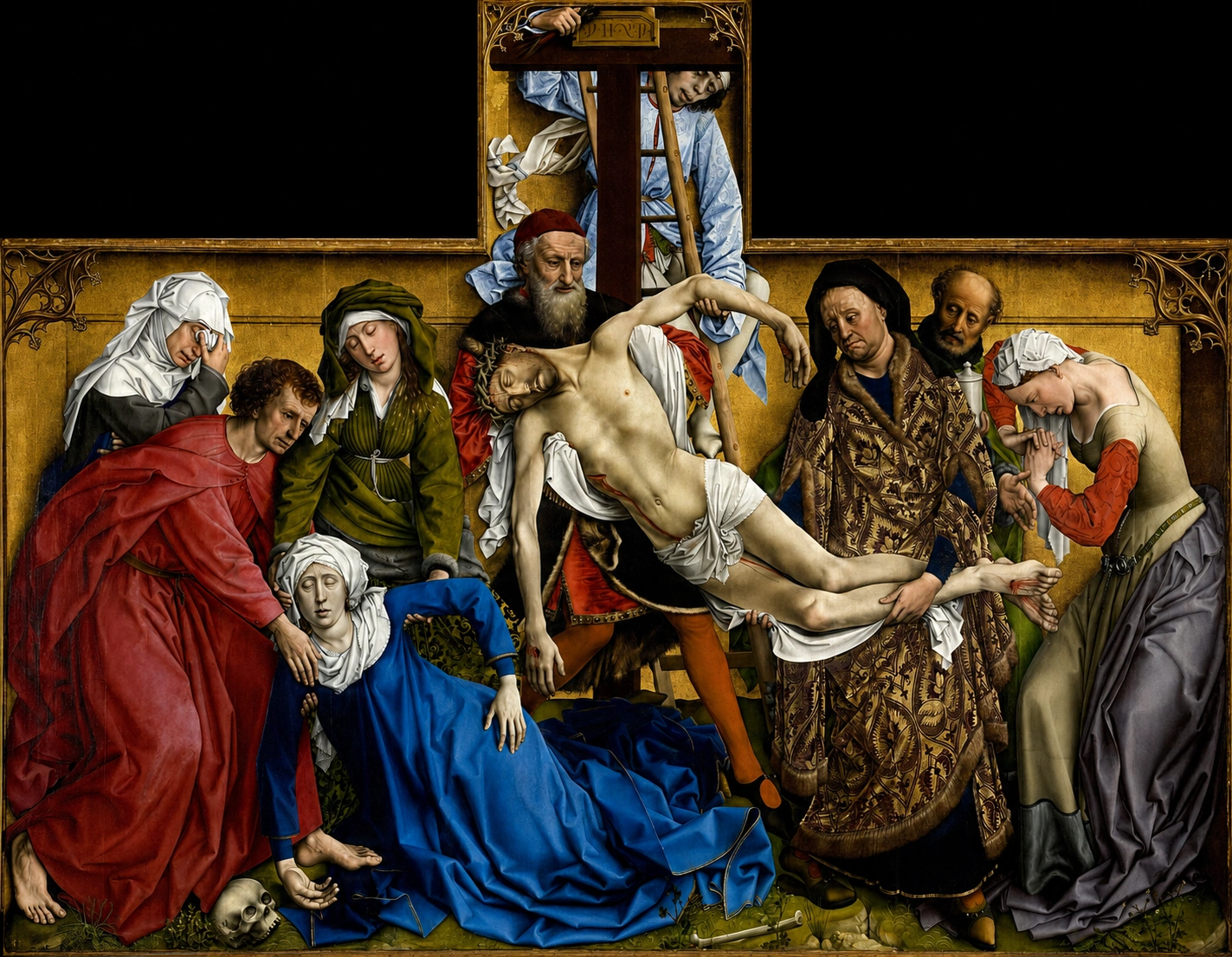
The Descent from the Cross by Rogier van der Weyden
Rogier van der Weyden’s “The Descent from the Cross,” painted around 1438, is one of the most emotionally powerful masterpieces of Early Netherlandish painting. The work presents the moment when the body of Jesus Christ is lowered from the cross after the Crucifixion. Rather than depicting the scene as a distant historical event, van der Weyden transforms it into an intensely human drama filled with grief, physical tension, and spiritual meaning.
The painting immediately commands attention through its compressed arrangement of figures. Ten people occupy a shallow, golden space resembling the interior of a carved shrine. The bodies overlap, bend, and curve around one another, creating the impression that the entire group has been carefully fitted into a narrow container. This crowded composition brings the viewer close to the mourners, leaving almost no visual distance between the sacred event and the audience.
Van der Weyden combines extraordinary technical precision with deep emotional sensitivity. Every tear, wrinkle, fold of fabric, and delicate strand of hair contributes to the painting’s atmosphere of sorrow. Yet the work is not chaotic. Its grief is organized through carefully controlled lines, colors, gestures, and repeated forms.
The Moment Depicted in the Painting
“The Descent from the Cross” represents the removal of Christ’s body from the cross following his death. Joseph of Arimathea and Nicodemus traditionally assisted with this task, while the Virgin Mary, Saint John, Mary Magdalene, and other mourners gathered nearby.
Christ’s body occupies the center of the composition. His lifeless form stretches diagonally across the painting, supported by several figures. His head falls backward, his arms hang loosely, and his legs extend toward the right side. The pale color of his skin contrasts with the rich clothing worn by those around him, emphasizing the vulnerability of his body.
Above the group, a servant stands on a ladder behind the cross. He holds one of the nails removed from Christ’s hands. This small detail connects the painting to the physical reality of the Crucifixion while avoiding excessive violence. The suffering is communicated primarily through the reactions of the mourners rather than through graphic imagery.
The cross itself is partially visible because the figures fill most of the available space. This compositional choice shifts attention away from the instrument of execution and toward the human consequences of Christ’s death.
The Parallel Between Christ and the Virgin Mary
One of the most important features of the painting is the visual relationship between Christ and the Virgin Mary. Mary has collapsed from grief in the lower left portion of the composition. Her body echoes the posture of her son with remarkable precision.
Christ’s right arm hangs downward, while Mary’s arm falls in a similar direction. Their bodies form related curves, and both figures appear physically powerless. This parallel suggests that Mary spiritually shares in Christ’s suffering. His death produces an emotional collapse within her, turning maternal grief into a reflection of divine sacrifice.
Mary’s blue robe spreads across the lower part of the painting in broad, heavy folds. The intensity of the blue gives her a strong visual presence even though she has fainted. Her pale face and closed eyes mirror the stillness of Christ, further uniting mother and son.
This connection would have encouraged medieval viewers to contemplate both Christ’s physical suffering and Mary’s emotional pain. The painting therefore offers two paths toward compassion. The viewer can mourn the death of Christ while also identifying with the sorrow of his mother.
A Composition Built from Curves and Repetition
Although the scene contains many figures, van der Weyden gives the composition a remarkable sense of order. The bodies create a sequence of curves that guide the eye across the painting. Christ and Mary form the central downward movement, while the mourners on either side bend inward around them.
The figures at the far left and far right create visual brackets. Saint John leans forward on the left, while Mary Magdalene bends dramatically on the right. Their curving bodies help contain the action within the golden background.
Mary Magdalene’s pose is especially expressive. She twists her hands together while leaning inward, her body visibly tightened by grief. The long folds of her dress reinforce this movement. Her sorrow differs from Mary’s fainting stillness. Instead of collapsing, she remains upright but appears overwhelmed by emotional tension.
Repetition also unifies the scene. Hands reach toward bodies, fabrics overlap, heads tilt, and tears appear on several faces. These repeated elements create a shared language of mourning. Each person reacts differently, but all are connected through gesture and emotion.
Color, Fabric, and Surface Detail
Van der Weyden uses color to organize the figures and heighten the emotional drama. Mary’s brilliant blue robe dominates the lower center, while Saint John’s red clothing fills the left side. On the right, Joseph of Arimathea wears a magnificent garment decorated with gold and dark patterns.
These colors are rich but carefully balanced. Red communicates emotional intensity and recalls Christ’s blood. Blue has long been associated with the Virgin Mary, purity, and heavenly devotion. Gold gives the background a sacred quality while separating the scene from ordinary time and space.
The detailed treatment of fabric demonstrates van der Weyden’s technical skill. Heavy robes form sharp, sculptural folds, while thin veils appear delicate and translucent. The contrast between costly textiles and Christ’s nearly uncovered body emphasizes his humility. Those carrying him are dressed in earthly wealth, while Christ possesses nothing but the cloth around his waist.
The artist’s attention to surfaces also makes the figures seem physically present. Skin, hair, tears, velvet, silk, metal, and wood are all represented with different textures. These details encourage prolonged looking and make the sacred narrative feel immediate.
Grief Expressed Through Faces and Gestures
The emotional force of “The Descent from the Cross” comes largely from the individuality of the mourners. Their grief is not represented by a single dramatic expression. Instead, van der Weyden explores several forms of sorrow.
Some figures cry openly. Tears run down their faces with astonishing delicacy. Others look downward in silent contemplation. Mary loses consciousness, Saint John rushes to support her, and Mary Magdalene twists her body and hands in anguish.
Joseph of Arimathea, positioned near Christ’s legs, appears solemn and controlled. His expression suggests responsibility and reverence. The older bearded figure supporting Christ’s upper body looks directly at the dead Savior with sorrowful concentration.
The variety of responses makes the scene emotionally believable. Grief affects each person differently, yet their gestures form a united expression of loss. The painting invites viewers to recognize their own emotional experiences within the sacred story.
The Shallow Golden Space
Unlike many religious paintings that place biblical scenes within detailed landscapes or architectural settings, “The Descent from the Cross” unfolds against a flat golden background. The space is extremely shallow, and the figures seem almost pressed against the surface of the panel.
This setting resembles a gilded wooden shrine containing painted or sculpted figures. Decorative tracery appears in the upper corners, reinforcing the connection to Gothic church ornament. The figures possess such strong volume and carefully modeled clothing that they can appear almost sculptural.
The lack of a distant landscape prevents the viewer’s attention from wandering. There is no horizon, open sky, or background activity. Everything is concentrated on Christ and the mourners.
The compressed space also creates psychological intensity. The figures cannot escape the scene, and the viewer cannot easily look beyond it. The painting becomes a contained chamber of sorrow in which every movement contributes to the central tragedy.
Symbolism and Spiritual Meaning
Several objects carry symbolic significance. A skull and bone appear near the bottom of the composition. These details refer to Golgotha, the place of the Crucifixion, which was also called the Place of the Skull. The skull may also allude to Adam, whose sin was believed to be redeemed through Christ’s sacrifice.
The crossbow-like shape formed by Christ’s curved body may relate to the painting’s original commission for the crossbowmen’s guild of Leuven. The small decorative forms in the corners have also been interpreted as references to crossbows. Such details connect the religious subject to the identity of the patrons.
Christ’s wounds are visible but restrained. Van der Weyden does not rely on graphic suffering to create emotion. Instead, the stillness of the body, the careful support of the mourners, and the sorrow surrounding him communicate the cost of the sacrifice.
The painting also anticipates the Lamentation and burial of Christ. His body is being lowered, but the mourners already handle him with the solemnity of a funeral procession.
Rogier van der Weyden’s Lasting Achievement
“The Descent from the Cross” demonstrates Rogier van der Weyden’s ability to combine realism, symbolism, and emotional drama. The figures are believable as human beings, but their arrangement is highly structured. Every curve, gesture, and color serves the larger spiritual message.
The painting became enormously influential because it offered a new model for religious emotion. Later artists imitated its figures, poses, and expressions. Its power comes from the balance between control and intensity. The composition is carefully ordered, yet the sorrow feels immediate and overwhelming.
Van der Weyden does not simply illustrate Christ’s removal from the cross. He creates a meditation on sacrifice, compassion, and shared suffering. The viewer is encouraged to stand among the mourners, observe their tears, and participate emotionally in the sacred event.
Centuries after its creation, “The Descent from the Cross” remains one of the defining achievements of Northern Renaissance art. Its technical brilliance attracts the eye, while its profound humanity gives the painting its lasting emotional power.