Allegory of Good Government by Ambrogio Lorenzetti: Vibrant Color Edit
Free to Download & Reuse: You are welcome to use this image! If you republish or share it online, you must include a direct link back to this webpage for attribution.
Original Image Source: commons.wikimedia.org
Introduction to “Allegory of Good Government”
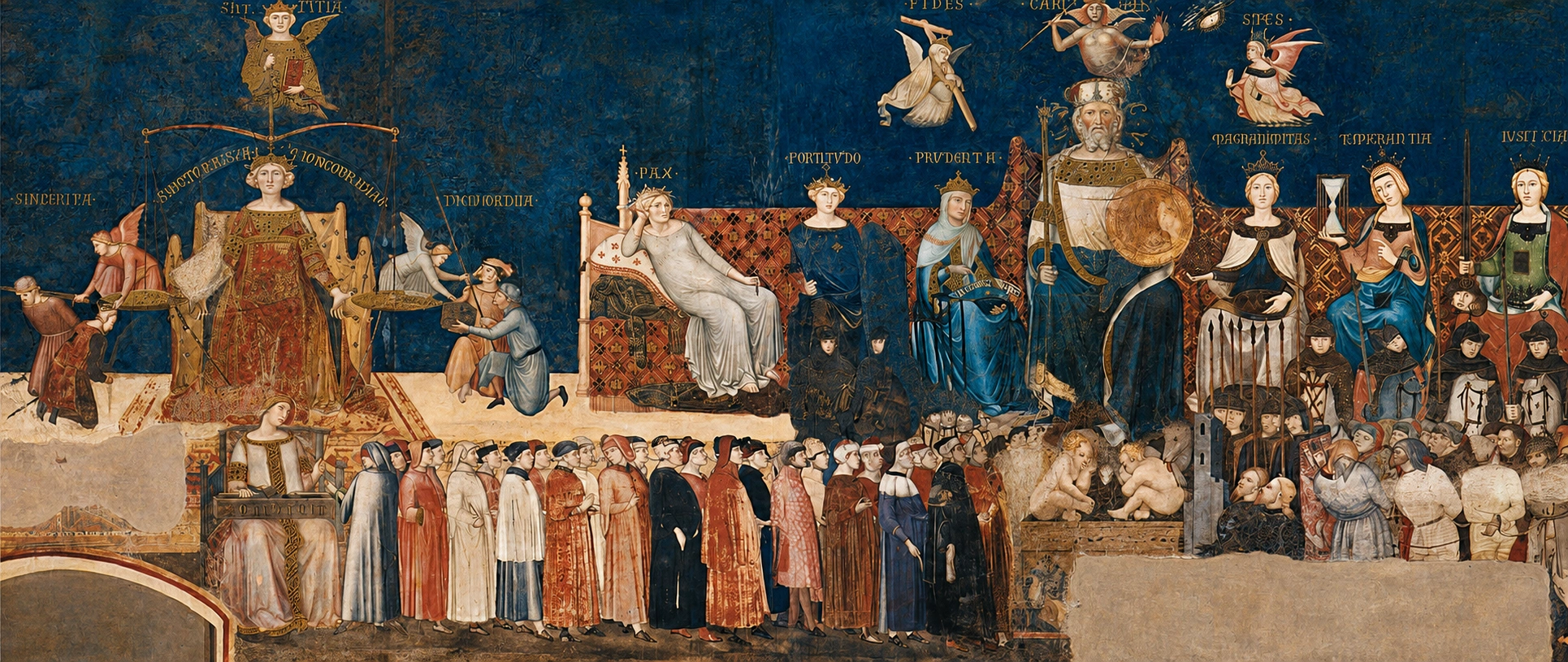
Ambrogio Lorenzetti’s “Allegory of Good Government,” painted around 1340, is one of the most ambitious political artworks of the medieval period. Created for the Palazzo Pubblico in Siena, the fresco formed part of a larger decorative program devoted to good and bad government and their consequences. Rather than illustrating a biblical narrative or the life of a saint, Lorenzetti transformed political philosophy into an elaborate visual drama.
The painting was designed for the Sala dei Nove, the meeting room used by Siena’s governing council. Its audience therefore consisted primarily of officials responsible for the city’s security, justice, and prosperity. Every figure and symbolic gesture reminded these leaders that government was not merely a privilege. It was a moral responsibility whose effects could be felt throughout society.
The fresco presents good government as a carefully balanced system built upon justice, wisdom, peace, civic unity, and the common good. Lorenzetti’s achievement lies in making these abstract ideas appear vivid, human, and emotionally persuasive.
The Central Figure of the Common Good
Near the center of the composition sits a large, dignified male figure representing the Common Good and, by extension, the civic authority of Siena. He occupies a raised position, giving him the appearance of a ruler, judge, or guardian. His mature face and imposing body communicate wisdom, stability, and strength rather than personal luxury.
The figure is associated with Siena through the city’s colors and political symbols. He does not represent an individual monarch because Siena was governed as a republic. Instead, he embodies the authority created when citizens place the welfare of the community above private ambition.
Lorenzetti surrounds the Common Good with personifications of essential civic virtues. These figures suggest that political authority can remain legitimate only when supported by moral qualities. Power without virtue would lead to corruption, fear, and disorder. Power guided by justice and wisdom can create security and prosperity.
The elevated placement of the Common Good also establishes a visual hierarchy. The gathered citizens below belong to a shared political community, while the virtues above represent the principles that should guide them.
Justice as the Foundation of Society
Justice appears prominently on the left side of the fresco. She is represented as a monumental female figure seated beneath Wisdom, who hovers above her. This arrangement suggests that justice must be directed by intelligence and moral understanding rather than personal emotion or political convenience.
The scales associated with Justice display two different but complementary forms of judgment. One side represents distributive justice, which rewards or assigns benefits according to merit. The other represents corrective justice, which punishes wrongdoing and restores balance after an offence.
Lorenzetti therefore presents justice as more than the enforcement of laws. It is the force that holds the entire political community together. From Justice’s scales descend cords that eventually reach the citizens gathered below. These cords symbolize concord, shared obligation, and the social bonds created by fair government.
The image communicates a clear political message. Citizens are more likely to remain united when the law is applied consistently. When justice becomes corrupted, the cords of civic harmony begin to break.
Concord and the United Citizens
Below Justice sits Concord, another female personification central to the fresco’s meaning. She holds or manages the cords descending from Justice before passing them to the assembled citizens. The placement of Concord between Justice and the people demonstrates how fair laws produce social unity.
The citizens form a long procession across the lower portion of the composition. Their clothing varies in color and design, suggesting differences in profession, social standing, and personal identity. Despite these distinctions, they are linked by the same cord and participate in the same civic order.
Lorenzetti does not erase individuality. Instead, he shows that a successful republic depends upon cooperation among people with different roles. Civic unity does not require everyone to look or behave identically. It requires citizens to recognize that their personal interests are connected to the health of the wider community.
The procession also creates visual movement across the fresco. The line of figures guides the viewer from Justice toward the Common Good, linking moral principle, civic concord, and political authority in a single continuous structure.
Peace and the Civic Virtues
One of the most memorable figures in “Allegory of Good Government” is Peace. She reclines gracefully on a cushioned seat, dressed in a pale garment that contrasts with the darker tones surrounding her. Her relaxed posture conveys comfort, confidence, and freedom from fear.
Peace is not shown as a warrior who has conquered an enemy. Instead, she appears as the natural result of successful government. Her calm body expresses the security enjoyed by a society where laws are respected and political institutions remain stable.
Around the Common Good are other personified virtues, including Fortitude, Prudence, Magnanimity, Temperance, and Justice. Together, they create an ideal model of leadership. Prudence represents wise decision-making, Temperance encourages moderation, Fortitude provides courage, and Magnanimity suggests generosity and nobility of purpose.
These virtues were especially relevant to the officials who met in the room. Lorenzetti’s fresco encouraged them to evaluate their decisions according to moral standards. A government might possess wealth or military strength, but without wisdom, restraint, and justice, it could not truly serve the public.
Composition and Visual Organization
The composition is dense, but Lorenzetti organizes it through a combination of hierarchy, repetition, and horizontal movement. The largest figures represent the most important political principles, while smaller citizens occupy the earthly level below.
The fresco resembles a public assembly or court ceremony. Thrones, architectural structures, patterned textiles, and formal gestures give the scene a solemn atmosphere. At the same time, the variety of poses prevents the composition from becoming static.
Lorenzetti uses scale symbolically rather than realistically. Justice and the Common Good are much larger than ordinary citizens because they represent ideas greater than any single person. This approach was common in medieval art, where physical size often reflected spiritual or political importance.
The dark background helps the pale robes, patterned surfaces, and individual faces remain visible. Although centuries of ageing have softened the original colours, traces of red, blue, gold, white, and green still create a rich visual rhythm.
Medieval Style and Emerging Naturalism
“Allegory of Good Government” combines medieval symbolism with an increasing interest in natural observation. The figures remain formal and idealized, but their bodies possess weight and volume. Their gestures communicate specific emotions and relationships.
Peace reclines convincingly, the citizens stand in varied positions, and the seated virtues appear to occupy believable spaces. Lorenzetti’s attention to fabric, facial expression, and posture gives the symbolic figures a human presence.
This naturalism makes the political message more accessible. Justice is not merely a written concept. She becomes a commanding woman whose actions visibly affect society. Peace is not simply the absence of conflict. She becomes a relaxed body enjoying the comfort created by public stability.
Lorenzetti’s ability to unite allegory with observation helped establish the fresco as a landmark of fourteenth-century Italian painting.
The Political Meaning of the Fresco
The painting reflects the civic culture of medieval Siena, where political stability could never be taken for granted. Italian city-states faced internal rivalries, economic competition, military threats, and struggles between powerful families.
Within this environment, the fresco offered both an ideal and a warning. It reminded officials that the prosperity of Siena depended upon their willingness to uphold justice and resist selfish ambition. Government was presented as a chain of responsibility connecting wisdom, justice, concord, civic authority, and the lives of ordinary people.
The work also communicates a sophisticated understanding of politics. Good government is not represented as the achievement of one heroic ruler. It emerges from cooperation among institutions, virtues, laws, and citizens. Lorenzetti therefore presents political health as something collective and fragile.
The companion scenes showing the effects of good and bad government strengthen this message. The moral character of leadership eventually becomes visible in streets, farms, businesses, homes, and public spaces.
The Lasting Importance of “Allegory of Good Government”
Ambrogio Lorenzetti’s “Allegory of Good Government” remains extraordinary because it treats civic life as a subject worthy of monumental art. The fresco moves beyond decoration and becomes a visual argument about how society should function.
Its central message remains understandable centuries after its creation. Justice creates trust, trust creates unity, and unity allows peace and prosperity to develop. When political leaders abandon virtue, the entire community suffers.
The painting also demonstrates the intellectual ambition of medieval artists. Lorenzetti combined political theory, moral philosophy, symbolism, portrait-like observation, and complex composition within a single work. The result is both an idealized vision of government and a practical reminder of political responsibility.
By transforming abstract virtues into an organized community of figures, Lorenzetti made the principles of good leadership visible. “Allegory of Good Government” is therefore not only a masterpiece of Sienese painting. It is one of the most powerful visual statements about justice, citizenship, and the common good in the history of Western art.