Lamentation of Christ by Giotto: Vibrant Color Edit
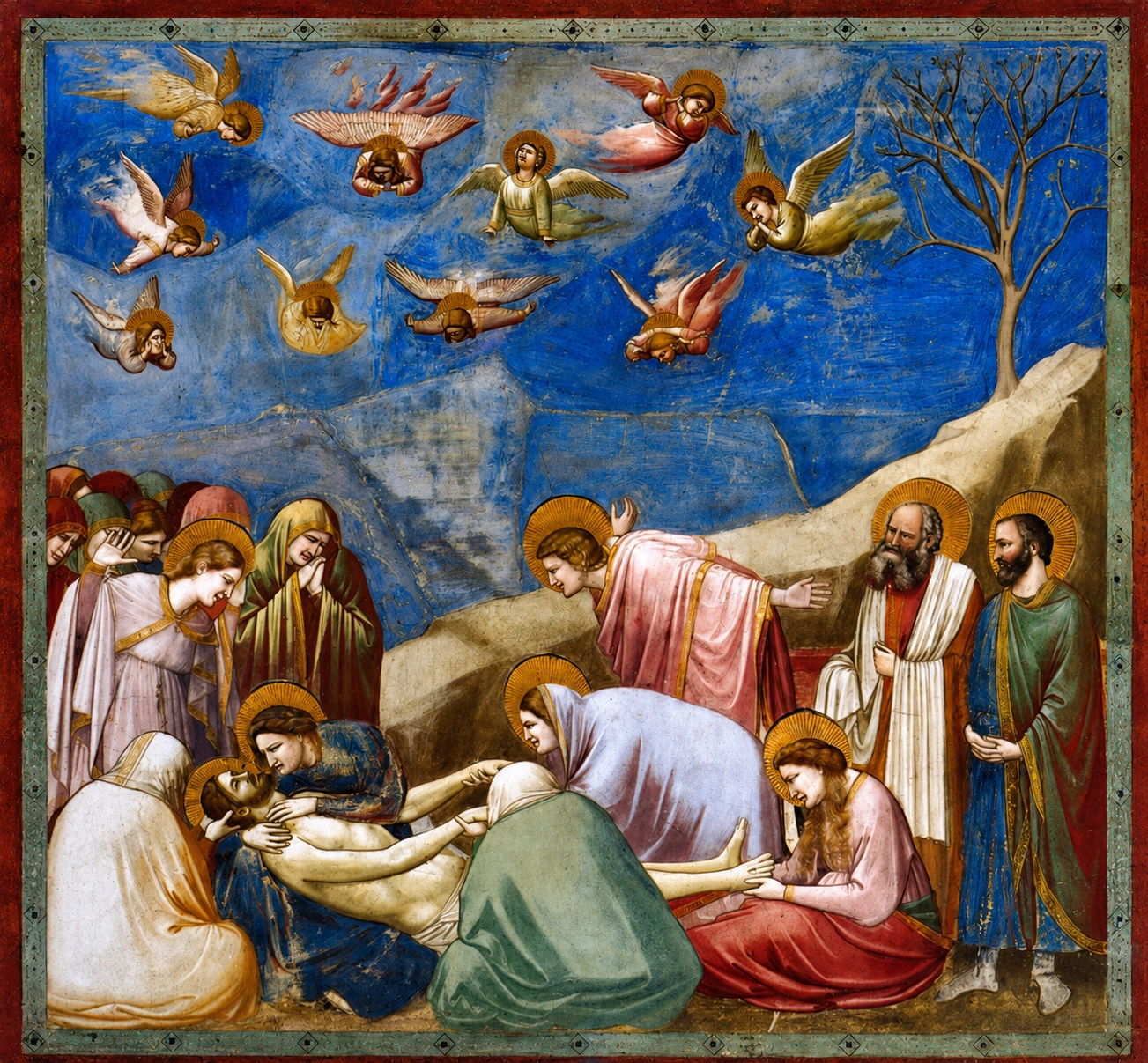
Free to Download & Reuse: You are welcome to use this image! If you republish or share it online, you must include a direct link back to this webpage for attribution.
Original Image Source: wikiart.org
Introduction
Giotto di Bondone’s “Lamentation of Christ,” painted around 1305, is one of the most emotionally powerful scenes in the history of Western art. Created as part of the fresco cycle decorating the Arena Chapel, also known as the Scrovegni Chapel, in Padua, the painting depicts the mourning that follows Christ’s removal from the cross. The Virgin Mary, Christ’s disciples, and several holy women gather around his lifeless body, while angels express their grief in the sky above.
Although the subject had appeared in Christian art for centuries, Giotto transformed it through his attention to human emotion, physical presence, and spatial unity. Instead of presenting the event as a distant religious symbol, he makes it feel immediate and personal. Every figure responds differently to the tragedy, creating a scene filled with sorrow, tenderness, shock, and quiet contemplation.
The Biblical Subject
The Lamentation takes place after Christ’s Crucifixion and before his burial. His followers have received his body and gathered to mourn him. Giotto concentrates on the relationship between Christ and the people who loved him, especially the Virgin Mary.
Mary bends close to her son, supporting his head and looking directly into his face. Her posture expresses both maternal affection and unbearable grief. Christ is not presented only as a divine figure. He is also shown as Mary’s child, whose death has created a deeply human moment of loss.
Around them are figures traditionally associated with the Passion, including Mary Magdalene, Saint John, and other mourners. Mary Magdalene kneels near Christ’s feet, which she gently holds. Saint John extends his arms backward in a dramatic gesture of anguish. His pose gives visible form to an emotion that seems too intense to be contained.
A Composition Leading Toward Christ
Giotto carefully organizes the composition so that the viewer’s attention is directed toward Christ’s body. The rocky ridge descends diagonally from the upper-right corner toward the lower-left part of the painting. This strong line leads the eye directly to the meeting between Christ and the Virgin Mary.
The figures also reinforce this movement. Several mourners bend forward, while others look downward toward Christ. Even the angels flying above appear to respond to the same emotional centre. Their bodies twist, dive, and stretch across the sky as though the entire heavenly realm has been disturbed by the event.
Christ’s pale body forms a horizontal line near the bottom of the fresco. This position emphasizes his physical vulnerability. He lies surrounded by protective figures, but he remains exposed and motionless. His stillness contrasts with the expressive gestures of the mourners and the energetic movement of the angels.
The empty space in the centre of the painting is equally important. It separates the angels above from the human figures below, while allowing the diagonal ridge to remain clearly visible. This openness prevents the composition from feeling overcrowded and gives greater force to the emotional relationships among the figures.
Human Emotion and Individual Grief
One of the most innovative aspects of “Lamentation of Christ” is the individuality of the mourners. Giotto does not show grief as a single repeated gesture. Instead, each person reacts according to a different emotional state.
Mary’s sorrow is intimate and controlled. She does not throw her arms into the air or turn away. She holds Christ close and searches his face, creating one of the most tender moments in the fresco. Her grief is intensified by the physical closeness between their faces.
Saint John responds more dramatically. His arms sweep backward while his body leans sharply toward Christ. The gesture suggests shock, protest, and helplessness. Mary Magdalene’s grief is quieter. By holding Christ’s feet, she expresses devotion through touch rather than theatrical movement.
Other figures cover their faces, bow their heads, or lean forward in silence. Two seated mourners in the foreground are shown with their backs turned toward the viewer. Their faces are hidden, but their rounded forms and lowered positions contribute to the atmosphere of mourning. By turning them away, Giotto encourages the viewer to imagine their expressions.
The angels above reflect the same variety of emotional responses. Some clasp their hands, while others cover their faces or reach toward the scene below. Their sorrow connects heaven with earth, suggesting that Christ’s death has affected the entire universe.
Giotto’s New Sense of Space and Form
Giotto’s figures possess a weight and solidity that distinguish them from many earlier medieval images. Their bodies appear to exist beneath their clothing, and their garments fall in broad folds that describe physical volume. The mourners occupy space rather than floating against a flat decorative background.
The figures overlap one another, creating a convincing sense of depth. Those in the foreground appear larger and closer, while the mourners behind them are partly hidden. The arrangement resembles a gathering of real people around a body rather than a collection of separate symbolic figures.
Giotto also gives the rocky landscape a structural purpose. It is not merely a background. The ridge divides the scene, guides the viewer’s eye, and creates a setting in which the figures can stand, kneel, and sit. The bare tree at the upper right contributes to the mood of death and desolation. Its empty branches echo the lifelessness of Christ’s body.
At the same time, the tree may suggest future renewal. Just as a tree can appear dead during winter and return to life in spring, Christ’s death will be followed by the Resurrection. The image therefore contains a quiet promise of hope within its sorrowful atmosphere.
Colour and Fresco Technique
The blue sky creates a striking background for the figures and angels. Against this deep field, the earth tones, pale garments, golden halos, and soft reds become clearly visible. The colour scheme is rich but controlled, allowing the emotional content to remain central.
Christ’s pale body stands out against the darker blue and green clothing around him. This contrast emphasizes his vulnerability and establishes him as the visual focus. Mary’s muted blue garment connects her with the sky while also creating a protective shape around Christ’s head and shoulders.
The golden halos identify the sacred figures, but Giotto integrates them into the physical scene. They appear behind the heads like solid discs, sometimes overlapping with faces and surrounding figures. The spiritual and material worlds are therefore presented together.
Because the painting was created in fresco, pigments were applied to wet plaster. This demanding method required careful planning and confident execution. The resulting surface became part of the chapel wall, making the scene inseparable from the sacred architectural space in which it was viewed.
The Role of the Viewer
Giotto places the viewer close to the mourners. The seated figures in the foreground form a visual entrance into the scene. Because they face away from us, they seem to occupy the same position that we might occupy if we were present at the event.
The composition does not encourage detached observation. Instead, it invites emotional participation. The viewer’s gaze follows the mourners toward Christ and Mary, creating a feeling of shared grief. The figures do not look outward to acknowledge the audience. They remain completely absorbed in the tragedy, making the moment feel private even though it is displayed publicly.
This emotional immediacy would have supported religious meditation. Viewers were encouraged not only to understand the story of Christ’s death but also to imagine its emotional reality. Compassion for the mourners could lead to deeper reflection on sacrifice, suffering, and redemption.
Giotto’s Importance in Art History
Giotto is often associated with the transition from medieval art toward the visual language of the Renaissance. In “Lamentation of Christ,” this transformation can be seen in the substantial bodies, believable gestures, unified space, and careful observation of human emotion.
The painting does not abandon medieval spirituality. Its purpose remains religious, and its golden halos, symbolic landscape, and sacred subject belong to Christian tradition. However, Giotto presents that tradition through recognizably human experiences.
His achievement lies in combining spiritual meaning with emotional truth. The figures are sacred, but their grief is understandable to anyone who has experienced loss. Their gestures communicate without requiring explanation, allowing the painting to remain emotionally accessible centuries after it was created.
Conclusion
“Lamentation of Christ” by Giotto is a masterpiece of emotional storytelling. Through a carefully directed composition, solid figures, expressive gestures, and a restrained landscape, Giotto turns a sacred event into an intimate encounter with grief.
The descending ridge leads the viewer toward Christ, while the mourners form a protective circle around his body. Mary’s quiet tenderness, Saint John’s dramatic anguish, Mary Magdalene’s devotion, and the angels’ despair create a complete vision of sorrow shared between heaven and earth.
Yet the painting is not without hope. The bare tree, the sacred halos, and the viewer’s knowledge of the Resurrection suggest that death is not the final moment of the story. Giotto captures the painful interval between loss and renewal, making “Lamentation of Christ” both a profound religious image and a timeless study of human mourning.