Maestà (Madonna with Angels and Saints) by Duccio di Buoninsegna: Vibrant Color Edit
Free to Download & Reuse: You are welcome to use this image! If you republish or share it online, you must include a direct link back to this webpage for attribution.
Original Image Source: https://commons.wikimedia.org/wiki/File:Duccio_Maest%C3%A0.jpg

Introduction
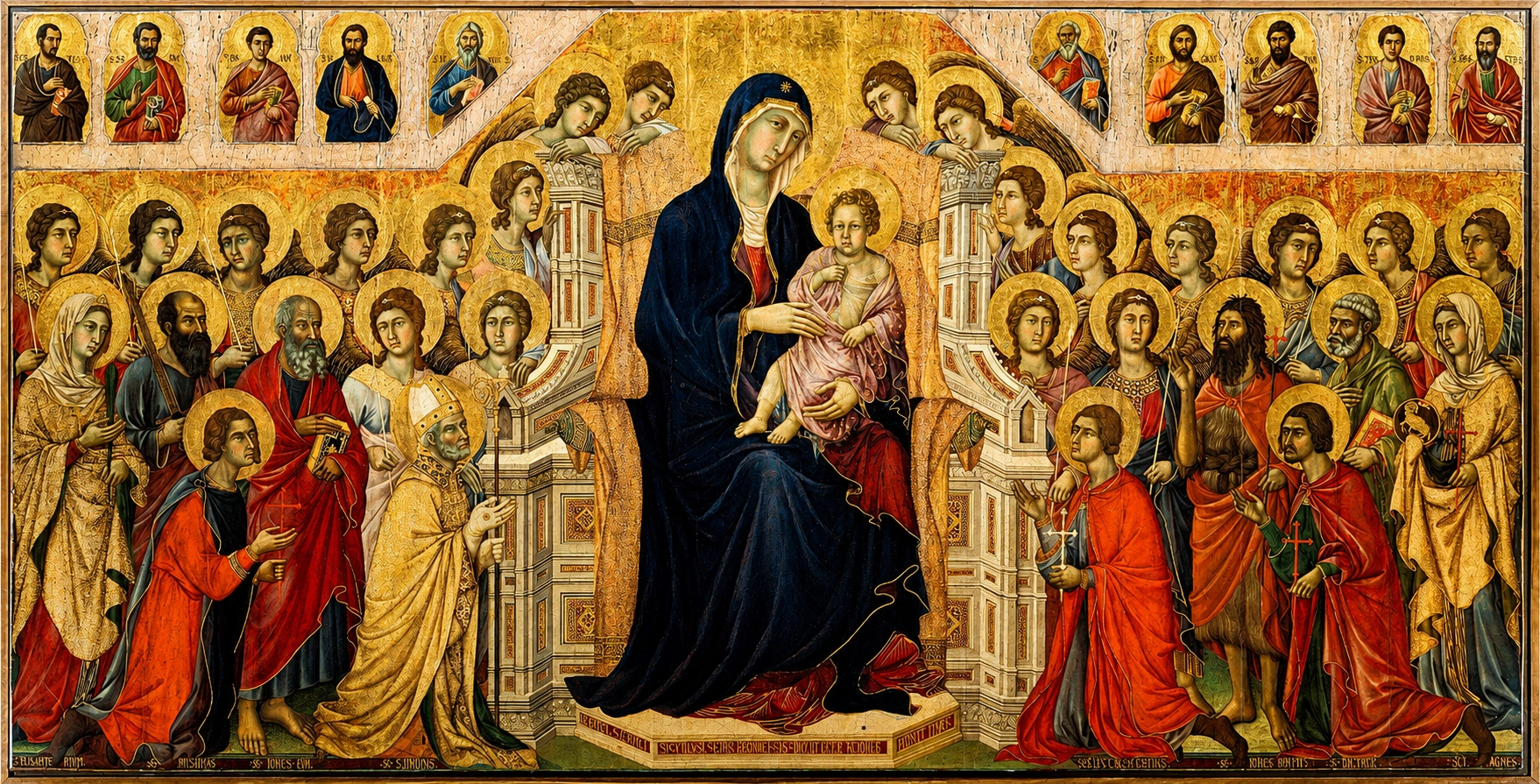
Duccio di Buoninsegna’s “Maestà (Madonna with Angels and Saints),” completed in 1311, is one of the defining masterpieces of medieval Italian painting. Created for Siena Cathedral, the monumental altarpiece presented the Virgin Mary not simply as a tender mother, but as the majestic Queen of Heaven and spiritual protector of Siena. Surrounded by angels, apostles, saints, and other sacred figures, Mary occupies the center of a carefully ordered celestial court.
The term “Maestà” refers to an image of the Virgin enthroned in majesty, usually holding the Christ Child and accompanied by heavenly attendants. Duccio transformed this established religious subject through an unusual combination of Byzantine solemnity, Gothic elegance, emotional sensitivity, and early experiments with space. The painting therefore stands between two artistic worlds. It preserves the symbolic grandeur of medieval icon painting while anticipating the greater naturalism that would shape Italian Renaissance art.
The Enthroned Virgin and Christ Child
The Virgin Mary dominates the composition. She sits on a magnificent architectural throne placed almost exactly at the center of the painting. Her dark blue mantle creates a powerful visual anchor amid the surrounding gold, red, cream, and green robes. The depth of the blue separates her from the luminous background while emphasizing her dignity and sacred importance.
Mary’s body is enlarged in comparison with many of the surrounding figures. This difference in scale is intentional. Medieval artists frequently used size to communicate spiritual rank rather than physical distance. Mary is larger because she is the central figure of devotion, the mother of Christ, and the symbolic Queen of Heaven.
Although her posture is formal, Duccio gives her face a subtle emotional softness. Her head tilts gently, and her expression contains both tenderness and seriousness. She appears aware of the future suffering that awaits her son. This quiet sadness gives the image emotional depth without disturbing its ceremonial atmosphere.
The Christ Child sits upright upon Mary’s lap. He raises one hand in blessing while holding a scroll in the other. His gesture identifies him as a divine teacher and ruler. At the same time, his small body and placement within Mary’s protective embrace emphasize the human relationship between mother and child. Duccio does not present Christ merely as a miniature adult. His softer proportions and relaxed position introduce a sense of physical vulnerability.
The Heavenly Court
The figures surrounding Mary and Christ form an immense sacred assembly. Angels appear closest to the throne, while apostles and saints occupy the outer areas. Their symmetrical arrangement creates an impression of perfect heavenly order. Each figure has a clear place within the spiritual hierarchy.
The angels are shown with youthful faces, delicate features, and elegantly curved wings. They gather around Mary’s throne as attendants in a royal court. Their repeated forms contribute to the painting’s rhythm, yet Duccio avoids complete uniformity. The angels turn their heads in different directions, and their expressions vary subtly.
Saints and apostles stand on either side of the throne. Many can be recognized through traditional attributes, clothing, inscriptions, or physical characteristics. Some hold books, crosses, staffs, or other objects associated with their identities and religious roles. Their halos overlap one another, creating a dense field of golden circles that reinforces the unity of the sacred community.
The figures in the lower foreground appear especially prominent. They kneel or stand close to the Virgin, establishing a transition between the heavenly realm and the viewer’s earthly space. The variety of gestures, from prayerful hands to open palms, suggests devotion, conversation, and spiritual attention.
Symmetry, Hierarchy, and Composition
Duccio organized the painting around a strong central axis. Mary’s head, the Christ Child, the throne, and the base beneath them align to create stability. The surrounding figures are distributed with near symmetry, producing balance and ceremonial formality.
This symmetry is not mechanical. Duccio introduces small differences in posture, expression, and color to keep the composition visually active. The saints do not simply form rigid rows. Some lean forward, others turn toward neighboring figures, and several direct their attention toward Mary and Christ.
The architectural throne is essential to the composition. Its tall sides frame Mary while creating the impression of a sacred structure within the painting. Slender columns, carved details, geometric patterns, and pale stone surfaces contrast with the softness of the figures’ robes. The throne functions both as royal furniture and as an architectural symbol of the Church.
Duccio also attempted to create spatial depth. The throne recedes slightly, and the figures are arranged in overlapping layers. These elements suggest a three-dimensional environment, even though the perspective is not mathematically consistent. The artist’s goal was not to reproduce ordinary physical space, but to make the divine gathering appear coherent and believable.
Color and the Golden Background
The golden background immediately establishes a supernatural atmosphere. Gold does not represent a particular time of day or physical location. Instead, it symbolizes heavenly light, eternity, and divine perfection. The absence of a natural landscape removes the scene from ordinary experience.
Against this gold, Duccio arranged a rich but controlled palette. Mary’s deep blue mantle signals both her importance and her traditional association with purity. Red appears throughout the robes of saints and sacred attendants, bringing warmth and energy to the composition. Pale greens, muted pinks, creams, and earthy browns create harmony without competing with the central figures.
The painted garments are enriched with fine decorative lines and delicate highlights. Gold edging follows the folds of the fabric, causing the robes to shimmer. These details would have appeared especially luminous under candlelight inside Siena Cathedral.
Duccio’s color choices also create movement. Repeated areas of red lead the eye across the lower register, while blue and green tones provide contrast. The visual rhythm connects the numerous figures and prevents the crowded assembly from becoming confusing.
Byzantine Tradition and Gothic Elegance
The “Maestà” reflects the powerful influence of Byzantine art. The frontal presentation of sacred figures, the golden background, the solemn expressions, and the hierarchical scale all belong to a long tradition of religious icons. Mary’s elongated face, narrow nose, and controlled expression also recall Byzantine models.
However, Duccio softened these conventions. His figures possess greater emotional warmth and physical grace. Their heads tilt gently, their hands communicate feeling, and their garments fall in flowing curves. These qualities reveal the influence of Gothic art, particularly its preference for elegance, refinement, and expressive movement.
Duccio’s drapery is especially important. Instead of relying entirely on rigid lines, he uses gradual shifts in tone to suggest the weight and volume of fabric. The bodies beneath the clothing remain idealized, but they possess a stronger sense of physical presence than figures in many earlier medieval paintings.
This combination of Byzantine spirituality and Gothic naturalism gives the painting its distinctive character. Duccio respected traditional sacred imagery while making it more emotionally accessible to contemporary worshippers.
Civic Pride and Religious Devotion
The “Maestà” was not created solely as a private devotional image. It was a major public commission intended for Siena Cathedral. According to historical tradition, the completed altarpiece was carried through the streets of Siena in a grand procession before being installed. The event reflected the city’s intense devotion to the Virgin Mary.
Mary was regarded as Siena’s special protector. Her central position therefore carried both religious and civic meaning. The painting presented Siena as a community under divine protection, united through faith in the Virgin.
An inscription on the throne asks Mary to bring peace to Siena and life to Duccio because he painted her with devotion. This request connects the artist, the city, and the sacred figure. The work becomes both a prayer and a public declaration of collective identity.
Legacy and Importance
Duccio’s “Maestà” represents a turning point in Western art. Its golden background and formal hierarchy belong to the medieval world, but its emotional expressions, graceful gestures, and emerging sense of space point toward later developments in Italian painting.
The work also established Duccio as the leading artist of the Sienese school. His elegant lines, refined colors, gentle figures, and poetic atmosphere influenced generations of painters, including Simone Martini and the Lorenzetti brothers. While Florentine artists increasingly emphasized solid form and dramatic spatial construction, Sienese painters often pursued decorative beauty, lyrical expression, and spiritual refinement.
The painting remains compelling because it combines grandeur with intimacy. Mary is an enthroned queen surrounded by a vast celestial court, yet she is also a mother holding her child. Christ appears as the ruler and savior of humanity, yet he rests securely on Mary’s lap. Through this balance, Duccio created an image that is majestic, compassionate, and deeply human.