The Triumph of Death by Pieter Bruegel the Elder: Vibrant Color Edit
Free to Download & Reuse: You are welcome to use this image! If you republish or share it online, you must include a direct link back to this webpage for attribution.
Original Image Source: wikiart.org
An Apocalyptic Vision of Human Mortality
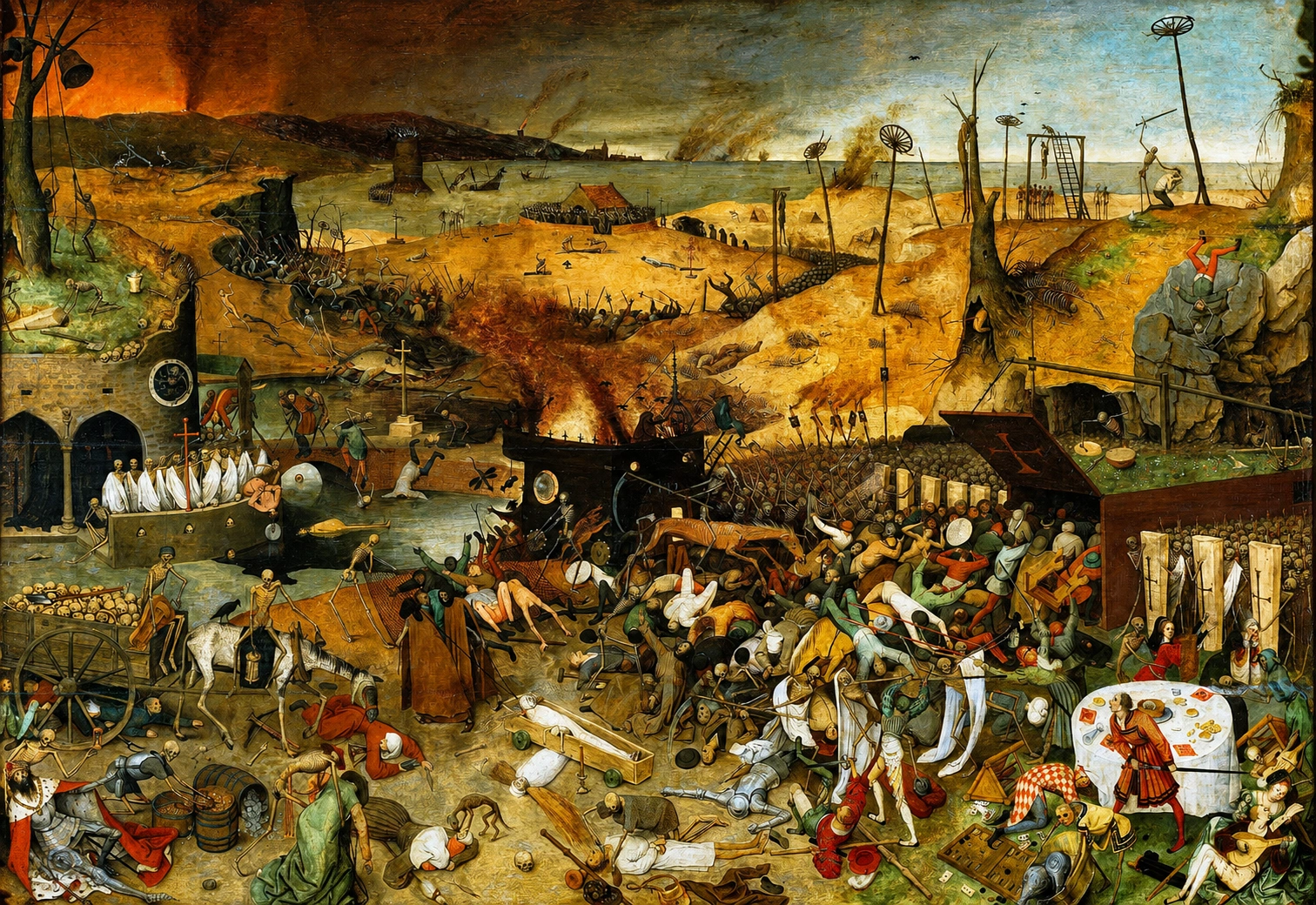
At first glance, The Triumph of Death appears almost impossible to absorb. Hundreds of figures crowd the landscape, and nearly every part of the composition contains a separate scene of destruction. Skeletons drag people toward their graves, attack soldiers, interrupt celebrations, and force terrified crowds into a large coffin-shaped structure. Fires burn across the horizon, ships sink in the distance, and the earth itself seems stripped of life.
Bruegel does not provide a single central event. Instead, he constructs a world in which death is happening everywhere at once. The viewer’s eye moves restlessly from one horrifying episode to another, never finding a safe or peaceful place. This visual instability reflects the painting’s subject. Death cannot be contained within one section of the landscape because it governs the entire scene.
The result is a universal image of human vulnerability. No one can escape the advancing skeletal army. Kings, soldiers, peasants, lovers, musicians, and religious figures are all treated equally. The painting’s central message is simple but uncompromising: every human life ends, and worldly distinctions become meaningless in the face of mortality.
The Army of Skeletons
The skeletons are not passive symbols or lifeless remains. They behave like an organized military force. Some carry weapons, shields, torches, and banners. Others ride skeletal horses or operate wagons filled with skulls. Their coordinated movements transform death into a disciplined army that cannot be resisted.
In the middle distance, rows of skeletons advance behind coffin lids used as shields. Nearby, a dense crowd of living people is driven toward a dark enclosure shaped like an enormous coffin. A cross appears on its surface, linking the structure to burial and judgment. The entrance resembles a trap from which no one will return.
The skeletons also parody ordinary human behavior. They ring bells, play instruments, ride carts, and perform tasks that would normally belong to the living. This imitation creates a disturbing sense that death has taken control of human civilization. The structures, tools, and customs created by people have been turned against them.
Bruegel’s skeletons are frightening partly because they appear energetic and purposeful. The living figures are confused, wounded, or helpless, while the dead act with confidence. The natural relationship between life and death has been reversed. The dead dominate the world, while the living have become temporary intruders within it.
A Landscape Without Hope
The surrounding landscape contributes greatly to the painting’s atmosphere. Bruegel replaces the green fields and lively villages found in many of his other works with a barren, poisoned environment. The ground is dry and yellow. Trees have lost their leaves, and the distant hills are darkened by smoke and flames.
The horizon offers no possibility of escape. Fires burn across the countryside, while ruined ships lie in the water. Even the sea, traditionally associated with travel and freedom, has become a place of disaster. The entire world appears to be collapsing.
The division of the sky intensifies the apocalyptic mood. On the left, the atmosphere is dark and fiery, suggesting destruction and perhaps the entrance to hell. Toward the right, the sky becomes lighter, but this brightness does not bring comfort. Violence continues beneath it. Bruegel therefore denies the viewer the usual symbolic contrast between darkness and salvation. There is no clearly protected region within the composition.
This lifeless setting may also suggest famine, plague, war, and social breakdown. Such disasters were familiar to sixteenth-century European audiences. The painting does not represent one specific historical catastrophe, but it gathers many forms of suffering into a single overwhelming vision.
Death as the Great Equalizer
One of the painting’s most important themes is the uselessness of wealth and authority when confronted by death. In the lower-left area, a king lies on the ground while a skeleton displays an hourglass beside him. Another skeleton searches through barrels of gold and silver. The king’s crown, armour, and treasure cannot purchase additional time.
The hourglass is a traditional symbol of life’s limited duration. Its appearance beside the dying ruler makes the meaning unmistakable. Political power may influence other people, but it cannot command time or prevent physical death.
Elsewhere, heavily armed soldiers are defeated by skeletal attackers. Their armour offers little protection. Religious clothing, noble dress, and fashionable accessories are equally ineffective. Bruegel repeatedly contrasts signs of social identity with the identical bones hidden beneath every human body.
This idea would have been familiar through the medieval tradition of the “Dance of Death,” in which skeletons lead people from every social class toward the grave. Bruegel expands that tradition into a massive battlefield. Instead of dancing with individuals, death conquers civilization as a whole.
Interrupted Pleasures and Human Distraction
The lower-right corner contains one of the painting’s most memorable scenes. A richly dressed couple continues to play music while destruction surrounds them. The man plays a lute, and the woman sings from a musical score. Behind them, a skeleton joins the performance with another instrument.
The lovers seem absorbed in their music and perhaps unaware of the danger approaching them. Their elegant clothing and intimate posture create a small image of beauty, pleasure, and affection. Yet the skeleton behind them transforms the scene into a warning. Their enjoyment cannot protect them from the fate shared by everyone else.
Nearby, another man hides beneath a table covered with food, cards, and overturned objects. A skeleton prepares to strike him. The remains of the banquet symbolize earthly pleasure suddenly interrupted. Food, gambling, music, romance, and entertainment all lose their meaning when time runs out.
Bruegel does not necessarily condemn pleasure itself. The painting instead questions the human tendency to behave as though pleasure, wealth, or distraction can make mortality disappear. The figures continue their routines until death enters their private world.
Composition and Visual Movement
Bruegel organizes the immense number of figures with remarkable control. The elevated viewpoint allows the viewer to see across the entire battlefield. This perspective resembles a panoramic map, but the dense activity makes the space feel chaotic and unstable.
The composition generally moves from the fiery background toward the crowded foreground. Death spreads through the landscape until it reaches the viewer’s immediate visual space. The skeletal army forms diagonal movements that guide the eye toward the coffin-shaped trap in the centre-right area.
Although the painting contains many individual stories, they are connected by repeated shapes and gestures. Spears, crosses, bare trees, gallows, and skeletal limbs create a harsh network of vertical and diagonal lines. These forms make the landscape feel sharp and threatening.
The limited palette also supports the subject. Brown, yellow, grey, black, and muted green dominate the scene. Brighter reds appear in clothing, fires, banners, and bloodlike accents, drawing attention to moments of danger. Bruegel avoids luxurious colour harmony, choosing instead a dry and scorched appearance.
Religious Meaning and Moral Warning
The painting reflects Christian ideas about judgment, sin, and the temporary nature of earthly life. Crosses appear throughout the landscape, but organized religious authority seems unable to stop the massacre. This does not necessarily suggest that faith is powerless. Rather, it emphasizes that physical death comes to everyone, including members of the Church.
The painting may be understood as a call for spiritual preparation. Since death can arrive suddenly, people should not place complete trust in possessions, status, or physical pleasure. The terror of the scene encourages viewers to examine how they are using the limited time available to them.
However, Bruegel avoids providing a simple image of divine salvation. Angels do not descend, and no clear route to heaven appears. The painting remains focused on earthly destruction. Its moral power comes from uncertainty. The viewer is forced to imagine what may follow death without being shown a comforting answer.
The Enduring Power of The Triumph of Death
The Triumph of Death remains powerful because it combines detailed observation with an almost unimaginable scale of destruction. Each small episode can be examined independently, yet all of them contribute to the same overwhelming conclusion.
Bruegel transforms mortality into a visible social force. Death is not hidden in a private chamber or represented by one symbolic figure. It occupies the fields, roads, buildings, seas, and skies. It enters royal courts, religious ceremonies, military conflicts, romantic encounters, and ordinary meals.
Despite its fantastic skeletons and apocalyptic setting, the painting feels deeply connected to real human fears. It addresses the loss of control, the fragility of civilization, and the certainty that time eventually defeats every form of power. Bruegel’s vision is terrifying, but it is also intellectually precise. The painting strips away comforting illusions and confronts the viewer with the one condition shared by all human beings.