The Tower of Babel by Pieter Bruegel the Elder: Vibrant Color Edit
Free to Download & Reuse: You are welcome to use this image! If you republish or share it online, you must include a direct link back to this webpage for attribution.
Original Image Source: wikiart.org
Introduction
Pieter Bruegel the Elder’s “The Tower of Babel,” painted in 1563, transforms a familiar biblical story into one of the most ambitious architectural visions in European art. The painting presents the legendary tower described in the Book of Genesis, a structure built by humanity in an attempt to reach the heavens. According to the story, God disrupted the project by confusing the builders’ language, preventing them from understanding one another and scattering them across the world.
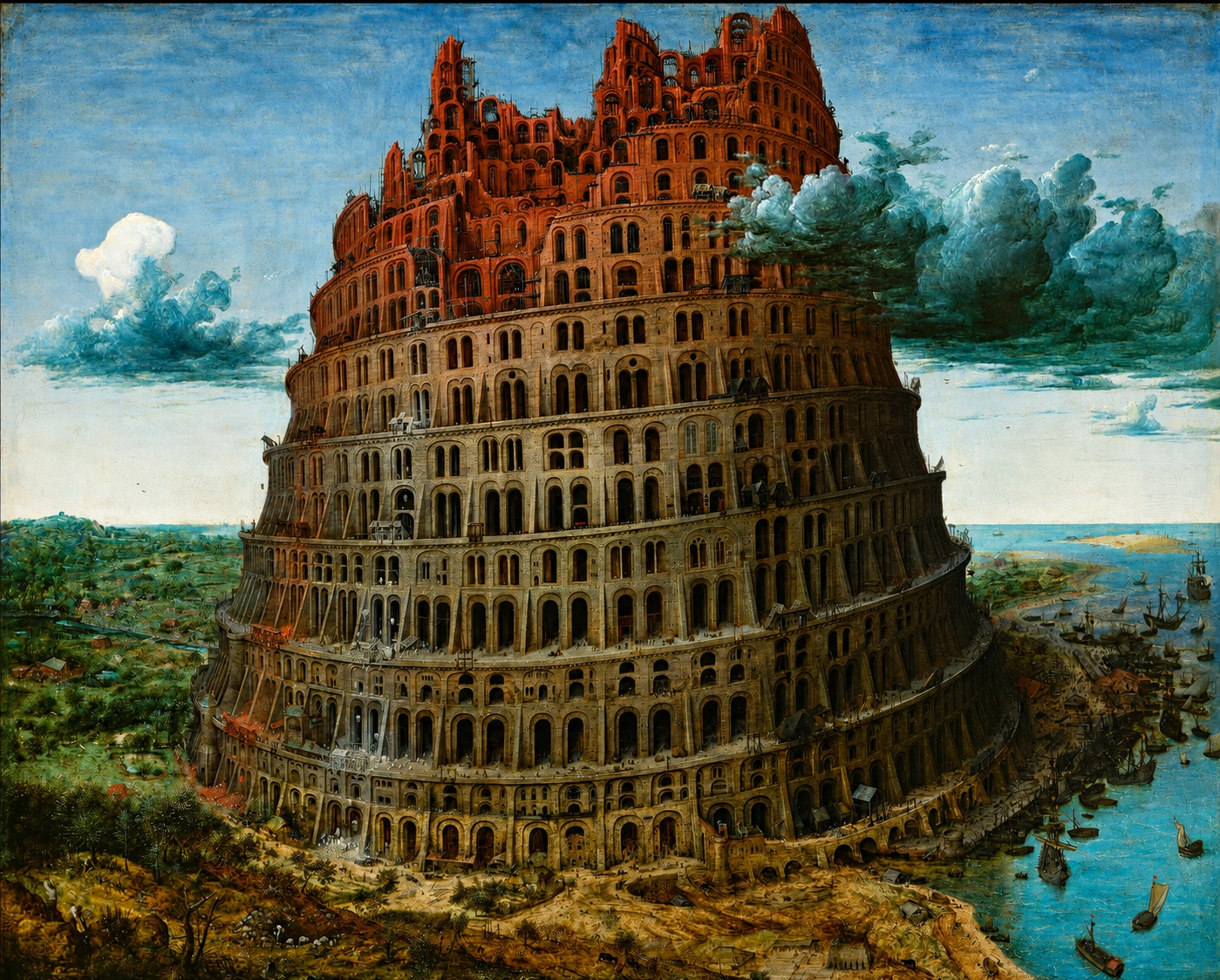
Bruegel does not depict the dramatic moment of divine intervention. Instead, he shows the construction project at the height of its apparent success. The tower dominates the landscape, thousands of workers appear busy, ships deliver materials, and an entire city has developed around the building site. Yet signs of instability are already visible. The tower seems enormous and impressive, but its uneven construction suggests that it cannot survive.
Through this tension between achievement and collapse, Bruegel creates a powerful meditation on human pride, political ambition, social organization, and the limits of technological progress.
The Monumental Scale of the Tower
The tower occupies nearly the entire composition. Its immense circular structure rises from the foreground toward the upper edge of the painting, dwarfing the surrounding countryside, city, harbour, and human figures. Bruegel exaggerates its scale so dramatically that the building appears less like an ordinary structure and more like an artificial mountain.
The tower is composed of multiple curved levels, each containing arches, passageways, workshops, ramps, and partially completed chambers. Its spiralling form guides the viewer’s eye upward, encouraging us to follow the building toward its unfinished summit. However, the tower never reaches the sky. Its uppermost levels remain exposed, broken, and incomplete.
Bruegel’s design was likely inspired by ancient Roman architecture, particularly the Colosseum. The repeated arches and massive stone tiers resemble Roman amphitheatres, which were widely associated with imperial power. By using this architectural language, Bruegel connects the biblical city of Babel with the pride and authority of great empires.
The building’s size creates an immediate impression of human achievement. At the same time, its overwhelming scale feels disturbing. The tower is so large that it seems to consume the civilization that created it.
Architecture Filled with Contradictions
At first glance, the tower appears carefully planned. Its repeated arches, circular levels, and rising spiral suggest order and engineering skill. A closer inspection, however, reveals serious structural problems.
Some levels are complete while others remain hollow. Certain arches appear properly aligned, but many rest on irregular foundations. Sections of the exterior rise before the interior has been finished. Ramps and walls connect awkwardly, while different parts of the tower seem to follow conflicting construction plans.
The tower also appears to lean slightly. Its foundation follows the shape of the natural rock rather than resting on a stable horizontal platform. This gives the building an organic and uneven appearance, as though it is growing uncontrollably rather than being constructed according to a unified design.
These inconsistencies visualize the central problem of the Babel story. The workers may possess technical ability, but they lack true coordination. The project requires complete cooperation, yet its enormous scale makes cooperation increasingly difficult. The tower therefore becomes an image of organized confusion.
Bruegel suggests that impressive appearances can hide fundamental weaknesses. The structure seems powerful from a distance, but its internal contradictions make collapse inevitable.
King Nimrod and the Illusion of Control
In the lower-left foreground, Bruegel includes a group of figures led by King Nimrod, the traditional ruler associated with the construction of Babel. Nimrod is richly dressed and surrounded by attendants, soldiers, and workers. Several labourers kneel before him, emphasizing his political authority.
This scene is remarkably small compared with the tower. Although Nimrod believes himself to be the master of the project, he is visually overwhelmed by the building created under his command. His authority appears impressive among the nearby figures, but almost insignificant within the larger composition.
Nimrod’s presence introduces a political dimension to the painting. The tower is not simply the product of collective ambition. It is also a state project directed by a ruler who wishes to demonstrate power through monumental construction.
The kneeling workers suggest obedience, but the unstable tower raises questions about the effectiveness of Nimrod’s leadership. He can command labour and demand respect, yet he cannot control the deeper consequences of the project. Bruegel presents political power as theatrical and limited. The king may dominate the foreground ceremony, but the tower dominates the world.
The Workers and the Machinery of Construction
Throughout the painting, countless workers carry stones, operate cranes, build walls, climb ladders, and move along the tower’s enormous ramps. Many figures are so small that they almost disappear into the architecture.
Bruegel was famous for his careful observation of everyday labour, and the painting contains an extraordinary range of construction activities. Wooden scaffolding surrounds unfinished walls. Mechanical cranes lift heavy materials. Carts travel along pathways, while workers gather near workshops and storage areas.
These details make the impossible tower feel believable. Bruegel does not present Babel as a vague fantasy. He imagines how such a structure might actually have been built using the technology of his own century.
Yet the abundance of activity also creates unease. Every person performs a specialized task, but few appear aware of the complete project. The workers have become parts of a vast system that exceeds individual understanding. Their labour contributes to a structure whose ultimate purpose is shaped by ambition rather than necessity.
This contrast gives the painting much of its intellectual power. Human skill is celebrated through the remarkable detail of the construction process, but that skill is directed toward a deeply flawed goal.
Landscape, Harbour, and Expanding Civilization
The tower rises beside a busy coastal city. Ships fill the harbour, carrying supplies and connecting Babel with distant regions. Smaller boats travel through the water, while buildings and roads spread around the base of the tower.
To the left, the landscape extends into green fields, settlements, and distant hills. To the right, the harbour opens toward the sea. These broad views suggest that Babel is the centre of an expanding commercial civilization.
The city’s dependence on the tower is especially significant. Roads, workshops, docks, and neighbourhoods have developed around the construction site. The tower has reorganized the entire region. It is no longer simply a building. It has become the economic and political heart of society.
However, the structure casts a heavy visual presence over everything nearby. The city seems trapped beneath it, while the harbour appears crowded against its enormous base. The tower has brought prosperity and activity, but it has also overwhelmed the natural landscape and reduced human life to a supporting role.
Colour, Light, and Atmosphere
Bruegel uses a rich but restrained palette of earthy browns, muted reds, cool blues, and deep greens. The lower levels of the tower are painted in grey and brown stone, while the unfinished upper sections contain warmer red tones. These reddish areas suggest exposed brick, raw construction, and continuing labour.
The cool sky contrasts with the tower’s warm upper levels. Large clouds gather around the structure, especially on the right, where darker masses seem to press against the building. These clouds contribute to the painting’s sense of approaching danger.
Light falls unevenly across the tower. Some sections are clearly illuminated, while others are hidden in shadow. This changing light emphasizes the building’s complexity and makes it difficult to understand as a single coherent form.
The atmosphere is calm, but it is not peaceful. There is no visible storm, destruction, or panic. Instead, the painting captures the quiet moment before failure. The danger comes from the tower itself rather than from an external force.
Human Pride and the Limits of Progress
“The Tower of Babel” is often interpreted as a warning against pride. Humanity’s desire to reach heaven represents an attempt to overcome natural and divine limits. The builders believe that technical achievement can secure power, unity, and lasting fame.
Bruegel’s interpretation is more complex than a simple rejection of ambition. The painting clearly admires human creativity. The architecture is astonishing, the construction methods are inventive, and the workers display discipline and skill. The tower is both magnificent and absurd.
This duality prevents the painting from becoming a straightforward moral lesson. Bruegel shows that the same abilities that allow societies to create extraordinary things can also lead them toward destruction. Intelligence without humility becomes dangerous. Organization without shared understanding becomes confusion. Progress without wisdom produces instability.
The tower therefore remains relevant because it represents more than a biblical building. It can symbolize empires, institutions, cities, political systems, or any project that becomes too large and complicated to control.
Conclusion
Pieter Bruegel the Elder’s “The Tower of Babel” combines biblical storytelling, architectural imagination, social observation, and political commentary. Its vast tower is one of the most memorable structures in Western painting, not simply because of its scale, but because of the contradiction it embodies.
The building appears close to completion, yet it is already failing. Thousands of people work together, yet true communication is absent. King Nimrod commands obedience, yet he cannot master the forces unleashed by his ambition. The surrounding city appears prosperous, yet its entire existence depends upon an unstable monument.
Bruegel’s painting ultimately presents civilization as both brilliant and fragile. Human beings can reshape landscapes, develop complex technologies, and construct extraordinary monuments. However, no achievement can remain secure when pride replaces judgment and scale replaces purpose. The tower rises as a triumph of human imagination, but its unfinished summit reminds us that greatness without understanding can never truly reach the heavens.