The Jewish Bride by Rembrandt: Vibrant Color Edit
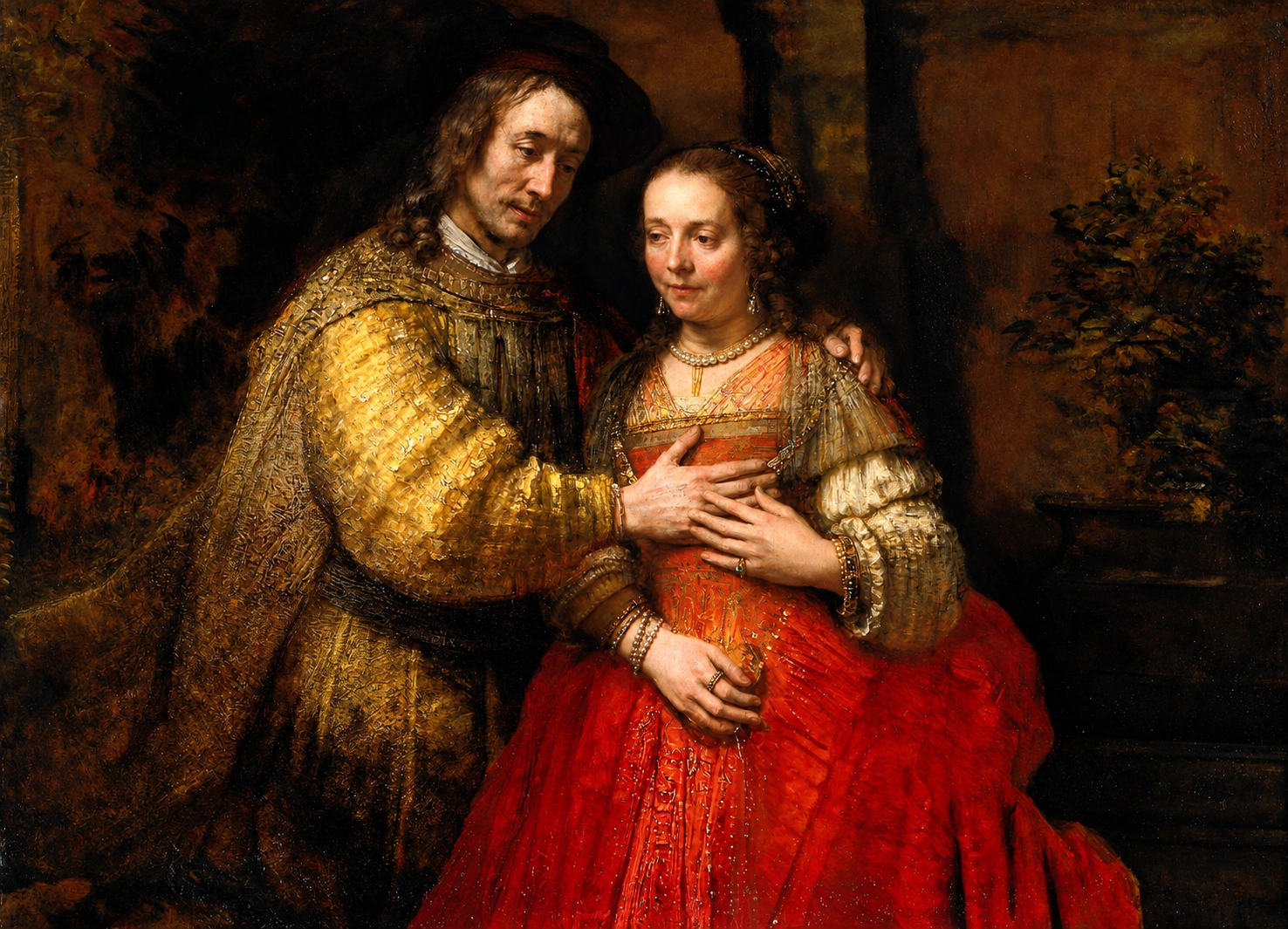
Free to Download & Reuse: You are welcome to use this image! If you republish or share it online, you must include a direct link back to this webpage for attribution.
Original Image Source: wikiart.org
The Jewish Bride by Rembrandt: An Intimate Vision of Love and Devotion
Rembrandt’s “The Jewish Bride,” painted around 1666, stands among the most emotionally powerful works of the Dutch Golden Age. Rather than presenting love through dramatic movement or elaborate storytelling, Rembrandt creates a remarkably quiet scene in which two figures communicate through gesture, proximity, and expression. The painting has become famous for its tenderness, psychological depth, and extraordinary handling of light and paint.
The title “The Jewish Bride” was not given to the painting by Rembrandt himself. It became associated with the work much later, and the precise identity of the couple remains uncertain. Scholars have proposed several interpretations, including the possibility that the figures represent the biblical couple Isaac and Rebecca, while others have suggested that Rembrandt portrayed contemporary sitters dressed as historical or biblical characters. This uncertainty has contributed to the painting’s fascination because its emotional meaning remains accessible even without a definitive narrative.
Composition and the Relationship Between the Figures
The composition of “The Jewish Bride” is dominated by the two figures, who stand close together against a dark and largely undefined background. Rembrandt removes almost everything that might distract from their relationship. The surrounding architecture and vegetation remain subdued, allowing the couple’s faces, clothing, and hands to emerge as the visual center of the painting.
The man stands slightly behind and beside the woman, placing one arm around her shoulders while his other hand rests gently against her chest. The woman responds by placing one hand over his while her other hand rests lower on her body. Their gestures overlap in a carefully constructed arrangement that visually joins the two figures together.
This arrangement gives the painting a sense of intimacy without relying on dramatic physical movement. The figures appear completely absorbed in one another, yet their expressions remain restrained. Rembrandt suggests affection through stillness, creating an atmosphere that feels private and deeply personal.
The Meaning of the Hands
The hands are among the most important elements in Rembrandt’s “The Jewish Bride.” They occupy the center of the composition and function almost like a second set of faces. Through these gestures, Rembrandt communicates tenderness, protection, trust, and emotional connection.
The man’s hand resting over the woman’s heart is especially significant. His gesture can be interpreted as protective and affectionate, while the woman’s hand gently placed over his reinforces the sense of mutual devotion. Instead of portraying love through exaggerated expressions, Rembrandt allows a simple touch to carry much of the painting’s emotional weight.
The positioning of the hands also creates a visual rhythm across the richly colored clothing. The man’s pale hand stands out against the woman’s red dress, while her hand introduces another point of light lower in the composition. These gestures guide the viewer’s attention downward from the faces and then back through the intertwined forms of the couple.
Rembrandt's Use of Light
Light plays a crucial role in establishing the emotional atmosphere of “The Jewish Bride.” Rembrandt illuminates selected areas of the figures while allowing much of the surrounding environment to disappear into shadow. This contrast creates an intimate world that seems separated from everything outside the couple’s relationship.
The brightest light falls across the man’s golden sleeve, the woman’s face, her neckline, and portions of her red dress. These glowing areas emerge dramatically from the deep browns and blacks of the background. Rather than describing every detail evenly, Rembrandt controls visibility so that certain forms appear vivid while others dissolve into darkness.
The lighting gives the painting a sense of warmth. Gold, red, cream, and brown interact across the surface, producing a rich and almost glowing atmosphere. The darkness surrounding the couple enhances their physical closeness because they seem enclosed within a small zone of illumination.
The Rich Red and Gold Color Palette
Color is one of the most memorable qualities of “The Jewish Bride.” The woman’s magnificent red dress creates the strongest chromatic presence in the painting, while the man’s golden garment provides an equally luxurious contrast. Together, these colors give the composition warmth, richness, and visual intensity.
The red dress is particularly important because it anchors the lower half of the composition. Its deep scarlet and orange-red tones seem to glow from within, especially where Rembrandt applies thicker highlights. The folds are not described with polished precision. Instead, they are suggested through broad passages of color and light.
The man’s golden sleeve is similarly expressive. Its shimmering surface appears almost sculptural because Rembrandt built up areas of paint to imitate the texture of embroidered or decorated fabric. The gold does not merely indicate wealth or costume. It also contributes to the warmth that surrounds the couple and reinforces the emotional harmony between them.
Texture and Rembrandt's Late Painting Technique
“The Jewish Bride” is an extraordinary example of Rembrandt’s mature technique. During the later years of his career, his brushwork became increasingly loose, tactile, and expressive. He was less concerned with producing perfectly smooth surfaces and more interested in using the physical substance of paint to create light, texture, and emotional intensity.
Some areas of the painting contain thick layers of pigment, particularly in the garments and jewelry. These raised passages catch the light and give the surface a physical presence that cannot be fully appreciated through reproductions alone. Elsewhere, Rembrandt allows forms to remain soft and almost unfinished.
This contrast between thick and thin paint contributes to the painting’s remarkable visual energy. The faces are handled with sensitivity, while the clothing often becomes a complex arrangement of strokes, highlights, and textured surfaces. From a distance, these marks combine into convincing fabrics. Up close, they reveal Rembrandt’s extraordinary freedom with the brush.
Facial Expressions and Psychological Depth
The expressions of the two figures are subtle, which makes them particularly compelling. Neither person smiles broadly or displays an obvious emotion. Instead, both appear thoughtful, calm, and emotionally absorbed.
The man looks toward the woman with an expression that suggests affection and concern. His slightly inclined head strengthens the sense that his attention is entirely focused on her. The woman looks outward and slightly downward, appearing reflective rather than directly responding to his gaze.
This difference in direction creates psychological complexity. The figures are connected physically, yet each appears to possess an independent inner life. Rembrandt frequently explored this tension between outward appearance and inward emotion, and “The Jewish Bride” demonstrates how effectively he could create psychological depth through extremely subtle expressions.
A Possible Biblical Interpretation
One of the most widely discussed interpretations identifies the couple as Isaac and Rebecca from the Book of Genesis. In the biblical account, Isaac and Rebecca concealed the fact that they were married while living in the land ruled by Abimelech. Their relationship was eventually discovered when the king observed behavior that revealed their affection for one another.
If Rembrandt intended this story, the restrained intimacy of the painting becomes particularly meaningful. The couple’s gestures could represent a private moment of affection rather than a formal portrait. Their luxurious clothing, however, places the scene outside ordinary seventeenth-century life and gives it the timeless quality of a biblical or historical drama.
Even so, the painting does not depend on identifying a particular episode. Rembrandt deliberately avoids obvious narrative details that would clearly establish a specific story. The result is a painting that functions equally well as a biblical image, a portrait of a married couple, and a broader meditation on human affection.
Love Without Idealization
One of the most remarkable aspects of “The Jewish Bride” is its refusal to idealize love in a conventional way. The figures are not presented as youthful symbols of romantic beauty. Instead, Rembrandt emphasizes tenderness, trust, maturity, and emotional connection.
The painting’s power comes from small gestures rather than theatrical passion. The hand over the heart, the woman’s response, the man’s protective arm, and the slight inclination of their heads communicate more than an elaborate narrative might have achieved. Their relationship feels established and enduring rather than newly discovered.
This gives the work a universal quality. Viewers do not need to know the identity of the figures to understand the emotional bond Rembrandt presents. The painting suggests that intimacy can be expressed through quiet presence rather than dramatic action.
The Dark Background and Sense of Privacy
The background of “The Jewish Bride” is deliberately subdued. Architectural forms appear behind the couple, while vegetation can be seen toward the right side of the composition, but these details remain secondary. Rembrandt allows much of the setting to dissolve into darkness.
This limited environment creates a strong sense of privacy. The couple appears separated from the surrounding world, almost as though the darkness protects their intimate moment. The effect also increases the viewer’s concentration on their physical gestures and facial expressions.
The background demonstrates Rembrandt’s ability to use omission as effectively as detail. By refusing to describe the entire setting, he encourages viewers to concentrate on what matters most. Emotional presence becomes more important than location.
The Lasting Importance of The Jewish Bride
“The Jewish Bride” represents many of the qualities that define Rembrandt’s greatest late paintings. Its rich colors, dramatic light, thickly worked surfaces, and psychological subtlety combine to create an image that feels both monumental and deeply private. The painting transforms a quiet interaction between two people into a profound meditation on affection and commitment.
Its mystery also contributes to its lasting appeal. The uncertain identities of the figures allow the painting to exist beyond a single historical or biblical interpretation. Whether they are understood as Isaac and Rebecca, a seventeenth-century married couple, or symbolic figures representing enduring love, their emotional connection remains convincing.
More than three centuries after Rembrandt created it, “The Jewish Bride” continues to resonate because it presents intimacy with remarkable restraint. There is no dramatic embrace, elaborate setting, or obvious narrative climax. Instead, Rembrandt relies on touch, light, color, and expression to communicate the strength of a relationship.
The painting ultimately demonstrates Rembrandt’s extraordinary understanding of human emotion. His technical mastery is evident in every glowing highlight and textured passage of paint, but technique never overwhelms feeling. “The Jewish Bride” endures because Rembrandt turned a simple moment of closeness into one of the most moving images of love in Western art.